
Is swapping ETH for stETH taxable? Nobody can tell you with certainty, because the IRS has never ruled on it. The conservative position treats ETH to stETH as a taxable crypto-to-crypto exchange. The aggressive position says your economic exposure never changed, so nothing was disposed of. And that unresolved question is only the front door: behind it sit daily rebasing income, reward-bearing tokens that defer everything, restaking deposits, points programs, and airdrops that are definitely income. Our DeFi tax guide covers the broader transaction framework.
Liquid staking is how most ETH actually gets staked now. Instead of locking 32 ETH in your own validator, you hand ETH to Lido, Rocket Pool, or Coinbase and receive a token (stETH, rETH, cbETH) that represents your staked position and keeps earning while staying tradeable. Restaking protocols like EigenLayer then let you pledge those same tokens again for extra yield, points, and airdrops. Every layer of that stack has a tax consequence, and several sit in genuinely unsettled law where the gap between the conservative and aggressive position can be an entire tax bill.
This guide covers Ethereum liquid staking and restaking taxes end to end for 2026: the swap question in both directions, rebasing versus reward-bearing tokens, wstETH, EigenLayer and liquid restaking tokens, points and airdrops, DeFi use of LSTs, and how to keep basis intact through it all. It is one piece of our full Ethereum tax guide, and it pairs with our guide to native Ethereum staking taxes, which covers validators, sweeps, and Schedule C questions.
Disclaimer: This guide is for informational purposes only and is not tax or legal advice. Cryptocurrency rules change quickly. Always consult a qualified CPA about your specific situation.
The Landscape: Three Token Models, Three Tax Profiles
Before any tax analysis, sort your tokens, because the tax treatment follows the mechanism, not the brand.
- Rebasing tokens: stETH (Lido), eETH (ether.fi). Your token balance increases daily to distribute staking rewards. Hold 10 stETH today, hold 10.001 tomorrow. The token aims to trade near 1:1 with ETH while the quantity grows.
- Reward-bearing tokens: rETH (Rocket Pool), cbETH (Coinbase), wstETH (wrapped stETH). Your token count never changes. Instead, each token’s redemption rate against ETH climbs as rewards accrue. Hold 10 rETH forever; what changes is that those 10 rETH are redeemable for progressively more ETH.
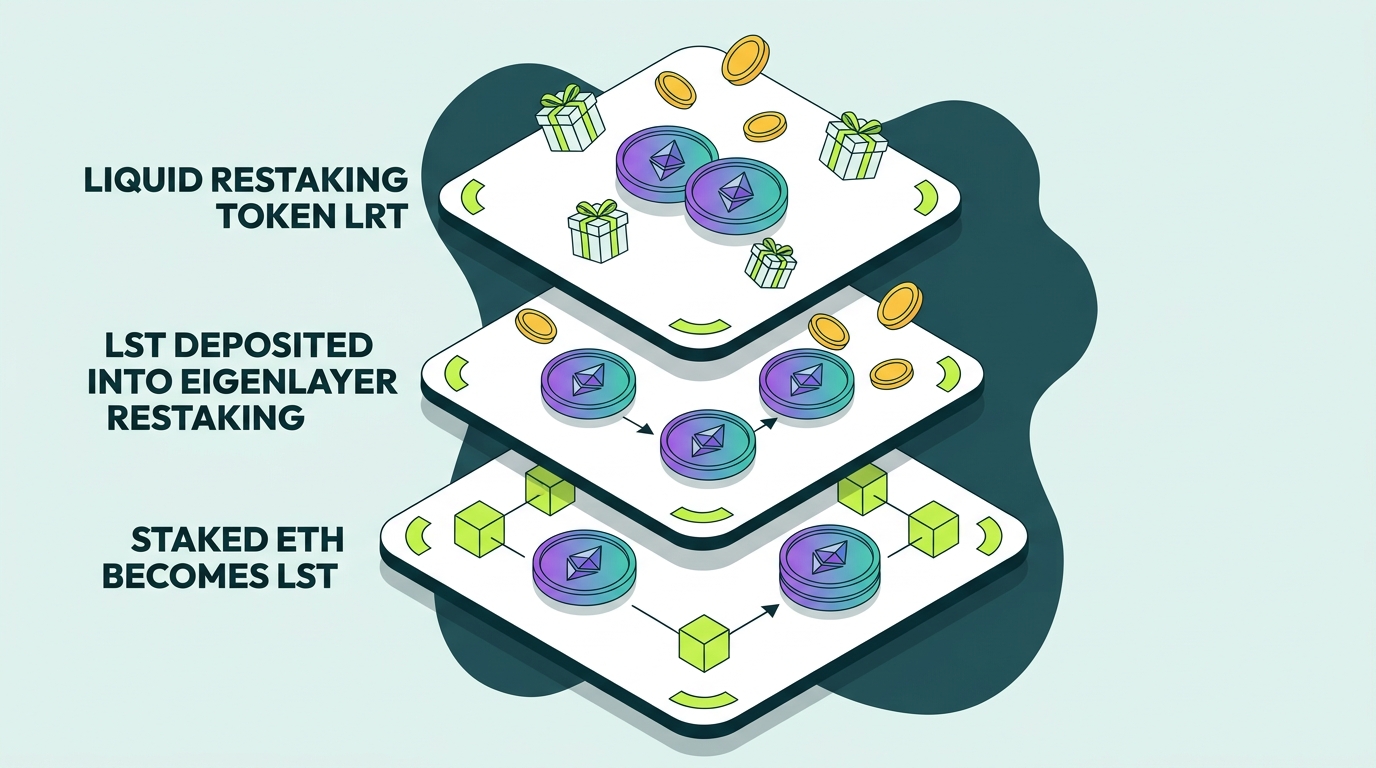
- Liquid restaking tokens (LRTs): eETH/weETH (ether.fi), and peers. Tokens representing ETH that has been staked and restaked through EigenLayer or a similar protocol, layering extra yield, points, and airdrop exposure on top of base staking rewards.
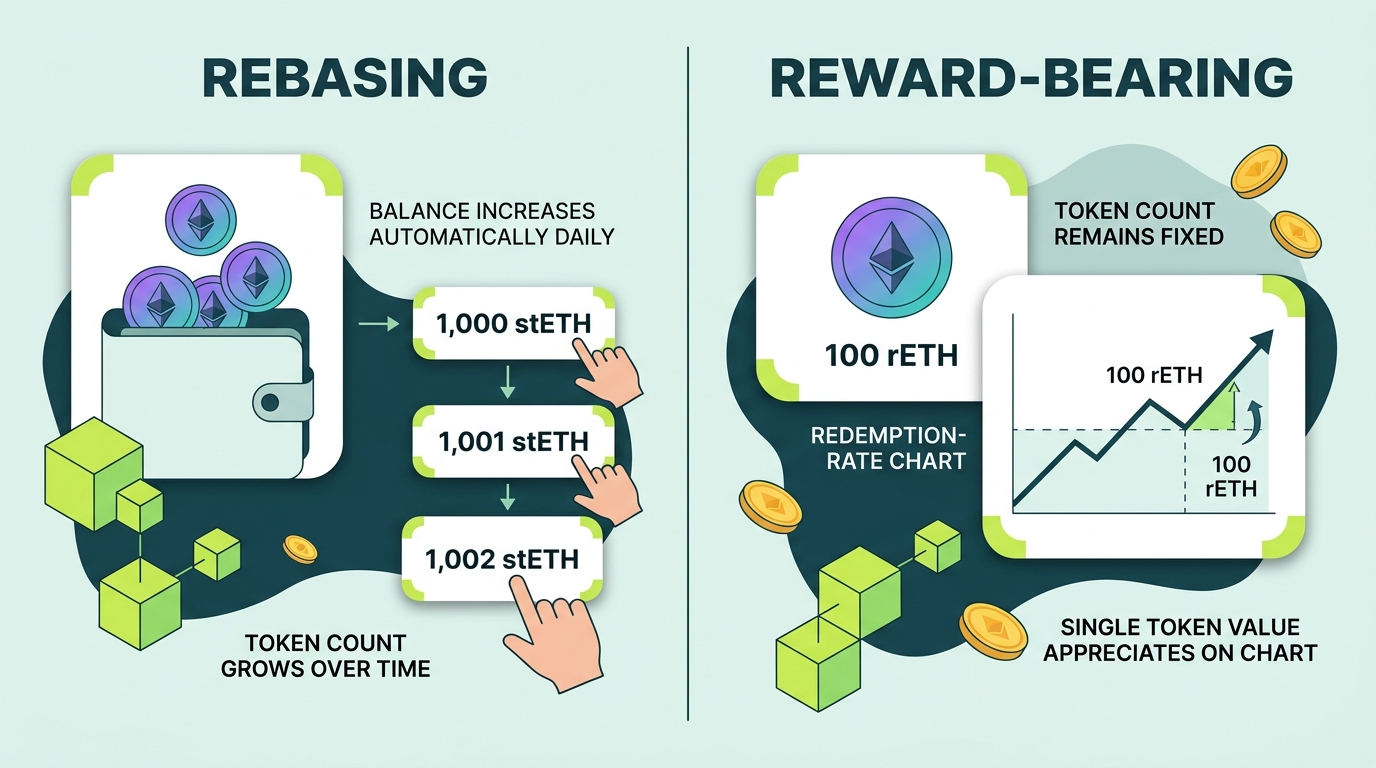
The one-line summary of everything that follows: rebasing tokens generate a steady drip of ordinary income under the conservative view, reward-bearing tokens defer everything to disposal as capital gain, and the entry and exit swaps are unsettled either way.
The Entry Question: Is ETH to stETH a Taxable Swap?
This is the same unresolved problem we walk through for BTC and WBTC in our wrapped Bitcoin tax guide, transplanted to Ethereum, and the two defensible positions mirror exactly.
First, separate the clear case from the murky one. If you acquire stETH or rETH by trading ETH for it on Uniswap, Curve, or a centralized exchange, you executed a crypto-to-crypto trade with a counterparty at a market price. That is a taxable exchange under standard rules, full stop, under either camp’s theory. The genuinely unsettled question is direct minting: depositing ETH into Lido’s contract and receiving freshly minted stETH, or minting rETH through Rocket Pool.
The conservative position: minting is an exchange. You gave up one asset (ETH) and received a materially different one: a token issued by an identifiable protocol, carrying smart contract risk, validator slashing exposure, and its own market price that can and does deviate from ETH (stETH traded meaningfully below peg in mid-2022). Different asset, different rights, different risks; crypto-to-crypto exchanges are taxable, so the mint realizes gain or loss on your ETH and the LST takes a fresh basis. This reading fits the letter of the property rules and is the harder position to attack.
The aggressive position: nothing happened. Your economic exposure is unchanged: ETH in, an ETH-denominated claim out, redeemable through the protocol. Minting resembles changing the form of an asset you still own rather than disposing of it, so there is no realization. Plenty of practitioners find this persuasive, particularly where redemption at the protocol rate is live and permissionless, and industry groups have asked the IRS to adopt exactly this rule.
What the IRS has actually said: nothing definitive. No ruling, no regulation, no case on LSTs. The closest signal is procedural: Notice 2024-57 temporarily exempted wrapping and unwrapping transactions from broker reporting, pending further study, which tells you the government itself has not decided how to characterize them.
What to do in practice:
- Pick a position deliberately, scaled to your dollar amounts, ideally with advice from a crypto tax specialist. A seven-figure mint deserves a memo; a small one deserves a consistent software setting.
- Apply it symmetrically. Mint and redemption must use the same theory.
- Be consistent across tokens and years. stETH this year and rETH next year should get the same answer.
- Record values at every mint date regardless, so you can recompute under either theory if guidance ever arrives.
One Mint, Two Tax Outcomes
You bought 10 ETH at $1,800 each and mint stETH through Lido when ETH trades at $3,200. Conservative treatment: you recognized a $14,000 capital gain today, and your stETH basis is $32,000. Aggressive treatment: no gain today, and your stETH carries the original $18,000 basis and holding period. Both roads eventually tax the same total gain; what differs is when it lands, and paying tax years early on exposure you never exited is exactly what the aggressive camp objects to.
Rebasing Income: The stETH Question
Once you hold stETH, a new question starts compounding daily: your balance grows every day as Lido distributes staking rewards across holders. Is each rebase taxable income?
The conservative position, and the majority practice: yes. Each rebase credits new tokens to an address you control, with a market price and immediate liquidity. That fits Rev. Rul. 2023-14’s dominion and control standard cleanly: value received, controlled, and disposable at will. Under this view, each daily rebase is ordinary income at that day’s stETH price, and each rebase creates a new basis lot. A year of holding stETH produces 365 small income events, which is exactly how most crypto tax software books it by default.
The minority position: rebases are not income until disposal. The argument runs that a rebase is not a payment from a counterparty but a bookkeeping adjustment across all holders, that your proportional claim on the pool is what you own, and that quantity changes without proportional changes should not be income. Some analogize to stock splits. It is a genuine argument, but it strains against the fact that rebases reflect real new value (staking rewards actually earned by the pool), not a mere re-denomination, and it is not how mainstream software or most preparers handle it.
Practical consequences of the standard treatment:
- Your reported income tracks rewards, not price. Rebases are income even in a year stETH’s dollar price falls. You can owe ordinary income tax on rewards while sitting on an unrealized loss on the principal, which is worth remembering before you commit a large position. If you later harvest that loss, read the crypto wash sale guide first.
- Every rebase adds a basis lot. Those tiny lots are what protect you at sale. Skip the income and your software assigns the growth zero basis, taxing it a second time as inflated gain.
- NIIT can apply. For high earners, rebase income generally counts toward the 3.8% Net Investment Income Tax, the same as other staking income. Our native staking guide covers NIIT and quarterly estimates in detail, and both apply with equal force here.
Reward-Bearing Tokens: rETH, cbETH, and the Deferral They Offer
rETH and cbETH answer the rebase question by never asking it. Your token count is fixed; the exchange rate does the work. One rETH was redeemable for about 1.0 ETH at launch and is redeemable for meaningfully more today, with the rate climbing continuously as Rocket Pool validators earn.
Under standard property rules, the treatment is clean: no income while you hold, capital gain or loss when you dispose. Unrealized appreciation is not taxed, whether it comes from market price or an accreting redemption rate. When you eventually sell or redeem, the entire spread between your basis and your proceeds is capital gain, and if you held more than a year, it is long-term gain taxed at the 0%, 15%, or 20% brackets rather than ordinary rates.
That makes the token model itself a tax planning decision:
- stETH (standard treatment): ordinary income yearly as rewards arrive, then capital gain or loss on the principal at sale.
- rETH/cbETH: nothing yearly, then everything at disposal, potentially all at long-term rates.
For a high-bracket holder planning to hold long term, deferring reward income and converting it into long-term capital gain is a meaningful rate arbitrage on top of the deferral itself. That is not a loophole; it is the ordinary consequence of the property rules applied to a token that accrues value instead of paying it out. It is also, candidly, an area where future guidance could impose an accrual model, so document your positions and stay current.
With stETH the tax clock ticks every day. With rETH it does not start until you let go. Same underlying rewards, completely different tax calendars.
wstETH: The Wrapper on the Rebaser
wstETH deserves its own paragraph because it converts one model into the other. Wrapping stETH into wstETH freezes your token count; the rebase value accrues in wstETH’s exchange rate instead, exactly like rETH. Two tax notes:
- The wrap itself is another instance of the swap question. Conservative: stETH for wstETH is a token-for-token exchange, taxable. Aggressive: it is a change of form of the same claim, a non-event. Mirror whatever position you took at the original mint, and apply it again at unwrap.
- Wrapping does not erase the income question retroactively. Rebases received while you held raw stETH were income under the standard view. Wrapping just stops new rebase events from occurring in your wallet going forward, shifting future accrual into the deferred-gain model.
Restaking: EigenLayer, LRTs, Points, and Airdrops
Restaking pledges your staked ETH or LSTs as security for additional networks and services, stacking extra rewards on top of base staking yield. Tax-wise, it stacks extra questions in the same way.
Depositing Into EigenLayer
Depositing stETH or another LST into EigenLayer’s contracts, where you retain a withdrawable claim on the same tokens, is generally treated as a non-taxable deposit, analogous to moving coins between your own accounts. You have not exchanged your asset for a different one; you have parked it with strings you control. The conservative caveat: restaked assets take on new risk (slashing by the services you secure), and an aggressive auditor could argue the claim differs from the asset. Most practitioners land on non-taxable for pure deposits, but document the position, and note that your basis and holding period ride through the deposit unchanged.
If you instead swap into a liquid restaking token, the swap question returns at full strength. Trading stETH for an LRT on a DEX is a taxable exchange under standard rules. Minting an LRT by depositing ETH or an LST into the protocol raises the same conservative-versus-aggressive split as minting stETH itself, one layer up.
Rebasing LRTs: eETH and Friends
ether.fi’s eETH rebases like stETH, so the standard treatment books its balance increases as ordinary income daily, now reflecting staking rewards plus restaking yield. Its wrapped form, weETH, is the non-rebasing wrapper, mirroring the wstETH pattern: accrual shifts into the exchange rate and taxation defers to disposal. Sort every LRT you hold into the rebasing or reward-bearing bucket first; the tax model follows mechanically.
Points: The Pre-Income Asset
Restaking’s marketing engine runs on points: protocol-native scores that accrue to depositors and imply a future airdrop. Are points income when they accrue?
The practical answer is generally no, not yet. Points are typically non-transferable ledger entries with no market, no redemption right, and no ascertainable fair market value. Income requires an accession to wealth you control; a revocable score in a database is hard to value and harder to dispose of. The taxable moment almost always arrives later, when points convert into something real.
Airdrops: Definitely Income
When the airdrop lands, the analysis firms up completely. Under Rev. Rul. 2019-24 and the dominion and control standard, airdropped tokens are ordinary income at fair market value when you can claim, transfer, or sell them. The EIGEN airdrop is the instructive case study: initially non-transferable at claim, it became tradeable months later. Tokens you cannot sell or transfer support deferring income until the restriction lifts; once transferability switched on, income landed at that day’s price for holders taking the deferral view, while those who could claim earlier under different circumstances faced earlier income. Tranche unlocks work the same way: each tranche is income as it becomes yours to control.
The income value becomes your basis in the airdropped tokens, and later sales are capital gains or losses against it, reported like any other disposal on Form 8949 and Schedule D.
Exit: Unwrapping, Redeeming, and Withdrawing
Every exit mirrors an entry, and the rule is symmetry.
- Redeeming stETH or rETH for ETH through the protocol (Lido withdrawals, Rocket Pool redemption): under the conservative view, a disposal of the LST realizing gain or loss against its basis; under the aggressive view for directly minted tokens, a non-event that continues your original ETH basis and holding period. Use the same theory you used going in.
- Selling an LST for ETH or anything else on a DEX or exchange: a taxable disposal under every view. Proceeds minus basis equals gain or loss, with the holding period determining short-term or long-term treatment.
- Unwrapping wstETH to stETH, or weETH to eETH: the wrap question in reverse. Mirror your wrap position.
- Withdrawing from EigenLayer: unwinding a non-taxable deposit is itself non-taxable; you are reclaiming your own tokens with their original basis. Withdrawal queues and escrow periods delay access but do not create tax events on their own.
One wrinkle worth flagging: protocol withdrawal queues can hold your exit for days. As with validator exit queues in native staking, a delay in receiving your own principal back is not a tax event, and it does not defer income that already landed along the way.
Using LSTs in DeFi: Where the Layers Multiply
LSTs were built to be used, and every use has a tax angle. The short map, with the full treatment in our Ethereum DeFi tax guide:
- Lending stETH or wstETH on Aave or Morpho: supplying to a pool that issues a receipt token raises the deposit-versus-exchange question again; the yield is ordinary income as it accrues to your control either way. Rebases keep generating income while the tokens sit in the pool under the standard view.
- Borrowing against LST collateral: taking a loan is not taxable, which is precisely why LST looping strategies exist. But a liquidation is a forced disposal of your collateral at the liquidation price, realizing gain or loss whether you wanted it or not, often at the worst possible moment.
- LP positions (stETH/ETH on Curve, for example): entering a pool by depositing two assets for an LP token is treated by most preparers as a disposal of the deposited assets, and pool fees accrue as income or additional gain depending on the pool’s mechanics. Exiting reverses it. This is the highest-friction record-keeping in the stack.
- Swapping one LST for another (stETH to rETH, migrating to an LRT): a taxable crypto-to-crypto exchange under standard rules. Migration campaigns and “zaps” are disposals, however seamless the UX makes them feel.
- Spending or gifting LSTs: spending is a disposal at fair market value; gifts follow the usual gift rules with carryover basis. Gas paid along the way has its own treatment, covered in our Ethereum gas fee tax guide.
Basis Tracking: The Hardest Bookkeeping Problem on Ethereum
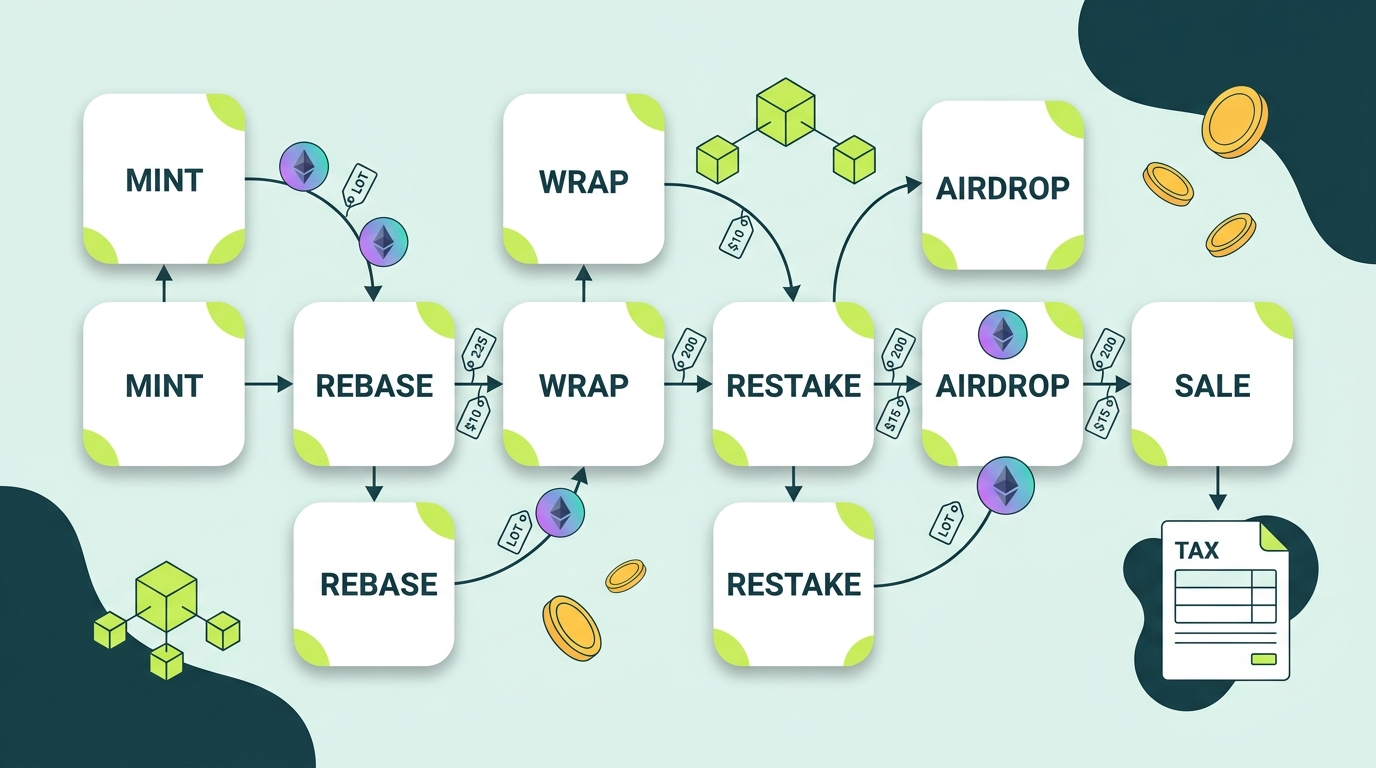
Everything above converges on one operational burden. Under Rev. Proc. 2024-28, effective January 1, 2025, basis is tracked per wallet and per account, not in a universal pool, and LST stacks generate lots faster than anything else in crypto. A single wallet holding stETH accumulates a new lot every day. Wrap some into wstETH, deposit some into EigenLayer, claim an airdrop, and LP the rest, and you have five parallel basis threads that all have to survive to your Form 8949. Our per-wallet cost basis guide covers the framework; here is what it demands from LST holders specifically:
- Record every acquisition with date, quantity, and value: mints, DEX buys, rebases (under the income treatment, each is a lot), and airdrops (income value equals basis).
- Carry basis through every transformation. Wraps, restaking deposits, and migrations either carry original basis (aggressive/deposit treatment) or reset it (conservative exchange treatment). Your records must reflect the position you actually filed, consistently.
- Track per wallet. stETH in your main wallet and stETH in your DeFi wallet are separate accounts with separate lots. Transfers between them carry specific lots and must be matched so they never read as disposals or zero-basis deposits.
- Watch your software’s defaults. Some platforms book every rebase as income, others miss rebases entirely, and few handle LRT wrappers correctly out of the box. Spot-check against Etherscan before trusting a year-end report.
- Reconcile against 1099s. Centralized exchanges file Form 1099-DA for proceeds when you sell LSTs on their platforms, and 1099-MISC for staking rewards they pay directly. On-chain activity generates no forms at all after the 2025 repeal of the DeFi broker rule, which means less paper and more personal responsibility, not less tax.
Common Liquid Staking and Restaking Tax Mistakes
The errors we untangle most often, in rough order of expense:
Mixing Entry and Exit Theories
Treating the mint as non-taxable, then claiming a stepped-up basis at redemption. Understates gain under every theory and reads as opportunism rather than a position.
Ignoring Rebase Income Entirely
Years of stETH rebases never reported. The income is missing and every lot the rebases created carries zero basis, so the same value gets taxed again as inflated gain at sale.
Treating LST-to-LST Swaps as Non-Events
stETH to rETH, or an LST into an LRT via a migration zap, is an exchange of one token for another. Seamless UX does not make it a transfer to yourself.
Missing the Airdrop Income Event
Claiming EIGEN or an LRT protocol token, selling it later, and reporting only the sale with zero basis. The claim was ordinary income; the sale is a second event measured against that income value.
Losing Basis Through Wrappers
wstETH unwrapped to stETH, deposited to EigenLayer, withdrawn, and sold, with software treating each hop as a fresh zero-basis acquisition. Every hop must carry lots or the final sale overstates gain badly.
Forgetting That Deposits Still Earn
stETH parked in Aave or EigenLayer keeps rebasing. Out of sight in a contract does not mean out of scope for income under the standard treatment.
Your LST and Restaking Tax Checklist
- Sort every token into rebasing, reward-bearing, or LRT before anything else.
- Pick your mint/wrap position (conservative exchange or aggressive non-event), document it, and apply it symmetrically at every entry and exit.
- Book rebase income at daily fair market value under the standard treatment, and verify your software actually captures it.
- Record airdrop claims with date, transferability status, and price; income value becomes basis.
- Trace basis through every wrap, deposit, and migration, per wallet, under Rev. Proc. 2024-28.
- Flag DeFi events: LP entries and exits, collateral liquidations, and LST-to-LST swaps are disposals.
- Reconcile 1099-DA and 1099-MISC forms against your own records before filing.
- Archive everything: mint dates and values, rebase logs, claim screenshots, and the reasoning behind your positions.
Bottom Line
Liquid staking compresses an entire tax textbook into a single wallet: an unsettled swap question at the door, daily ordinary income or deferred capital gain depending on token mechanics, deposits that are probably nothing, airdrops that are definitely something, and a basis-tracking problem that punishes every shortcut. The positions themselves are manageable; what ruins returns is inconsistency, and what triggers notices is proceeds hitting a 1099-DA with no reported history behind them.
If your wallets hold stETH lots stretching back years, wrapped and restaked positions, unclaimed or half-reported airdrops, or an LP entanglement you stopped tracking in 2024, this is exactly the reconciliation work we do. Count On Sheep rebuilds the history from the chain, applies your positions consistently, and delivers CPA-ready numbers to you and your preparer. A 15-minute call with a crypto tax specialist is the fastest way to find out where you stand, or reach out to our team for a full review. For the rest of the chain, start with our complete Ethereum tax guide.
Related Reading
- Ethereum Tax Guide: The Complete Picture
- Ethereum Staking Taxes: Validators, Rewards & Reporting
- Ethereum DeFi Taxes
- Ethereum Gas Fees and Taxes
- Ethereum NFT Taxes
- Wrapped Bitcoin & BTC DeFi Taxes
- Per-Wallet Cost Basis Under Rev. Proc. 2024-28
- Form 1099-DA Explained
Frequently Asked Questions
Is swapping ETH for stETH a taxable event?
It depends on how you acquire it and which position you take. Buying stETH on a DEX or exchange with ETH is a crypto-to-crypto trade, which is taxable under standard rules. Minting stETH directly through Lido raises the unresolved wrap question: the conservative position treats it as a taxable exchange, the aggressive position treats it as a non-taxable change of form. The IRS has never ruled directly.
Are stETH rebases taxable income?
The conservative and most common position is yes. Your stETH balance increases daily to reflect staking rewards, each increase is new tokens under your control, and that looks like income at fair market value under Rev. Rul. 2023-14. A minority position argues rebases are not income until disposal. Most tax software books rebases as daily income by default.
How is rETH taxed differently from stETH?
rETH does not rebase. Your token count stays fixed while the redemption rate against ETH climbs, so rewards accrue as unrealized appreciation. Under standard property rules there is no income until you sell or redeem, at which point the growth is capital gain. stETH pays rewards as daily balance increases, which the conservative position treats as ordinary income as they arrive.
Is cbETH taxed like rETH?
Structurally yes. cbETH is a reward-bearing token whose conversion rate against ETH grows over time, so there is no rebase income; growth is deferred until disposal and taxed as capital gain. Coinbase issues a 1099-MISC for rewards on its native ETH staking product, but cbETH itself accrues value in the exchange rate.
Is wrapping stETH into wstETH taxable?
It is the same unresolved wrap question one level down. wstETH is a non-rebasing wrapper around rebasing stETH. The conservative view treats the wrap as an exchange of one token for another; the aggressive view treats it as a change of form with no disposal. Whichever position you take, apply it symmetrically when you unwrap.
Is depositing stETH into EigenLayer a taxable event?
Depositing into a restaking contract where you retain your claim on the same asset is generally treated as a non-taxable deposit, similar to sending coins to your own account. But if you receive a liquid restaking token in exchange, the swap question returns, and the conservative view treats token-for-token exchanges as taxable.
Are EigenLayer or restaking points taxable?
Points themselves are generally not income while they are untradeable ledger entries with no fair market value. The taxable moment usually arrives when points convert into a transferable token, typically through an airdrop, which is ordinary income at the token's fair market value when you can claim and control it.
Are restaking airdrops like EIGEN taxable?
Yes. Airdropped tokens are ordinary income at fair market value when you gain dominion and control under Rev. Rul. 2019-24. If an airdrop unlocks in tranches or is non-transferable at first, income lands as each portion becomes sellable. The income value becomes your basis in the tokens.
Is redeeming stETH or rETH back to ETH taxable?
It mirrors your acquisition position. Under the conservative view, redemption is a disposal of the LST and realizes gain or loss against its basis. Under the aggressive view for directly minted tokens, nothing happens and your original ETH basis continues. Using one theory going in and the other coming out is the one clearly indefensible combination.
How does using stETH in DeFi affect my taxes?
Lending it, posting it as collateral for a loan, or holding it in a wallet does not itself trigger tax, but rebases keep generating income wherever the tokens sit. Swapping an LST for another token is a taxable trade, providing liquidity raises pool entry questions, and a liquidation of LST collateral is a forced disposal. Every layer adds record-keeping.
How do I track cost basis for liquid staking tokens?
Per wallet, per token, per lot, under Rev. Proc. 2024-28. Each acquisition of stETH, wstETH, rETH, or an LRT is its own lot with its own basis and holding period. Rebase income adds tiny new lots constantly, and every wrap, deposit, or migration must carry basis forward. This is the hardest tracking problem in Ethereum, and software defaults get it wrong often.
Do liquid staking protocols report to the IRS?
Generally no. The rule that would have treated DeFi front-ends as brokers was repealed in 2025, and Notice 2024-57 temporarily exempts wrapping and staking transactions from broker reporting. Centralized exchanges still file 1099-DA for sales on their platforms and 1099-MISC for staking rewards they pay. On-chain LST activity is your record-keeping burden alone.