
Are Ethereum NFT trades taxable? Yes, and usually twice per trade. Selling an NFT on OpenSea or Blur is a capital gain or loss on the NFT, and buying one with ETH is a disposal of the ETH you spent. Collectors who cycled appreciated ETH through a few dozen JPEGs have realized years of ETH gains without ever thinking they sold anything.
Ethereum is where NFTs were born and where most of the value still lives: the blue chips, the art platforms, the mint metas, the royalty wars between OpenSea and Blur. All of it runs on ordinary property tax law, which nobody reads before minting. The result is a market full of people with three-year trading histories, five wallets, and no idea that every purchase was also a sale.
This guide covers Ethereum NFT taxation end to end for 2026: the two-sided trade inside every purchase, sale mechanics and holding periods, the collectibles question and its 28 percent rate, creator and royalty income, minting, the wash sale angle unique to NFTs, worthless and rugged tokens, and how to move OpenSea and Blur history onto Form 8949. It is part of our complete Ethereum tax guide, alongside deep dives on Ethereum staking, liquid staking and restaking, gas fees, and Ethereum DeFi.
Disclaimer: This guide is for informational purposes only and is not tax or legal advice. NFT taxation includes genuinely unsettled areas. Always consult a qualified CPA about your specific situation.
The Machinery: What an NFT Trade Actually Is
NFTs are property, the same classification the IRS gives every crypto asset. So is the ETH you trade them with. Every marketplace interaction is therefore a property transaction with one of three outcomes: a disposal (taxed), an income receipt (taxed), or a nonevent (rare and worth confirming). The capital gains rules supply the rates; the marketplaces supply the volume.
The Ethereum-specific texture matters mostly for records. OpenSea and Blur are non-custodial and settle in ETH or WETH; Blur runs bid pools and reward seasons that generate token income; royalties flow, or do not, depending on which marketplace and which year; and gas rides on every action, carrying its own tax consequences that our gas fee guide covers in depth. Map each mechanism to disposal, income, or nonevent and the rest is arithmetic.
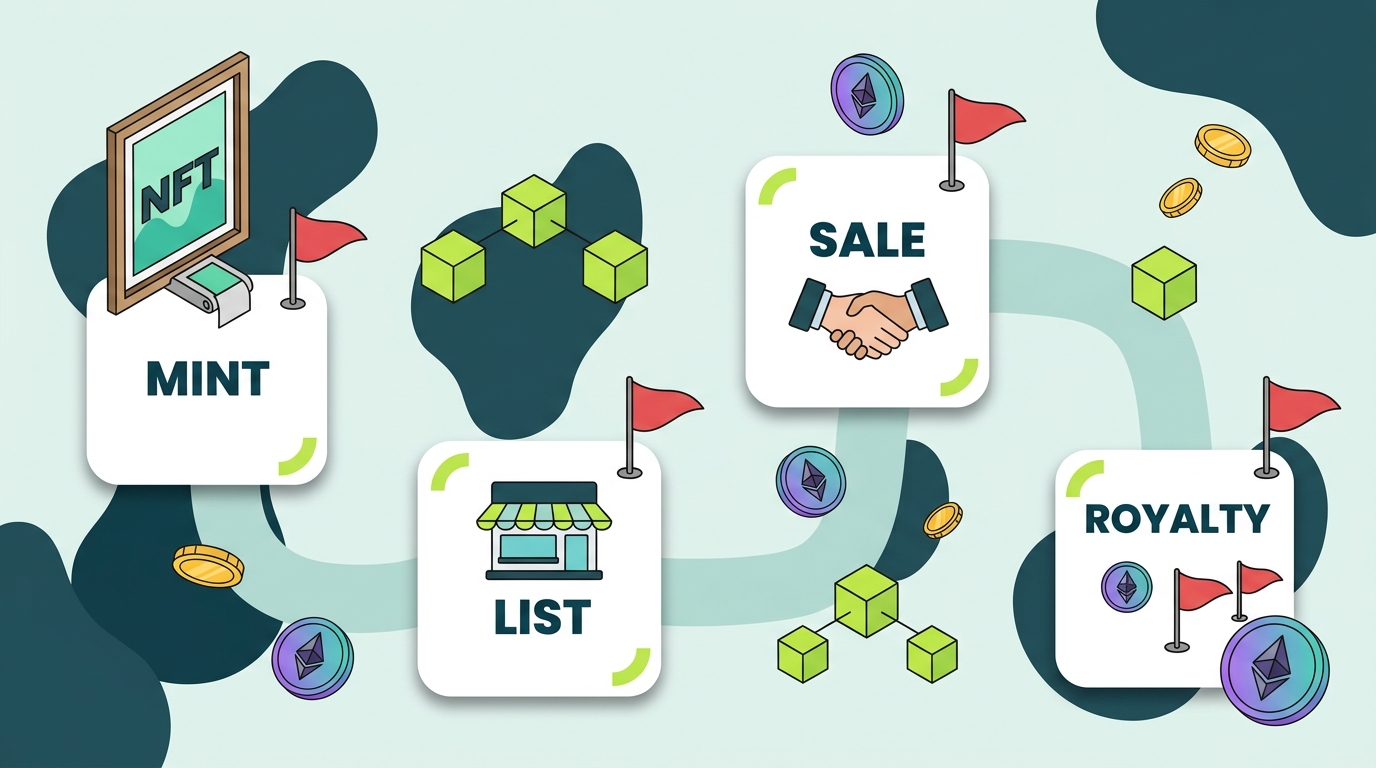
Buying With ETH: The Two-Sided Trade Nobody Sees
Here is the event that dominates NFT tax cleanups. When you pay 2 ETH for an NFT, two things happen at once:
Side one: you disposed of 2 ETH. ETH is property with a cost basis. Spending it is a realization event identical to selling it for dollars and spending the dollars. Gain or loss equals the ETH’s value at purchase time minus what you paid to acquire it, long-term or short-term by how long you held the ETH.
Side two: you acquired an NFT. Its cost basis is the dollar value you paid, ETH price plus marketplace fees plus gas, and its holding period starts now.
Buying a 2 ETH NFT With 2021 ETH
You bought 2 ETH at $900 each in 2021 ($1,800 total). In 2026 you spend them on an NFT when ETH trades at $3,200. Spending the ETH disposes of it: $6,400 value minus $1,800 basis is a $4,600 long-term gain, taxed at 15 or 20 percent depending on your bracket. The NFT takes a $6,400 basis. You owe real tax this year even if the NFT never sells.
Scale that across a collector who rotated early ETH through thirty purchases during a bull run and the missed gains reach six figures. The inverse is the quiet consolation: buying NFTs with ETH that has fallen since acquisition realizes a loss on every purchase, harvesting as you shop.
One WETH wrinkle: accepting a Blur or OpenSea bid means receiving WETH, and paying with WETH means disposing of WETH. Under the prevailing view that wrapping is a nonevent, WETH carries your ETH’s original basis and holding period, so the analysis is unchanged; our Ethereum DeFi guide covers the wrapping question in full.
Selling: Proceeds, Basis, and the Clock
Selling on OpenSea or Blur is the disposal everyone does expect: proceeds minus basis equals gain or loss. Proceeds are the dollar value of ETH or WETH received, net of marketplace fees and any creator royalty deducted from the sale. Basis is purchase or mint cost plus buy-side fees and gas. Held over a year: long-term rates of 0, 15, or 20 percent, subject to the collectibles question below. Held under a year: ordinary rates up to 37 percent.
Mechanical notes that decide real dollars:
- The ETH you receive starts fresh. Sale proceeds of 3 ETH take basis at their value on sale day, and their own holding period starts then. Every flip chains into your ETH lot history, wallet by wallet under Rev. Proc. 2024-28.
- NFT-for-NFT trades tax both sides. Swapping tokens with another collector disposes of yours at the value of theirs. There is no like-kind deferral for digital assets.
- Losses are fully usable. NFT capital losses offset capital gains without limit, then up to $3,000 of ordinary income yearly, with carryforward, the same loss-harvesting math as tokens.
The Collectibles Question: When 20 Percent Becomes 28
Long-term capital gains normally max out at 20 percent. Collectibles are the carve-out: art, antiques, gems, stamps, coins, and “any other tangible personal property” designated as such, taxed at ordinary rates capped at 28 percent when held over a year. In Notice 2023-27, the IRS said it will decide NFT status with a look-through analysis: an NFT is a collectible if the asset it represents is a collectible.
Run the look-through across the Ethereum landscape:
- NFTs tied to physical collectibles (a token redeemable for a painting, a watch, a case of wine) look through to the underlying item. Clearly collectible, clearly 28 percent territory.
- One-of-one digital art, the Art Blocks and Foundation end of the market, looks through to a work of art. “A work of art” is on the statutory collectibles list, and the IRS notice specifically flagged the question of whether digital files qualify. This is the highest-risk zone for 28 percent treatment.
- Utility NFTs: domains, game items, membership passes, ticket stubs with function. These look through to things that are not collectibles. Normal rates.
- Profile-picture collections, which is to say most blue-chip value, sit in the unresolved middle. Is a generative 10,000-piece PFP “a work of art”? No ruling, no case law, and credentialed professionals on both sides.
Practical posture while it stays open. Short-term flippers can ignore the issue entirely, since collectibles treatment only modifies long-term rates. Long-term holders sitting on large gains, especially in art-adjacent NFTs, should model both rates before selling and document the position taken with professional support. And the stakes extend past rates: collectibles are prohibited IRA investments, so NFTs inside self-directed retirement accounts carry deemed-distribution risk if the look-through lands wrong.
Creators: Mint Revenue, Royalties, and Schedule C
Everything above is investor taxation. Creators live under a different regime: ordinary income, because selling what you created is revenue, not investment return.
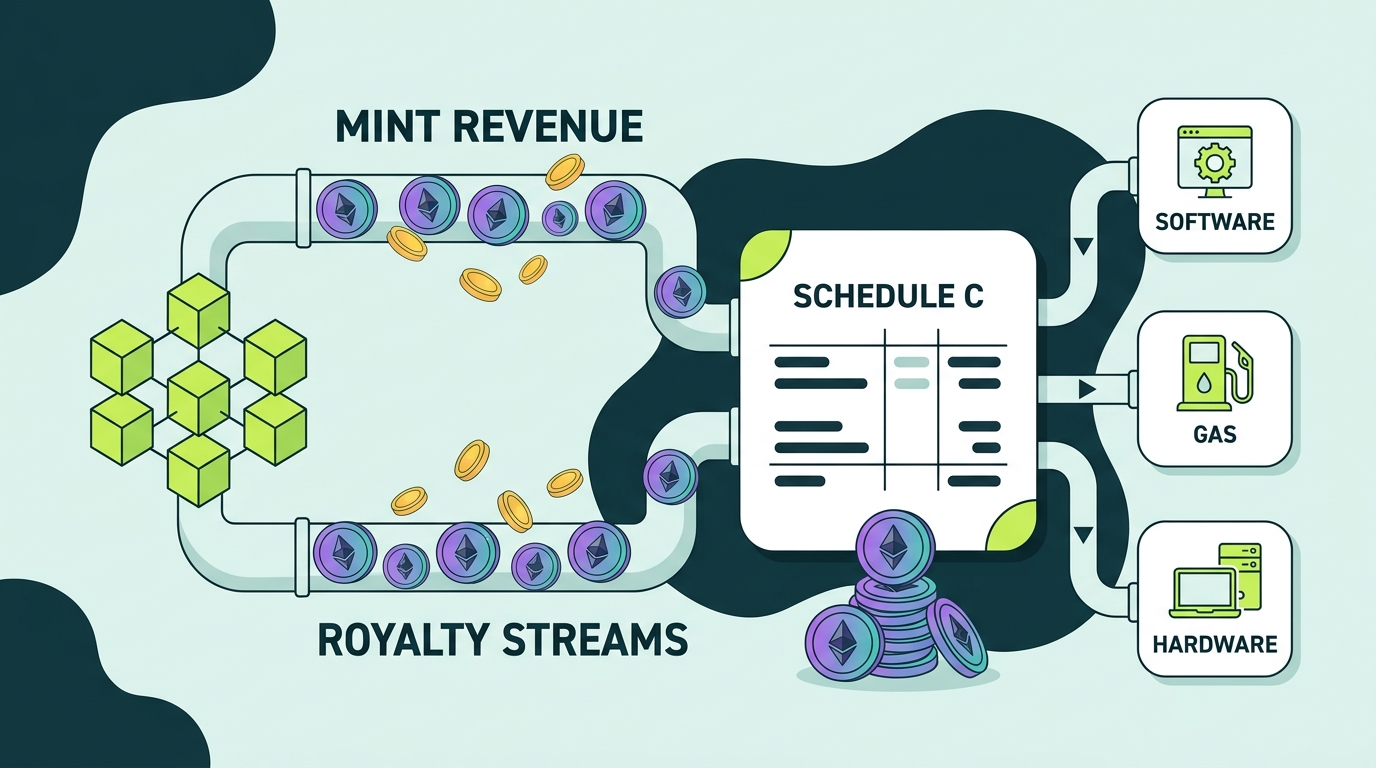
Primary sales. Mint proceeds are ordinary income at fair market value when received. A creator running a project with continuity and profit motive is self-employed: Schedule C, self-employment tax of 15.3 percent on top of income tax, and deductible business expenses to offset it, including art costs, developer payments, infrastructure, marketing, and the gas burned deploying contracts. That expense side is real money; a serious mint costs thousands to launch, all deductible against the revenue for a legitimate business.
Royalties. Secondary-sale royalties are ordinary income at fair market value as they arrive, a stream of small ETH payments with every resale. For an active creator they join mint revenue on Schedule C. A genuinely passive royalty interest, a co-founder long out of the project still receiving a share, may belong on Schedule E without self-employment tax. The 15.3 percent difference makes the classification worth a professional conversation rather than a guess; that is a normal topic for a 15-minute call with our team.
The received ETH keeps going. Every royalty payment takes basis at receipt value and becomes its own lot, feeding the same wallet-level records as everything else. A successful collection generates thousands of tiny lots, a record-keeping problem rather than a conceptual one, but a real problem.
Buyers who mint are not creators. Paying a mint price is a purchase: an ETH disposal plus an NFT acquisition at mint-cost basis, per the two-sided trade above. Flipping the mint next week is a short-term gain against that basis. And the gas from failed mints during gas wars is the double sting covered in our gas fee guide: the burned ETH is still a disposal, and investors get no clean deduction for the fee that bought nothing.
The Wash Sale Angle: NFTs’ Strange Advantage
The wash sale rule disallows losses when you sell a security and rebuy substantially identical property within 30 days. By its terms it covers stock and securities, and the IRS classifies crypto assets as property, so under current law it does not reach crypto at all, NFTs included. Congress has proposed extending it for years without passing anything; our wash sale guide tracks the live status.
NFTs add a wrinkle tokens do not have: uniqueness. Even under a future expansion, the rule turns on “substantially identical” property. Selling Token #4821 at a loss and buying Token #7733 from the same collection is a sale and purchase of two different assets with different traits and different market prices. A strong argument says they are not substantially identical, which would leave collection-level loss harvesting intact even in a world where token wash sales die.
Temper that with two cautions. First, selling to yourself is not harvesting. Wash-trading an NFT between your own wallets, or to a friend who sells it back, is not a bona fide disposal, and losses from circular trades invite disallowance under economic substance principles regardless of the wash sale statute. Second, the risky version is the pure round trip: selling an NFT at a loss and buying the same token back minutes later looks like a loss without a change in position, and even without a statutory wash sale rule, transactions with no purpose except tax generation are attackable. Sell to the open market, take real execution risk, and the loss is clean.
The tax code never anticipated an asset class where every unit is one of a kind. For loss harvesting, NFT uniqueness is a feature; for wash-trading your own JPEG in a circle, nothing was ever going to make that work.
Worthless and Rugged NFTs: Realizing the Damage
Every Ethereum wallet that survived a full cycle holds them: the mint that promised a game, the PFP whose founders vanished, the collection with no bids at any price. The economic loss is real. The tax system counts it only when realized.
Holding deducts nothing. An NFT at a 99 percent drawdown is still just property with a high basis. There is no line for unrealized regret.
Selling realizes the loss. Dispose of the NFT for whatever the market pays: accept a floor bid, a Blur pool bid, or use a legitimate loss-harvesting service that buys dead NFTs for nominal amounts. Proceeds of $5 against a $6,400 basis is a $6,395 capital loss, usable against gains immediately. Two integrity rules: the buyer cannot be you or a related party, and the sale should be a real market transaction you cannot quietly reverse.
The weaker routes are weak. Abandonment (provable relinquishment, such as burning the token to a dead address) and worthlessness deductions collide with the TCJA’s suspension of miscellaneous itemized deductions for individual investors, and theft-loss treatment requires actual theft, profit motive, and documentation, not just a team that stopped tweeting. Genuine drainer and scam cases have their own narrow paths, covered in our lost and stolen crypto guide. For an ordinary rugged JPEG, a real sale before December 31 is the clean, defensible answer.
Spam NFTs, the uninvited junk in every active wallet, deserve one line: worthless drops you never sought are not meaningful income, and their links are drainer bait. Hide them, mark them spam in your software, never interact on-chain.
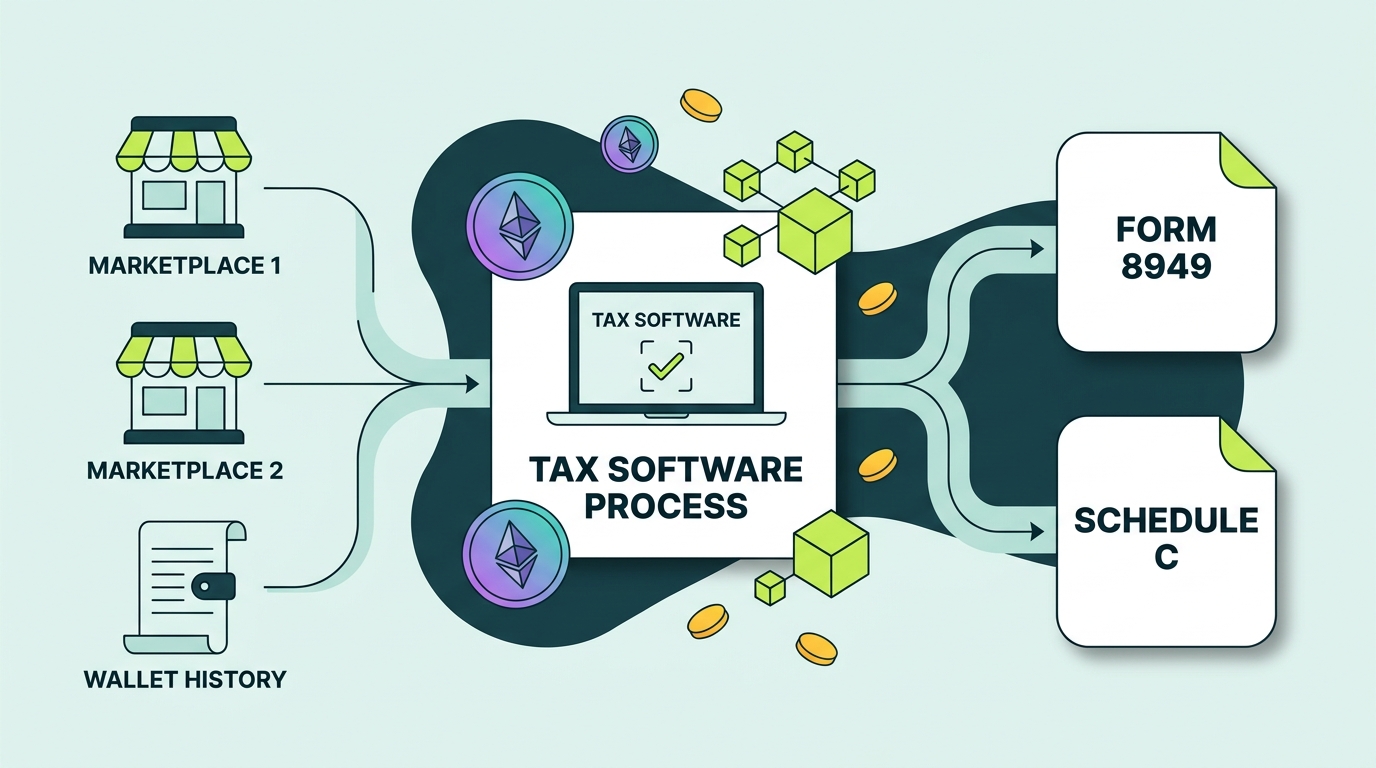
Marketplaces, Reporting, and the Records Pipeline to Form 8949
What gets reported for you: almost nothing. OpenSea and Blur are non-custodial, and after Congress repealed the DeFi broker rule in April 2025, they file no Form 1099-DA on your trades. Custodial exchanges do report, so the moment you send sale proceeds to Coinbase and cash out, that ETH sale hits a 1099-DA as gross proceeds. Years of unreported flipping capped by a large reported cash-out is the exact mismatch automated IRS matching is built to flag, and the chain itself is public evidence the whole way down.
The pipeline that closes the gap:
- Import every wallet that ever touched NFTs into crypto tax software with real NFT support: mint wallets, vault wallets, burner wallets, plus any L2 activity.
- Verify the two-sided trades. Every purchase should show an ETH disposal plus an NFT acquisition; every sale should show fee- and royalty-adjusted proceeds. NFT pricing data is the weakest link in every platform, so spot-check your largest trades against marketplace history.
- Book income separately. Creator revenue, royalties, and marketplace token incentives like BLUR seasons are ordinary income at receipt, not trades. Airdropped marketplace tokens follow the standard claim-date income rule.
- Filter spam so junk never pollutes income or holdings.
- Reconcile transfers between your own wallets so basis travels, per the wallet-by-wallet rules.
- Flag collectibles candidates. Long-term gains on art-like NFTs need the 28 percent analysis before filing, not after.
- Report: disposals on Form 8949 and Schedule D, including the ETH disposals from purchases; creator income on Schedule C; yes on the digital asset question; archive marketplace and explorer history as the audit file.
Common Ethereum NFT Tax Mistakes
Missing the ETH Disposal on Every Purchase
The defining error. Collectors track flips and never book the appreciated ETH they spent to buy. Across a bull-market history, this is the largest single understatement we find.
Reporting Gross Proceeds as Gain
Proceeds minus basis is the gain. Ignoring buy-side fees and gas in basis, or royalties and fees taken from proceeds, overstates income on every flip.
Letting Long-Term Art Gains File at 20 Percent Unexamined
Software will not raise the collectibles flag. A six-figure long-term gain on digital art deserves the look-through analysis before the return goes in.
Treating Royalties as Future Income
Creators sometimes plan to deal with royalties when they cash out. Each payment was income at receipt, in that year, at that value.
Wash-Trading Losses Between Own Wallets
A loss sold to yourself is not a loss. Harvest through the open market or a legitimate buyer, never in a circle.
Holding Dead NFTs Through Year-End
An unsold rug is an unbooked loss. December 31 is the deadline for making this year’s damage deductible.
Your Ethereum NFT Tax Checklist
- Import every wallet that touched NFTs, including mint and burner wallets and L2s.
- Verify each purchase booked an ETH disposal and set NFT basis with fees and gas.
- Verify sale proceeds are net of marketplace fees and royalties.
- Classify creator income as ordinary, Schedule C if active, with expenses captured.
- Record marketplace token rewards (BLUR and similar) as income at claim.
- Flag long-term art-like gains for the 28 percent collectibles analysis.
- Sell worthless NFTs to the open market before year-end to realize losses.
- Mark spam NFTs as spam and never interact with them.
- Reconcile wallet transfers so basis travels wallet to wallet.
- Report on Form 8949 and Schedule D, archive marketplace history as the audit file.
Bottom Line
Ethereum NFT taxes are ordinary property rules applied to an extraordinary market: every sale is a gain or loss, every purchase is also an ETH disposal, creator money is ordinary income, and the collectibles question hangs a possible 28 percent rate over long-term art gains while the wash sale rule, for now, leaves NFT loss harvesting unusually open. None of it is reported for you. The collectors who end up in trouble are rarely the ones who owed the most; they are the ones whose records could not explain what the chain plainly shows.
If your wallets hold years of OpenSea and Blur history, mint-week gambles, royalty streams, or a graveyard of rugged projects with unharvested losses, we can turn that history into clean, CPA-ready numbers. Book a 15-minute call with a crypto tax specialist, or reach out to our team for a full NFT review, and see our Ethereum tax guide for the complete picture.
Related Reading
- Ethereum Tax Guide: The Complete Picture
- Ethereum Staking Taxes
- Liquid Staking and Restaking Taxes: stETH, EigenLayer & More
- Ethereum Gas Fees and Taxes
- Ethereum DeFi Taxes: Uniswap, Aave & Beyond
- Crypto Wash Sale Rule: Current Status
- Crypto Tax-Loss Harvesting
- How to File Crypto Taxes: Form 8949 & Schedule D
Frequently Asked Questions
Is buying an NFT with ETH a taxable event?
Yes, on the ETH side. Paying 2 ETH for an NFT disposes of that ETH, so you realize gain or loss on it measured against what you originally paid for it. The NFT then takes a cost basis equal to the dollar value you paid plus fees. Buying with long-held, appreciated ETH quietly triggers tax on years of ETH gains.
How are NFT sales taxed?
As capital gains or losses. Proceeds are the dollar value of the ETH you receive, net of marketplace fees and royalties taken from the sale. Basis is your purchase or mint cost plus buy-side fees. Held over a year, gains are long-term; under a year, they are taxed at ordinary income rates. The ETH you receive also starts a new basis of its own.
Are NFTs taxed as collectibles at 28 percent?
Possibly. IRS Notice 2023-27 announced a look-through analysis: an NFT is a collectible if the asset it represents is a collectible, like art or gems. Long-term collectible gains are taxed at ordinary rates capped at 28 percent instead of the usual 20 percent maximum. Whether a profile-picture project is art is unsettled, so large long-term gains on art-like NFTs deserve professional review before sale.
How is NFT creator and royalty income taxed?
As ordinary income at fair market value when received. For an active creator, primary sales and royalties are self-employment income on Schedule C, subject to self-employment tax, with business expenses deductible against them. A truly passive royalty interest may belong on Schedule E without self-employment tax. The classification is fact-dependent and worth getting right.
How is minting an NFT taxed?
For the minter, paying the mint price in ETH is a disposal of that ETH, and the minted NFT takes basis equal to mint price plus gas. Minting does not create income for the buyer. Gas from failed mints is its own small mess: the ETH burned is still a disposal, and investors get no clean deduction for the wasted fee.
Does the wash sale rule apply to NFTs?
Under current law, the wash sale rule covers stock and securities, and the IRS treats crypto assets as property, so it does not directly apply. NFTs add a twist: every NFT is unique, so even under an expanded rule, buying a different token from the same collection is arguably not substantially identical property. Selling an NFT at a loss and buying it back immediately is the risky version; the economic substance doctrine still lurks over pure round trips.
Can I deduct a worthless or rugged NFT?
Not just by watching it die. Capital losses require a realization event, normally a sale or other disposal. The practical route is selling for whatever the market offers, even a nominal amount through a legitimate buyer or loss-harvesting service, which locks in a deductible capital loss. Abandonment and worthlessness theories are much weaker for individual investors under current law.
Do OpenSea or Blur report my trades to the IRS?
Generally no. They are non-custodial marketplaces, and after Congress repealed the DeFi broker rule in April 2025, platforms like these do not file Form 1099-DA on your trades. Custodial exchanges still report when you cash out. No form does not mean no tax; your wallet history is the record and sales still belong on Form 8949.
What about Blur bid pool rewards and marketplace airdrops?
Token incentives like the BLUR airdrop seasons are ordinary income at fair market value when you gain control of the tokens, typically at claim. That value becomes your basis. The same rule covers marketplace reward points that convert to claimable tokens.
Are NFT-to-NFT swaps taxable?
Yes, on both sides. Trading one NFT for another disposes of the NFT you gave up at the fair market value of what you received, and there is no like-kind deferral for crypto assets. Both parties realize gain or loss and both new NFTs take fresh basis.
How do I report NFT activity on my return?
Each sale or taxable disposal goes on Form 8949 and Schedule D with proceeds, basis, and holding period, including the ETH disposals hiding inside every purchase. Creator income goes on Schedule C for active creators. Flag potential collectibles for the 28 percent analysis, and check yes on the Form 1040 digital asset question.
What if I have years of untracked NFT trades?
The history is recoverable because every trade is on-chain. Expect real cleanup: NFT price data is spottier than token data, marketplace fees and royalties need to land in basis and proceeds, ETH disposals on purchases need to be booked, and spam needs filtering. That reconciliation is exactly what a crypto tax specialist can take off your plate.