
Are Ethereum gas fees tax deductible? Not the way most people hope. For investors, gas is not a deduction you claim; it is an adjustment baked into your cost basis and proceeds. And the ETH you spend on gas is itself a disposal of property, which means an active wallet generates hundreds of tiny taxable events a year that almost nobody tracks by hand.
Gas is the tollbooth of Ethereum. Every swap, every mint, every approval, every bridge hop burns a little ETH, and over a busy year those tolls add up to real money. The tax system does not ignore that money, but it also does not hand you a clean deduction line. Instead, gas gets absorbed into the machinery of capital gains: basis here, proceeds there, and a stream of micro-disposals underneath it all.
This guide covers Ethereum gas fee taxation end to end for 2026: gas on purchases, gas on sales, the gray zone of wallet-to-wallet transfers, the disposal-of-ETH problem hiding inside every fee, failed transactions, DeFi interactions, the business-versus-investor divide, Layer 2 fees, and the records that make all of it defensible. It is part of our complete Ethereum tax guide, alongside deep dives on Ethereum staking, liquid staking and restaking, Ethereum DeFi, and Ethereum NFTs.
Disclaimer: This guide is for informational purposes only and is not tax or legal advice. Several gas-fee questions sit in genuinely unsettled territory. Always consult a qualified CPA about your specific situation.
Why Gas Is a Tax Problem, Not Just a Cost Problem
Start with two facts and everything else follows.
First, the IRS treats cryptocurrency as property, per Notice 2014-21 and everything built on it since. ETH is property. Disposing of property, whether by selling, swapping, or spending it, is a realization event.
Second, gas is paid in ETH. There is no way to pay an Ethereum transaction fee with dollars. The network takes ETH out of your wallet, burns the base fee, and pays the tip to the validator.
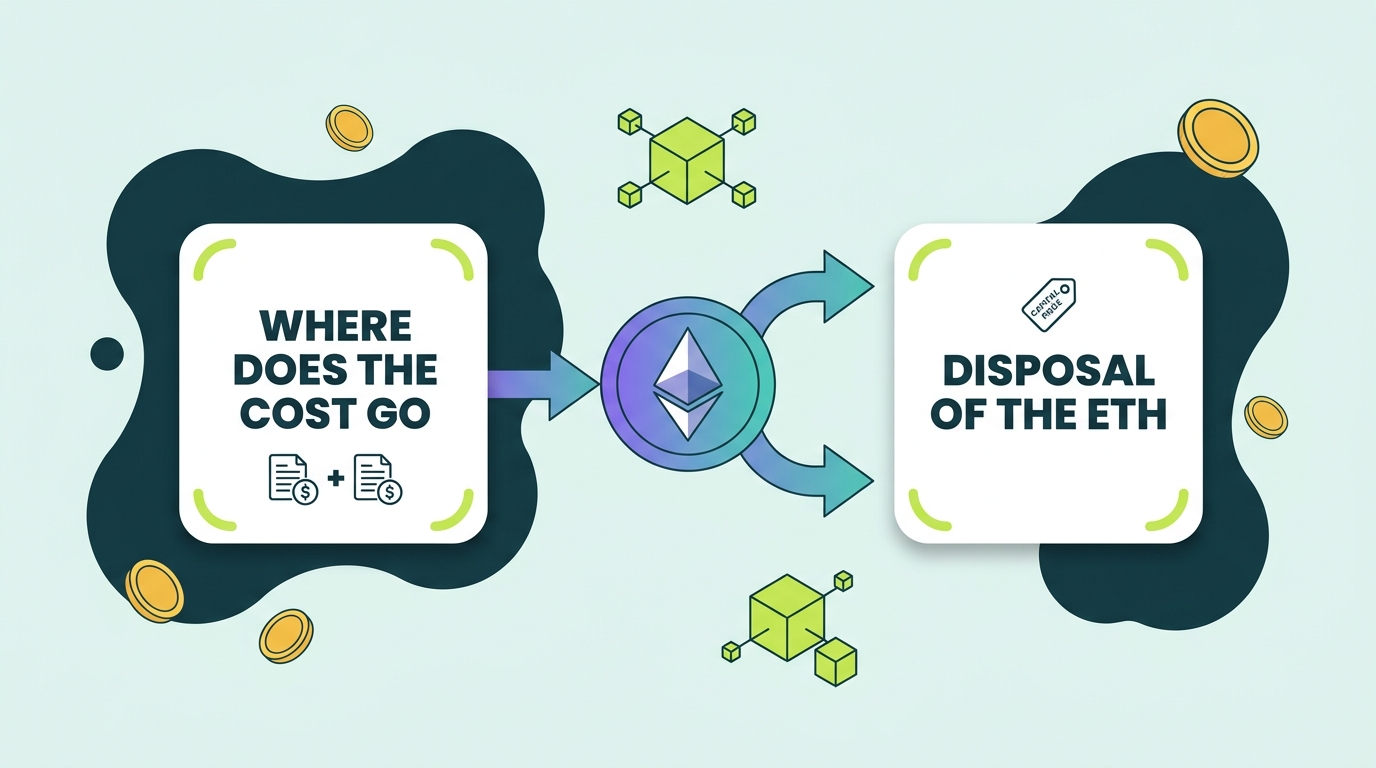
Put those together and every gas payment does two things at once. It spends money, which raises the question of where that cost lands (basis, proceeds, expense, or nowhere). And it disposes of ETH, which raises a second question people never ask: what was the basis of the ETH you just spent, and did you realize gain or loss on it?
Most articles about gas fees answer the first question and skip the second. Both matter. On a wallet that has done a few thousand transactions since 2021, the second one can quietly matter more.
Gas on Purchases: Capitalize Into Basis
When you pay gas as part of acquiring an asset, that gas is a cost of acquisition. Standard property tax rules capitalize acquisition costs into cost basis, the same way brokerage commissions and closing costs work in traditional finance.
Say you swap $5,000 of USDC for a token and the transaction costs $18 of gas. Your basis in the new token is $5,018. When you eventually sell, the gain is measured against that higher number, so the $18 comes back to you as a smaller gain or a larger loss. You never deducted it, but you never lost it either. It just waits inside the asset until the disposal.
This applies to any acquisition powered by gas:
- Token swaps. Gas adds to the basis of the token received.
- NFT purchases. Gas joins the purchase price and marketplace fees in the NFT’s basis. Our Ethereum NFT tax guide walks through the full stack.
- Mints. Mint price plus gas equals the minted asset’s basis.
- Bridging assets in. Gas paid to receive an asset on a new chain is reasonably treated as part of the cost of positioning that asset, though bridge mechanics create their own questions.
One nuance: when a single transaction both disposes of one asset and acquires another, which is what every swap does, the gas arguably splits between reducing proceeds on the sell side and adding to basis on the buy side. In practice, most tax software picks one side, usually capitalizing the full fee into the acquired asset, and either convention is defensible if applied consistently. Do not let perfect allocation theory stall you; consistency is the standard that survives review.
Gas on Sales: Subtract From Proceeds
Flip the direction and the rule flips with it. Gas paid to execute a sale or other disposal is a selling expense, and selling expenses reduce your amount realized.
Sell a token for $2,000 of ETH and pay $14 of gas to do it, and your proceeds on Form 8949 are $1,986. Same economic effect as the basis rule: the fee shrinks your gain, just from the other end of the calculation.
One Round Trip, Both Gas Rules
You buy a token for $1,000 plus $16 gas, so basis is $1,016. Months later you sell it for $1,500 and pay $14 gas, so proceeds are $1,486. Your reported gain is $470 instead of the $500 you would show ignoring gas. Both fees reached your return without a single deduction line.
The pattern to internalize: for investors, gas never appears as gas on a tax return. It disappears into basis and proceeds, and its only visible effect is smaller gains. If you ever find yourself typing “gas fees” as an itemized or miscellaneous deduction on a personal return, back up, because that path was closed for investment expenses when the TCJA suspended miscellaneous itemized deductions, and current law keeps it closed.
The Tax Event Everyone Misses: Gas Is a Disposal of ETH
Here is the part that separates people who understand crypto taxes from people who almost do.
The ETH you spend on gas did not appear from nowhere. You bought it, earned it, or received it at some price, and that price is its cost basis. When the network takes 0.004 ETH from you as a fee, you have disposed of 0.004 ETH at its current fair market value. If that ETH appreciated since you got it, you just realized a gain. On a fee.
The Gain Hiding Inside a $20 Fee
You bought ETH at $800. Today ETH trades at $3,200, and you pay a gas fee of 0.00625 ETH, worth $20. That 0.00625 ETH had a basis of $5 (0.00625 times $800). Disposing of it at $20 realizes a $15 capital gain, long-term if you held the ETH over a year. One fee, one micro-disposal, fifteen dollars of gain the network never mentioned.
Fifteen dollars is nothing. Fifteen dollars times 400 transactions a year on ETH that quadrupled is not nothing. Long-time holders who pay for everything with early ETH are drip-realizing years of appreciation one fee at a time, and none of it shows up anywhere except a properly built transaction import.
The reverse is also true and occasionally useful: paying gas with ETH that has fallen since acquisition realizes small losses with every fee. Either way, the disposals are real, they belong on Form 8949, and the capital gains framework applies at 0, 15, or 20 percent long-term or ordinary rates short-term, exactly as it would for a deliberate sale.
Every gas fee is two transactions wearing one trench coat: a cost that lands somewhere, and a sale of ETH that nobody meant to make.
Good crypto tax software books these micro-disposals automatically when it ingests your wallet. This is the single best argument for using software rather than a spreadsheet: no human being is manually computing gain or loss on 0.00625 ETH four hundred times.
Transfers Between Your Own Wallets: The Gray Zone
Moving assets from your hot wallet to your hardware wallet, or from MetaMask to a fresh address, is not a disposal of the assets you moved. You owned them before, you own them after, and no realization event occurred on the transferred property. That part is settled and covered in our taxable versus non-taxable events guide.
The gas you paid to make the move is the awkward part. It was not spent acquiring anything, and it was not spent selling anything, so neither of the clean rules applies. Two treatments circulate:
- Conservative: the gas simply vanishes. A transfer between your own wallets is a personal act of asset management, and the fee is a nondeductible personal expense, like paying a locksmith to move your gold between two safes you own. No basis adjustment, no deduction, cost gone.
- Aggressive: add the gas to the transferred asset’s basis. The argument is that safeguarding and repositioning property is a cost of holding it, so the fee capitalizes into the moved asset. Some tax software offers this as a setting.
The conservative reading has the stronger technical footing for investors, because capitalization generally attaches to acquisition or improvement, and moving an asset you already own is neither. The aggressive reading is not frivolous, and the dollars are usually small, but if you take it, apply it uniformly and note the choice in your records.
What is not gray: the ETH spent on that transfer gas is still a disposal of ETH, with gain or loss measured against its basis. The gray area is only about where the cost lands, not about whether the ETH left your hands.
Failed Transactions: Paying for Nothing
Ethereum charges for computation whether or not your transaction succeeds. A swap that reverts because slippage moved, a mint that fails because the collection sold out mid-block, a transaction stuck behind an out-of-gas error: in each case the network consumed resources, and your ETH is gone.
Two layers again:
The disposal layer is unambiguous. The ETH consumed by the failed transaction left your wallet at fair market value. That is a disposal of ETH with gain or loss against basis, identical to gas on a successful transaction.
The cost layer is genuinely unsettled for investors. The fee bought nothing. There is no acquired asset to capitalize it into and no sale whose proceeds it can reduce. The candidate treatments:
- Nondeductible personal cost. The strictest view: an investor’s failed transaction fee is a personal expense, deductible nowhere under current law. This is the conservative default.
- Loss on an abandoned attempt. A more assertive view treats the fee as a loss incurred in a transaction entered into for profit under Section 165(c)(2). It has logic behind it, but for individuals it collides with the same TCJA limitations that make most investment-expense theories fragile.
- Business expense. For a taxpayer whose crypto activity is a trade or business, failed transaction costs are ordinary and necessary expenses, deductible like any other operational waste. Clean and uncontroversial, but only if you actually qualify as a business.
Practical advice: let your software flag failed transactions, review how it booked them, pick the conservative treatment unless a professional signs off on something stronger, and keep the transaction hashes. Failed mint gas from a hyped drop can run to hundreds of dollars, and the record of what happened is the difference between a defensible position and a shrug.
Gas in DeFi: One Rule, Many Costumes
DeFi multiplies gas events because nothing in DeFi takes one transaction. A single Uniswap position can involve an approval, a swap, an add-liquidity call, periodic fee collection, and a removal, each with its own fee. Our Ethereum DeFi tax guide covers the positions themselves; here is how the gas maps:
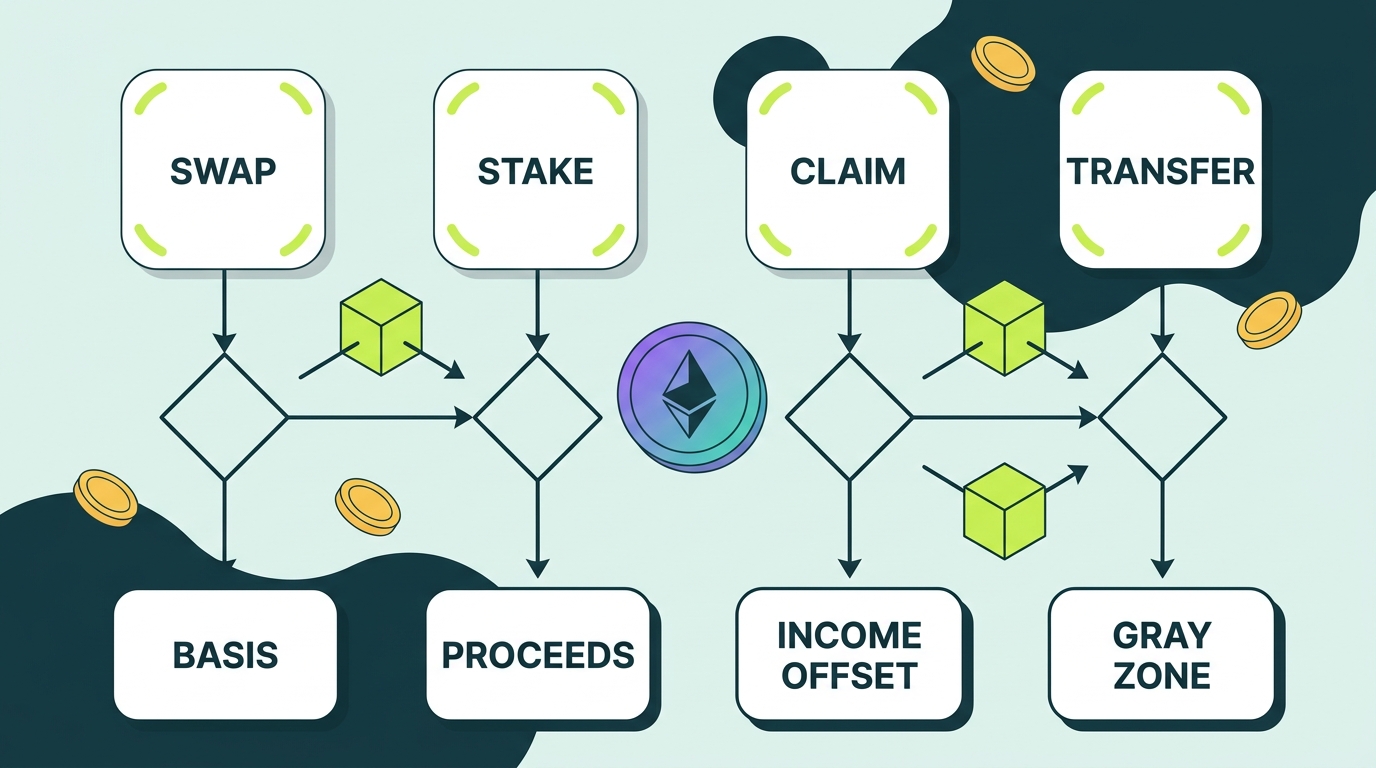
- Swaps. Acquisition-plus-disposal, as covered above. Gas capitalizes into the received asset or reduces proceeds on the sent one, per your software’s convention.
- Token approvals. An approval grants a contract permission and acquires nothing. Like transfer gas, it has no clean home: conservatively a vanished personal cost, aggressively a capitalizable cost of the position it enables. Small dollars, but active wallets sign a lot of approvals.
- Adding and removing liquidity. If you treat entering an LP position as a disposal-and-acquisition, gas follows the swap logic. Under nonrecognition readings, the gas attaches to the position’s basis. The gas treatment inherits whatever position you took on the LP event itself.
- Claiming rewards. Gas paid to claim staking or farming rewards is paid to collect income. A reasonable approach capitalizes it into the basis of the claimed tokens or nets it against the income; an investor cannot deduct it outright. Businesses can.
- Staking deposits and withdrawals. Gas to stake or unstake ETH sits closest to the transfer gray zone, since your ETH remains yours throughout. See our Ethereum staking tax guide for the full staking picture, including the income side, and our liquid staking and restaking guide for what happens when a token stands in for your stake.
- Bridging. Gas on both legs of a bridge plausibly attaches to the cost of positioning the bridged asset. Bridges also raise the separate question of whether the bridge event itself is a disposal, which depends on the mechanism.
Across all of it, the meta-rule holds: classify the transaction first, and the gas inherits the classification. Gas is never its own tax category. It is a cost rider on whatever the transaction actually did.
Investor vs. Business: Who Actually Gets a Deduction
Everything above assumed you are an investor, which is what the tax code presumes for someone buying and selling assets for their own account, even actively. Investors capitalize costs; they do not expense them. That has been the rule since long before crypto, and the TCJA’s suspension of miscellaneous itemized deductions removed the last consolation prize.
A trade or business plays by different rules. If your on-chain activity rises to a business, gas fees are ordinary and necessary business expenses, deductible in full on Schedule C in the year paid. That includes swap gas, approval gas, failed transactions, transfer gas, all of it. Who plausibly qualifies:
- NFT creators and project teams minting, deploying, and managing collections as a business. Creator taxation is covered in our Ethereum NFT guide.
- Validators and staking operations run with business-level continuity and profit motive, as discussed in our staking guide.
- Traders with trader tax status, a genuinely hard standard requiring frequency, regularity, and the pursuit of short-term swings as a livelihood. Most self-described full-time traders do not qualify, and claiming it incorrectly invites exactly the scrutiny you want to avoid.
- Businesses that transact on-chain, such as a company paying vendors in stablecoins, whose transaction fees are ordinary operating costs.
The dollars at stake are not trivial. An operation burning $8,000 of annual gas deducts it currently as a business but only recovers it through basis adjustments as an investor, and basis adjustments on assets you have not sold yet recover nothing this year. If you are near the line, this classification is worth a real conversation with a professional. You can put 15 minutes on the calendar with our team here.
Layer 2 Fees: Same Law, Smaller Numbers, More Rows
Arbitrum, Base, Optimism, and the rest of the L2 ecosystem run the same tax rules at a fraction of the price. A fee paid in ETH on Base is a disposal of that ETH and a cost that lands in basis or proceeds, exactly as on mainnet. Nothing about rollup architecture changes the analysis.
What changes is the shape of the data:
- Volume explodes. When a swap costs three cents instead of thirty dollars, people transact fifty times more. Wallets active on L2s routinely show thousands of transactions a year, each one a micro-disposal of fee ETH plus a basis event.
- Each entry shrinks. Gain or loss on 0.000008 ETH of gas rounds to fractions of a cent. Individually meaningless, but they must still net correctly across thousands of rows.
- Software support varies. Major platforms handle the big L2s well and the long tail inconsistently. Missing chains mean missing fees, missing disposals, and basis errors that surface later as phantom gains.
- Bridge hops multiply wallets. The same address on five chains is five transaction histories, and under wallet-by-wallet basis rules, each needs coherent records.
The practical posture: import every chain you touched, spot-check that fees are being captured and booked, and resist the urge to hand-wave L2 activity as too small to matter. The per-row amounts are tiny; the row count is not.
Record-Keeping: The Part That Decides Everything
Gas fee taxation is not conceptually hard. It is operationally hard, because the correct answer is assembled from thousands of small facts, and the chain remembers all of them whether you do or not. What your records need to support:
- Every wallet, every chain. Mainnet plus every L2, including addresses you abandoned. An incomplete import produces wrong basis everywhere downstream.
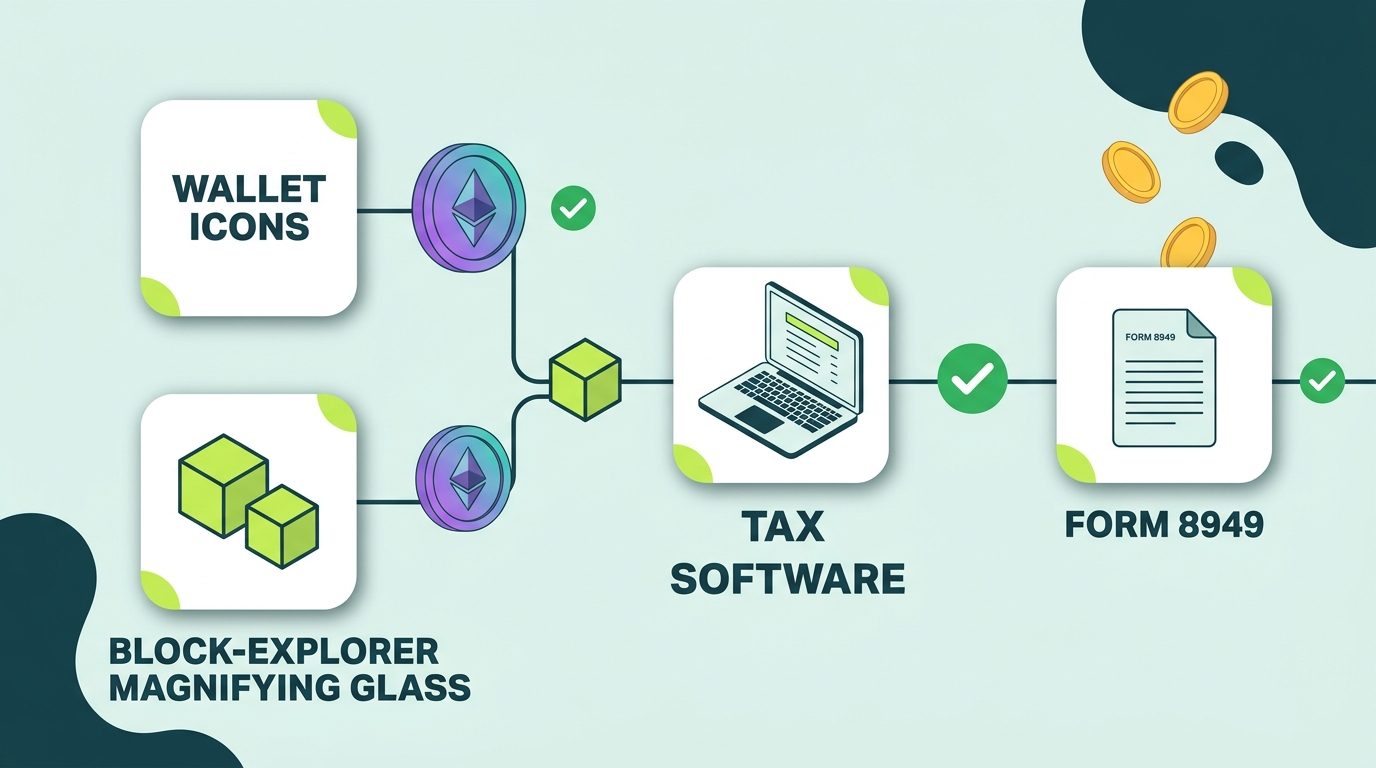
- Fee capture on every transaction. Hash, timestamp, gas used, effective gas price, and the dollar value of ETH at execution. Block explorers hold this; archive it rather than trusting it to stay queryable forever.
- The micro-disposals of fee ETH. Confirm your software books gain or loss on spent gas, not just the fee amount. This is a settings-level behavior in some platforms and worth verifying once.
- Your gray-area elections. A short note recording how you treat transfer gas, approval gas, and failed transactions. Consistency documented in advance beats improvisation explained after.
- Wallet-by-wallet basis integrity. Post Rev. Proc. 2024-28, transferred assets must carry their basis to the destination wallet in your records. Reconcile transfers so nothing arrives basis-less.
- Form 1099-DA awareness. Custodial exchanges are issuing Form 1099-DA now, and those forms know nothing about the gas you paid on-chain. Your records bridge the gap between reported gross proceeds and the true net numbers on your return.
If that list describes work you have not done across several years of activity, you are the normal case, not the exception. Rebuilding gas-aware records from raw chain data is exactly the reconciliation work we do; you can bring us the mess directly by booking a 15-minute call.
Common Gas Fee Tax Mistakes
Deducting Gas as an Expense on a Personal Return
The classic. Investors do not get an expense line for gas. It belongs in basis and proceeds, and claiming it elsewhere is an error in both directions: a deduction you cannot take and a basis adjustment you failed to make.
Ignoring the ETH Disposal Inside Every Fee
Treating gas as a pure cost misses the gain or loss on the ETH spent. For long-term holders paying fees with cheap ETH, this is systematically understated income across hundreds of events.
Losing Fees in Manual Spreadsheets
Hand-built records almost never capture gas correctly, and every missed fee overstates gains. If your history is more than trivial, software plus review beats spreadsheets every time.
Forgetting Failed Transactions Entirely
Failed mints and reverted swaps burned real ETH. They belong in the record as disposals of that ETH even when the fee itself deducts nowhere.
Treating L2 Activity as Too Small to Report
Three-cent fees across four thousand transactions are still disposals and basis events. Skipping chains creates import gaps that corrupt basis on assets you later sell for real money.
Claiming Business Treatment Without Qualifying
Deducting gas on Schedule C because you trade a lot is not trader tax status. The standard is high, and misclassification converts a small error into a posture problem.
Your Ethereum Gas Fee Tax Checklist
- Import every wallet on every chain, mainnet and L2s, into crypto tax software.
- Verify fees are captured on each transaction with ETH dollar values at execution.
- Confirm micro-disposals of fee ETH are being computed, not just fee amounts.
- Check basis capitalization on buys and proceeds reduction on sells.
- Pick and document a treatment for transfer gas, approvals, and failed transactions.
- Reconcile wallet-to-wallet transfers so basis travels with the assets.
- Match exchange 1099-DA forms against your on-chain records.
- Review business-versus-investor classification if your activity is heavy.
- Archive explorer data for every wallet as your audit file.
Bottom Line
Ethereum gas fees never show up on a tax return under their own name, and that is exactly why they cause problems. Gas on purchases hides in basis, gas on sales hides in proceeds, transfer and failed-transaction gas hides in gray areas, and underneath all of it, every fee is a disposal of ETH with its own gain or loss. None of this is exotic law; it is ordinary property taxation applied to thousands of small events that only software can track and only good records can defend.
If your wallets hold years of mainnet and L2 activity with fees nobody ever booked, we can rebuild the history into clean, CPA-ready numbers. Book a 15-minute call with a crypto tax specialist, or reach out to our team for a full review, and see the rest of our Ethereum tax guide for the complete picture.
Related Reading
- Ethereum Tax Guide: The Complete Picture
- Ethereum Staking Taxes
- Liquid Staking and Restaking Taxes: stETH, EigenLayer & More
- Ethereum DeFi Taxes: Uniswap, Aave & Beyond
- Ethereum NFT Taxes: OpenSea, Blur & the 28 Percent Question
- Crypto Capital Gains Tax Explained
- Per-Wallet Cost Basis Under Rev. Proc. 2024-28
- Form 1099-DA Explained
Frequently Asked Questions
Are Ethereum gas fees tax deductible?
Not as a standalone deduction for most investors. Gas paid to acquire an asset adds to that asset's cost basis, and gas paid to sell reduces your proceeds. Both lower your eventual capital gain, which is a deduction in effect but not on a schedule. Only taxpayers running a trade or business can deduct gas as a current business expense.
Is paying gas in ETH a taxable event?
Yes, and this is the piece most people miss. Gas is paid in ETH, and ETH is property. Spending 0.005 ETH on gas disposes of that ETH, so you realize gain or loss on it measured against its cost basis. The amounts are individually small, but an active wallet makes hundreds of these micro-disposals a year.
How does gas affect cost basis when I buy crypto?
Gas paid as part of an acquisition is capitalized into the cost basis of what you bought. If you swap USDC for a token and pay $15 of gas, the token's basis is the USDC value plus the $15. Higher basis means smaller gain when you sell.
How does gas affect a sale?
Gas paid to execute a sale is a selling expense that reduces your proceeds. Sell a token for $2,000 and pay $12 of gas, and your reported proceeds are $1,988. Most crypto tax software handles this automatically if the import is clean.
What about gas on transfers between my own wallets?
This is a gray area. Moving assets between wallets you own is not a disposal of the transferred assets, and the gas is not tied to a purchase or a sale. The conservative treatment is that transfer gas is a nondeductible personal expense that vanishes. The aggressive treatment adds it to the basis of the transferred asset. Whichever you choose, the ETH spent as gas is still a disposal of that ETH.
Can I deduct gas from failed transactions?
The ETH consumed by a failed transaction is still a disposal of that ETH, so you realize gain or loss on it. Whether the fee itself is deductible is murkier: it did not acquire anything and did not execute a sale. Investors have no clean deduction path; businesses can generally expense it. Most software treats failed-transaction gas as a fee expense or lost asset, and you should review how yours booked it.
Are Layer 2 fees on Arbitrum, Base, or Optimism treated differently?
No. An L2 fee paid in ETH follows the same rules: it is a disposal of the ETH spent, it capitalizes into basis on acquisitions, and it reduces proceeds on sales. The difference is scale. L2 fees are often pennies, which multiplies transaction count while shrinking each entry, and that is a data problem rather than a tax-law problem.
Do gas fees from DeFi interactions get any special treatment?
Each DeFi action inherits the treatment of the transaction it powers. Gas on a swap splits between the disposal side and the acquisition side. Gas to approve a token, claim rewards, or stake sits in grayer territory because it is not clearly attached to a buy or a sell. Consistency and documentation matter more than any single classification.
Can traders or businesses deduct gas directly?
Yes, if the activity rises to a trade or business. A market maker, an NFT creation business, or a taxpayer with trader tax status can deduct gas as an ordinary business expense on Schedule C. Ordinary investors cannot; their gas lives inside basis and proceeds.
Does the IRS actually care about amounts this small?
Individually, no. In aggregate, yes. An active Ethereum wallet can burn thousands of dollars of gas a year, and every one of those payments is both a micro-disposal of ETH and a basis adjustment somewhere. Get the treatment wrong across a few thousand transactions and the error compounds into real dollars on Form 8949.
How do I report gas fees on my tax return?
You do not report gas as its own line item. It shows up inside your Form 8949 numbers: capitalized into basis on buys, subtracted from proceeds on sells, and reflected in the micro-disposals of the ETH you spent as gas. Good crypto tax software builds all three in during import. Your job is verifying it did.
What records should I keep for gas?
Your wallet's transaction history is the primary record: hash, timestamp, gas used, gas price, and ETH value at the time. Export or archive block explorer data for every wallet, keep your tax software's fee handling settings documented, and note which treatment you chose for gray-area items like transfer gas. If you have years of untracked activity, a crypto tax specialist can rebuild it from the chain.