
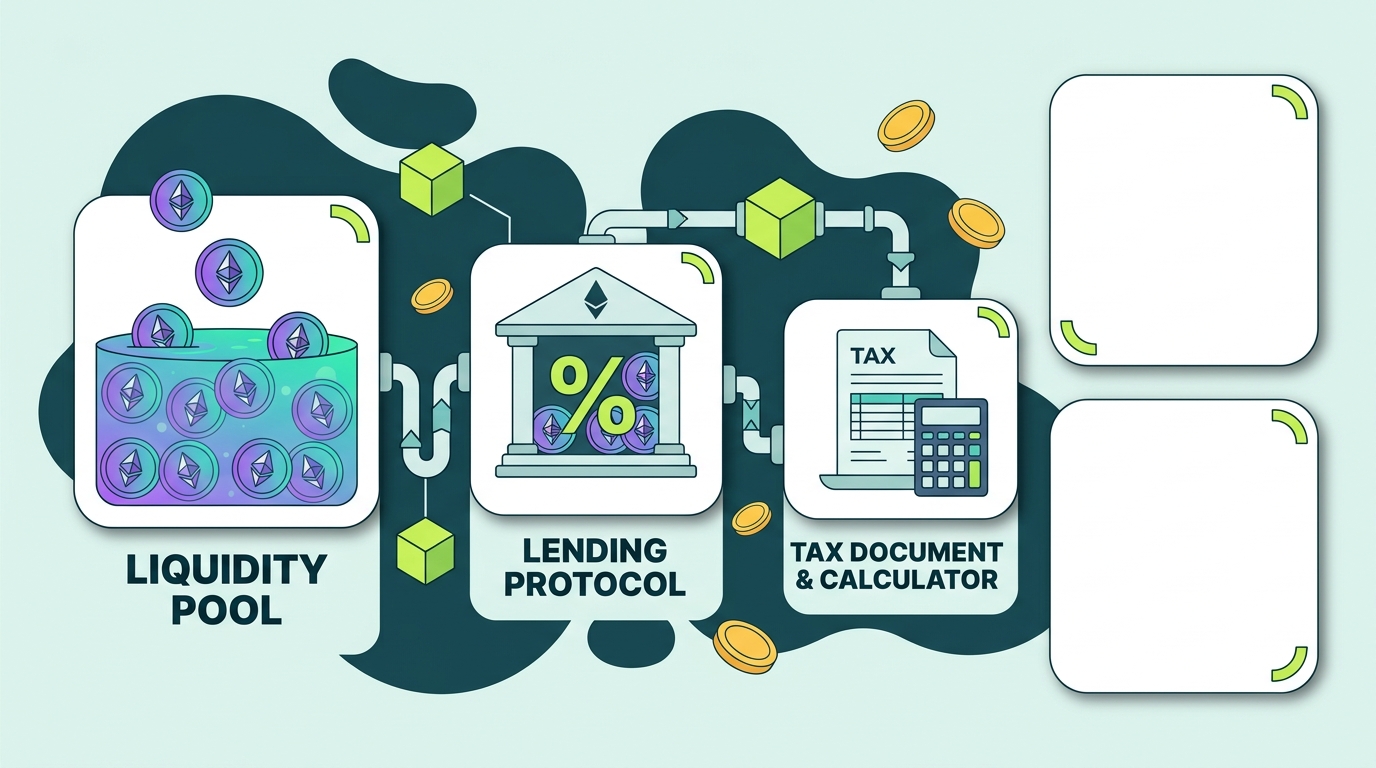
Are Ethereum DeFi taxes due on most activity? Yes, and usually sooner than people expect. Every Uniswap swap is a disposal, lending interest is ordinary income as it accrues, airdrops are income the moment you claim them, and a liquidation is a forced sale with your name on it. The only major exception is borrowing, which is tax-free right up until the collateral cliff.
Ethereum is where DeFi lives. Uniswap alone has processed trillions in volume, Aave holds tens of billions in deposits, and a typical active wallet touches a dozen protocols in a year without thinking of any of it as taxable. The IRS thinks otherwise. DeFi does not get its own tax code; it gets the ordinary property and income rules applied to extraordinary machinery, and the mapping between the two is where every mistake happens.
This guide covers Ethereum DeFi taxation end to end for 2026: swaps, liquidity provision on v2 and v3, impermanent loss, lending on Aave and Compound, borrowing and liquidations, the WETH wrapping question, airdrops, the current state of broker reporting after the DeFi rule repeal, and the wallet-by-wallet basis regime underneath it all. It is part of our complete Ethereum tax guide, alongside deep dives on Ethereum staking, liquid staking and restaking, gas fees, and Ethereum NFTs.
Disclaimer: This guide is for informational purposes only and is not tax or legal advice. Several DeFi questions are genuinely unsettled. Always consult a qualified CPA about your specific situation.
The One Rule Under All of DeFi
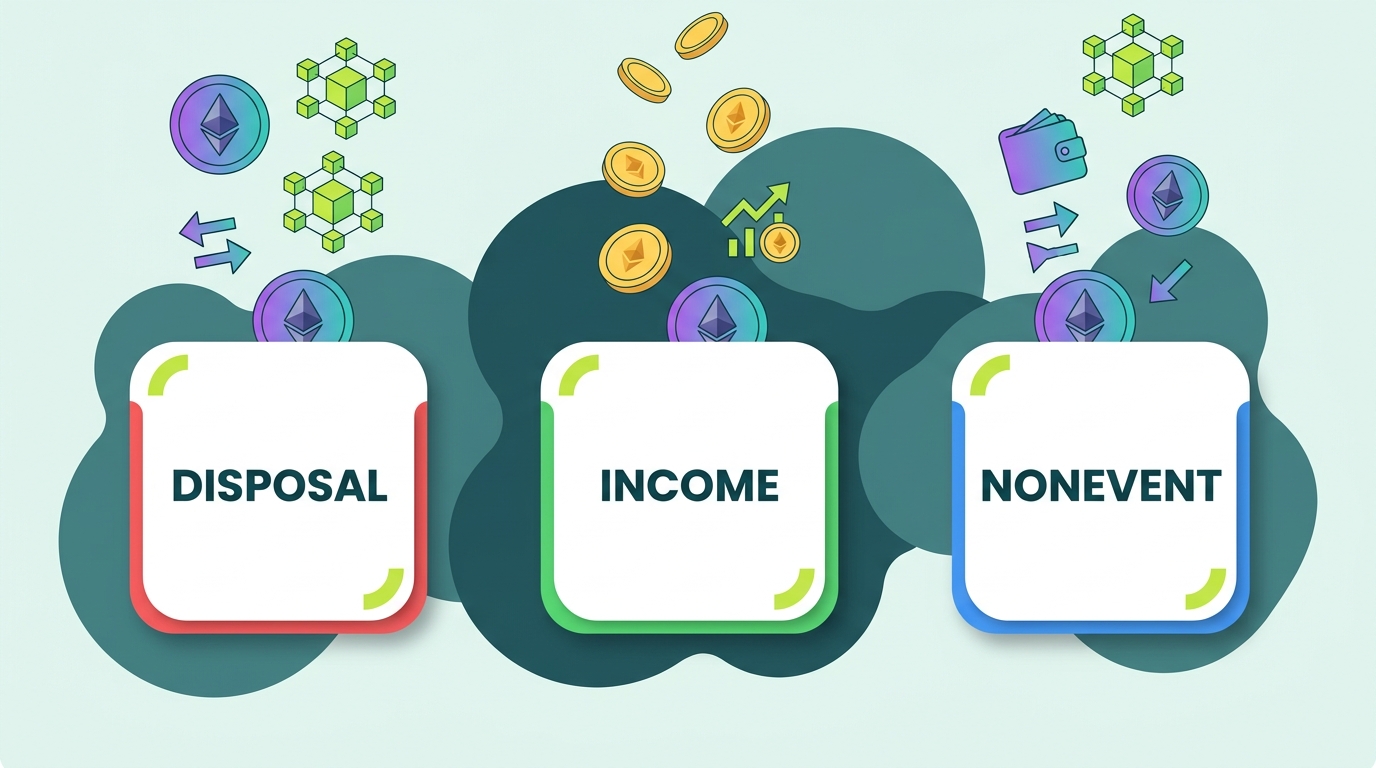
Strip away the interfaces and DeFi reduces to three tax events, the same three that govern everything in crypto:
- Disposals. You gave up property. Gain or loss equals value received minus cost basis. This is the capital gains machinery: 0, 15, or 20 percent on long-term gains, ordinary rates up to 37 percent on short-term.
- Income receipts. Value arrived that you did not buy: interest, rewards, airdrops. Ordinary income at fair market value on receipt, which also becomes your basis.
- Nothing. Some actions move property without disposing of it or generating income. These are the events you want, and correctly identifying them is half the game.
Every protocol interaction below is one of those three, or a genuine dispute about which of the three it is. Hold that frame and DeFi taxation stops being mysterious and starts being merely laborious.
Uniswap Swaps: The Easy Part
A swap is a disposal, full stop. Trade ETH for UNI and you have sold your ETH at its current fair market value; trade UNI for USDC and you have sold your UNI. Gain or loss is measured against the basis of whatever you gave up, and the received token takes basis equal to the value at the swap.
Three points people still get wrong:
- Stablecoin swaps count. Rotating a token into USDC to sit out volatility is a disposal that locks in your gain or loss. USDC’s stability does not defer anything.
- Token-to-token counts. No dollars need to appear anywhere. ETH to PEPE is a sale of ETH at that moment’s price, even if you never touch fiat all year.
- The gas on every swap has its own tax life. Fees capitalize into basis or reduce proceeds, and the ETH spent as gas is itself a micro-disposal. Our Ethereum gas fee guide covers that layer in full.
An active swapper generates hundreds of disposals a year, each needing basis, proceeds, and holding period. This is unremarkable law and brutal bookkeeping, which is the theme of everything that follows.
Liquidity Pools: Where the Law Runs Out
Providing liquidity is DeFi’s signature act and its biggest unresolved tax question. You deposit two tokens, receive something representing your share (v2 LP tokens, or a v3 position NFT), and later hand it back for the underlying assets plus fees. What happened, tax-wise? The IRS has never said directly, and two coherent positions have emerged.
The Conservative View: Both Ends Are Disposals
Depositing ETH and USDC into a pool exchanges your tokens for a different asset, the LP position. Property exchanged for other property is a disposal, so you realize gain or loss on both deposited tokens at entry. At exit, you dispose of the LP position and realize gain or loss on it, with the withdrawn tokens taking fresh basis.
This view has the cleaner doctrinal footing: LP tokens are genuinely different property with different rights, and crypto gets no nonrecognition provision. It is also what most major tax software does by default, which gives it practical gravity. The cost is acceleration: entering a pool with appreciated ETH triggers tax on all of that appreciation immediately, before you have earned a cent of fees.
The Aggressive View: Deferral Until Exit
The alternative treats the deposit as a contribution in which you retain beneficial ownership of the pooled assets, analogized to partnership contributions under Section 721 or to a mere change in form. No disposal at entry, basis carries into the position, and tax waits until you withdraw or sell the position.
The economics support the analogy; the statutes do not obviously reach it, since pools are not partnerships that issue K-1s and no ruling blesses the treatment. Some practitioners take it for clients with the risk tolerance and documentation to defend it.
Uniswap v3: Same Questions, Sharper Edges
v3 concentrates liquidity into price ranges and issues each position as an NFT. The core entry-and-exit questions are unchanged, but v3 adds mechanics worth tracking:
- The position NFT is unambiguously property. Selling or transferring the NFT itself is a disposal of the position, whatever view you took at entry.
- Fees accrue inside the position rather than auto-compounding into your share, and you collect them explicitly. Collected fees are reasonably treated as income at collection, or under stricter readings as part of the overall position calculation at exit. Software handling varies; check what yours did.
- Ranges make composition swings sharper. A position that crossed out of range converts entirely to one asset, and the reconstruction at exit needs to reflect what actually came out, not what went in.
Entering an ETH/USDC Pool With Appreciated ETH
You deposit 5 ETH (bought at $1,400, now $3,200) plus $16,000 USDC into a v3 position. Under the conservative view, depositing the ETH disposes of it: $16,000 value minus $7,000 basis is a $9,000 gain, realized before the position earns anything. Under the aggressive view, nothing is realized and your basis carries into the position. Same click, a five-figure difference in this year’s taxable income, and no ruling that settles it.
Impermanent Loss: Real Pain, No Deduction Yet
Impermanent loss is the gap between what your pooled assets are worth and what they would be worth had you simply held them. Every LP knows the feeling. The tax system does not care about the feeling.
Unrealized IL deducts nothing. While the position is open, IL is an unrealized change in value, no different from a token drawdown in your wallet. There is no line on any form for “my pool underperformed HODLing.”
Realization happens at exit. Withdraw from the pool and, under the conservative view, you dispose of the LP position: proceeds are the value of what you withdrew, basis is what you carried in, and the resulting loss (or gain) is finally real and reportable. Under the aggressive view, the exit itself may not realize anything until you sell the withdrawn tokens, at which point their carried basis produces the gain or loss.
The planning implication runs both directions. A pool sitting on heavy IL is an unbooked capital loss that only counts if you exit before year-end, a cousin of the tax-loss harvesting playbook. And a pool that quietly appreciated is an unbooked gain that exit will crystallize, possibly alongside fees you forgot were income.
Impermanent loss becomes permanent the day you withdraw, and that is also the first day the tax code will split it with you.
Lending on Aave and Compound: Interest Is Income
Deposit USDC into Aave and you receive aUSDC, a balance that grows block by block as interest accrues. Supply to Compound and you receive cTokens that redeem for ever more of the underlying. Different mechanics, same substance: you are earning interest, and interest from lending crypto is ordinary income.
The clean parts:
- Character. Lending yield is ordinary income, not capital gain, in the same family as the yields covered in our crypto income guide. It lands on Schedule 1 for typical individuals, Schedule B by analogy in some preparers’ practice, or Schedule C if the activity is a business.
- Basis. Income recognized becomes basis in the tokens received, so you are not taxed twice when you later sell.
The timing part is messier. Rebasing receipt tokens like aTokens make your balance visibly grow, and the natural treatment recognizes income as it accrues, which is what most software does. Exchange-rate tokens like cTokens do not change your balance, only your redemption value, which lets a stricter argument defer income to redemption. Deposit-and-receipt-token designs also raise the same entry question as LPs, whether the deposit itself is a disposal, though the 1:1 redeemable structure makes nonrecognition a more comfortable answer here than in pools for many practitioners. As always: one treatment, applied everywhere, written down.
Borrowing: The Tax-Free Move and the Liquidation Cliff
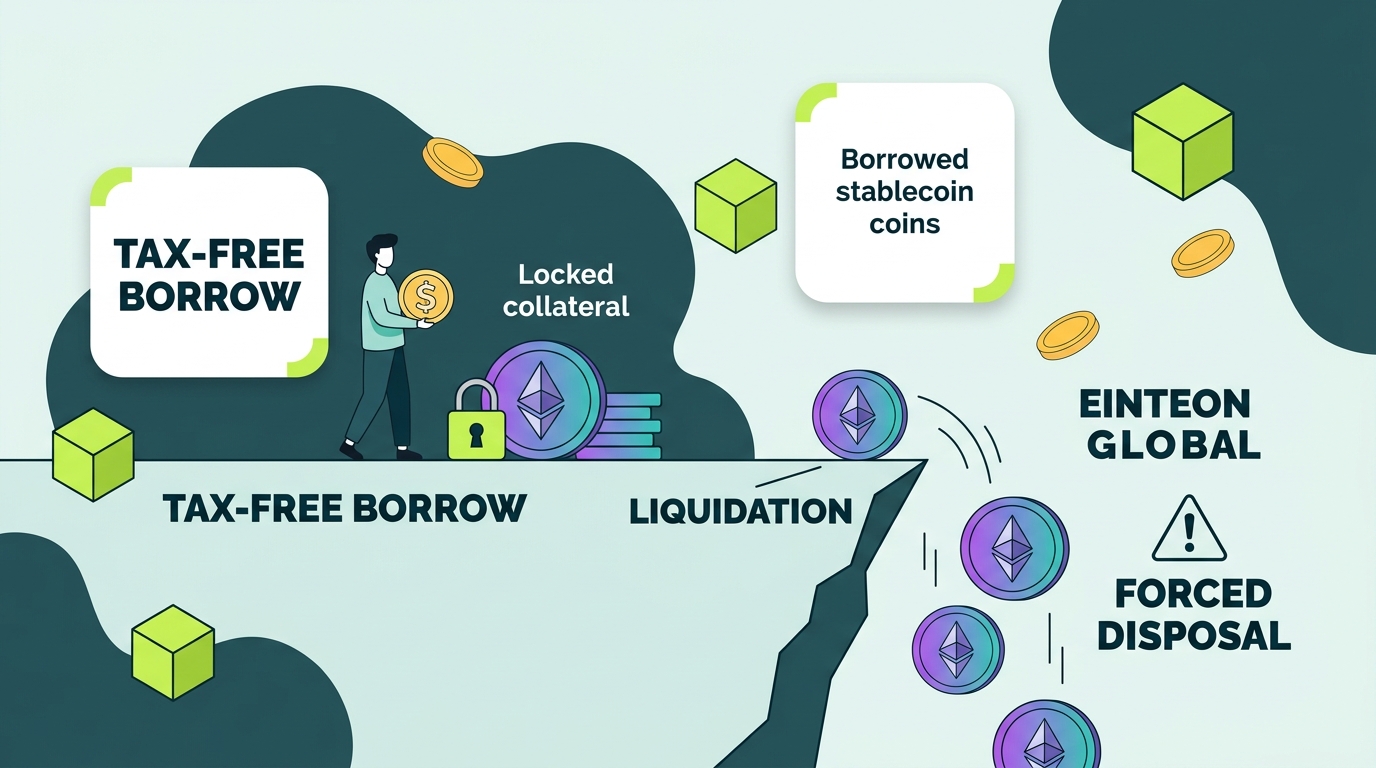
Here is DeFi’s genuine tax shelter, and it is the same one real estate has used forever: loans are not income. Borrow $50,000 of USDC against your ETH on Aave and nothing taxable happened. You still own the ETH; posting it as collateral is not a disposal. You received cash, but debt is not income because you owe it back. Repay the loan and unlock your collateral, and still nothing taxable happened.
This is why “borrow against it, never sell” became the mantra of long-term ETH holders. Used carefully, it converts paper wealth into spendable liquidity with zero realization. Used carelessly, it walks you off a cliff.
The cliff is liquidation. If your collateral ratio breaks, the protocol seizes and sells collateral to cover your debt plus a penalty. That sale is your disposal. The protocol executed it, but the tax result belongs to you: proceeds measured by the debt extinguished and value returned, basis from your original collateral, gain or loss the difference.
The Liquidation That Cost Twice
You posted 25 ETH (basis $400 each, $10,000 total) and borrowed against it. ETH dips hard intraday, your position breaks, and the protocol liquidates 17.5 ETH at $3,000 to cover debt and penalty. You lost the ETH, paid the penalty, and realized a $52,500 gain (17.5 times $3,000, minus 17.5 times $400) on the forced sale. The year you got liquidated is also the year you owe five figures in capital gains tax. Nobody warns you about the second part.
Two adjacent notes. Interest you pay on a DeFi loan is generally investment interest for investors, deductible only within the investment-interest limits if you itemize, and often stranded in practice. And repaying a loan in a different asset than you borrowed, or having debt discharged for less than you owe, creates its own disposal and income questions worth professional eyes.
The WETH Question: Is Wrapping a Taxable Event?
Wrapping ETH into WETH deposits ETH into a contract that mints a 1:1 redeemable ERC-20. Unwrapping reverses it. Nothing about your economic position changes for even a block.
The prevailing practice says nonevent. WETH is ETH in a different jacket: same value, same exposure, instant 1:1 redemption, no counterparty discretion. Most practitioners and most tax software treat wrap and unwrap as nonevents, with basis and holding period carrying straight through.
The conservative argument says disposal. ETH and WETH are technically different assets, one native and one a contract token, and property exchanged for different property is a realization event. On this view every wrap realizes gain or loss on the ETH.
No ruling resolves it. The nonevent position is widely held and, given the total absence of economic change, well reasoned; the disposal position is safer in the narrow sense that recognizing gain early is rarely challenged. What matters operationally is that active DeFi wallets wrap and unwrap constantly, so whichever treatment you pick multiplies across hundreds of events. Configure the software, keep the setting, and note the decision. The same logic extends to other pure 1:1 wrappers, while anything with a floating exchange rate, like the liquid staking tokens covered in our liquid staking and restaking guide, raises harder questions because value genuinely accrues inside the token.
Airdrops: UNI, ARB, and Income You Did Not Ask For
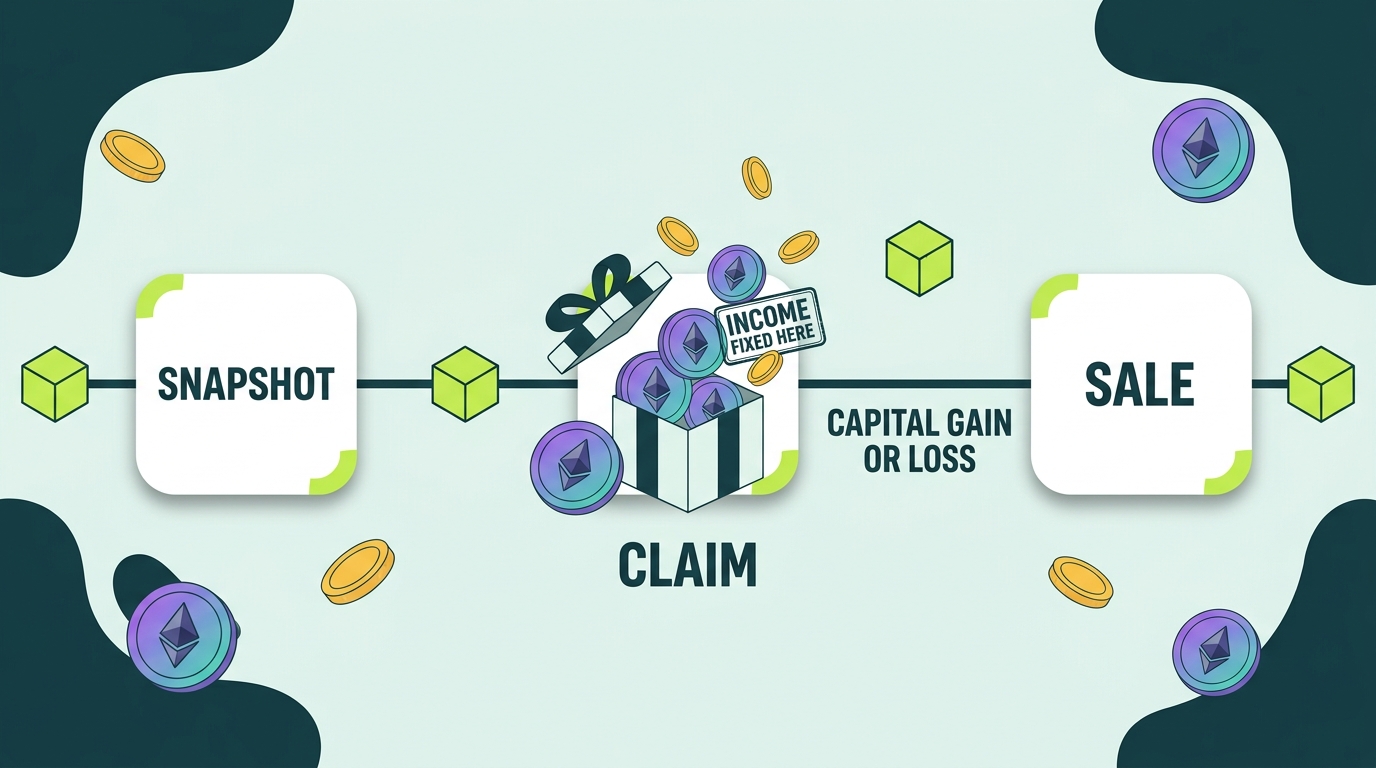
Ethereum DeFi invented the retroactive airdrop: UNI to early Uniswap users, ARB to Arbitrum users, ENS to name holders, and a long tail since. The tax rule, per Rev. Rul. 2019-24 and consistent guidance after it, is blunt: airdropped tokens are ordinary income at fair market value when you gain dominion and control.
For claim-based drops, which is most of them, dominion and control arrives when you claim, not when the snapshot was taken and not when the announcement pumped your Discord. The claim-date value is your income, and it simultaneously becomes your cost basis, so later movement is capital gain or loss from there.
The trap is the crash after the claim. Claim 1,000 tokens at $8 and you have $8,000 of ordinary income, locked. If the token slides to $2 before you sell, you now hold an unrealized $6,000 capital loss that can offset capital gains but cannot undo the $8,000 of income, since capital losses net against ordinary income only $3,000 per year. People who claimed hot airdrops and diamond-handed them into the floor have paid real tax on vapor. The clean play for anyone not committed to holding: claim and sell promptly, so income and proceeds roughly match and no gap opens.
Unclaimed drops sitting in a claim contract are generally not yet income, which gives you timing control; claiming in a low-income year is legitimate planning. Points programs that later convert to tokens follow the same logic, with income at the moment tokens become claimable and controlled.
Broker Reporting in 2026: What the IRS Sees and What It Does Not
The reporting landscape split in two, and DeFi users need to know exactly where the line sits.
Custodial exchanges report. Form 1099-DA is live: Coinbase, Kraken, and other custodial brokers reported gross proceeds for 2025 transactions on forms delivered in early 2026, with cost basis reporting phasing in for 2026-acquired assets. Cash out DeFi profits through an exchange and that sale is on a form the IRS also receives.
DeFi does not report. The regulation that would have treated DeFi front-ends as brokers was repealed by Congress under the Congressional Review Act in April 2025. Uniswap, Aave, and the protocols and interfaces around them file nothing about your swaps, pools, loans, or claims.
Read that gap correctly. It does not mean on-chain activity is invisible; the chain is a public ledger, and IRS analytics contractors read it fine. It means no third party is computing your DeFi numbers for you, and when your reported 1099-DA cash-outs arrive with no basis and no history behind them, the story connecting years of unreported on-chain activity to that reported exit is yours to tell with your own records. Large reported proceeds sitting on top of thin filed history is precisely the mismatch that automated matching flags.
Wallet-by-Wallet Basis: The Rule DeFi Users Feel Most
Since January 1, 2025, Rev. Proc. 2024-28 requires cost basis tracking per wallet or account, ending the era of one universal basis pool across everything you own. For an exchange-only user this is a bookkeeping detail. For a DeFi user it is a daily constraint, because DeFi is nothing but assets moving between wallets, protocols, and chains.
Every hop matters now. ETH moved from your vault wallet to your hot wallet must carry specific basis lots to the new wallet in your records. LP exits, reward claims, unwraps, and bridge withdrawals all deposit assets somewhere, and that somewhere needs coherent lot-level records. Disposals are then matched against lots in the wallet that made them, using FIFO or specific identification within that wallet; our per-wallet basis guide and FIFO versus HIFO comparison cover the mechanics.
The failure mode is the basis-less asset: a token that surfaces in a wallet with no recorded history, which software then books at zero basis, converting its entire value into phantom gain at sale. Years of DeFi activity imported carelessly produce these by the dozen. Reconciling transfers so every asset arrives with its history intact is unglamorous work and the highest-leverage hour in all of DeFi tax prep. If your imports are showing zero-basis assets and negative balances, that is a solvable mess, and it is one we untangle constantly; book a 15-minute call and bring the wallets as they are.
How to Report Ethereum DeFi: Step by Step
- Import every wallet on every chain into crypto tax software with strong DeFi support, including retired wallets and L2s.
- Classify the gray areas deliberately. LP entries and exits, WETH wrapping, lending deposits: choose conservative or aggressive, set the software to match, and document the choices.
- Verify swaps and disposals. Spot-check the largest trades for correct basis, proceeds net of fees, and holding periods.
- Verify income items. Interest accruals, collected v3 fees, rewards, and airdrops should appear as ordinary income at receipt-date values, with matching basis created.
- Hunt zero-basis assets and broken transfers. Reconcile every wallet-to-wallet move so basis travels; this is where most phantom gains hide.
- Reconcile 1099-DA forms from any custodial exchange against your records so reported proceeds match filed proceeds.
- File it. Capital events on Form 8949 and Schedule D, ordinary income on Schedule 1 or Schedule C as applicable, and yes on the digital asset question.
Common Ethereum DeFi Tax Mistakes
Treating Token-to-Token Swaps as Untaxed
Still the most common error in crypto. Every swap is a disposal, dollars or no dollars.
Deducting Impermanent Loss From a Dashboard
IL is unrealized until you exit the pool. Analytics numbers are not tax numbers.
Forgetting That Claimed Airdrops Were Income at Claim
The income was fixed on claim day at claim-day value. Selling later at a loss creates a capital loss; it does not erase the income.
Missing the Liquidation as a Disposal
Liquidated collateral was sold, by force, at market. The gain on appreciated collateral is reportable in the liquidation year, penalty and heartbreak notwithstanding.
Flip-Flopping Gray-Area Treatments
Conservative on entries, aggressive on exits, whichever is cheaper each time: this pattern converts defensible ambiguity into indefensible inconsistency.
Ignoring Basis Transfers Between Wallets
Post-2025, basis lives per wallet. Unreconciled transfers create zero-basis assets and phantom gains that surface at the worst time, on your biggest sale.
Your Ethereum DeFi Tax Checklist
- Import every wallet and chain, including L2s and abandoned addresses.
- Choose and document positions on LP entries/exits, WETH wrapping, and lending deposits.
- Verify every swap booked as a disposal with fee-adjusted numbers.
- Confirm interest, fees, rewards, and airdrops recognized as income with basis created.
- Check claimed airdrops valued at claim date, not snapshot or sale date.
- Review any liquidations as forced disposals with correct gain or loss.
- Reconcile all wallet transfers so basis travels wallet to wallet.
- Match 1099-DA forms from exchanges against on-chain history.
- Harvest realized losses deliberately, including underwater pools, before year-end.
- Archive protocol and explorer data as your audit file.
Bottom Line
Ethereum DeFi taxation is three familiar rules wearing unfamiliar clothes: disposals are taxed, income is taxed, and everything else needs a defensible reason to be neither. Swaps and liquidations sit firmly in the first bucket, interest and airdrops in the second, borrowing in the third, and liquidity pools and wrapping in the contested space between, where consistency and documentation are the only real protection. Since the broker-rule repeal, nobody reports any of it for you, which makes your wallet records the entire case.
If your DeFi history spans years of pools, loans, claims, and bridges that no one ever reconciled, we can turn it into clean, CPA-ready numbers and defensible positions on the gray areas. Book a 15-minute call with a crypto tax specialist, or reach out to our team for a full DeFi review, and see our Ethereum tax guide for the complete picture.
Related Reading
- Ethereum Tax Guide: The Complete Picture
- Ethereum Staking Taxes
- Liquid Staking and Restaking Taxes: stETH, EigenLayer & More
- Ethereum Gas Fees and Taxes
- Ethereum NFT Taxes: OpenSea, Blur & the 28 Percent Question
- NFT & DeFi Taxes: Liquidity Pools, Staking, and Lending
- Form 1099-DA Explained
- Per-Wallet Cost Basis Under Rev. Proc. 2024-28
Frequently Asked Questions
Are Uniswap swaps taxable?
Yes, every one. Swapping one token for another is a disposal of the token you gave up, taxed as a capital gain or loss against its cost basis, measured at fair market value at the time of the swap. The token you receive takes a new basis equal to that value. There is no same-kind exception for crypto.
Is adding liquidity to a pool a taxable event?
It is unsettled. The conservative view treats depositing two tokens for an LP position as a disposal of both tokens, realizing gain or loss immediately. The aggressive view treats it as a nonrecognition event, like a contribution, with tax deferred until you exit. The IRS has not ruled directly. Most tax software defaults to the conservative treatment, and whichever position you take should be applied consistently and documented.
How are Uniswap v3 positions taxed differently?
Mechanically, a v3 position is an NFT that represents your specific price-range position. The open tax questions are the same as v2: is entering a disposal, is exiting a disposal. The NFT wrapper adds record-keeping complexity because fees accrue inside the position and the position itself can be transferred or sold, which is unambiguously a disposal.
Is impermanent loss tax deductible?
Not while you hold the position. Impermanent loss is an unrealized change in the composition and value of your pooled assets. It only becomes a deductible capital loss, or taxable gain, when you withdraw from the pool and dispose of assets, or otherwise realize the position. Watching a dashboard show IL deducts nothing.
Is interest from Aave or Compound taxable?
Yes. Interest earned from lending crypto is ordinary income at fair market value as it accrues to you or when you gain control of it, depending on the mechanism. Receipt-token designs like aTokens that grow in balance create income as the balance grows; exchange-rate designs like cTokens raise timing questions that most software resolves at redemption or accrual. The income also becomes basis in what you received.
Is borrowing against my crypto taxable?
No. Taking a loan is not income and posting collateral you still own is not a disposal. That is the whole appeal of borrowing against ETH instead of selling it. The cliff is liquidation: if the protocol seizes and sells your collateral to repay the loan, that is a forced disposal of your collateral, and you realize gain or loss on it whether you wanted to or not.
Is wrapping ETH into WETH a taxable event?
Unsettled, but the widely used position is no. WETH is a 1:1 claim on ETH with no economic difference, and most practitioners and most software treat wrapping and unwrapping as nonevents where basis and holding period carry over. The conservative counterargument says any token-for-token exchange is a disposal. Pick a treatment, apply it everywhere, and document it.
Are DeFi airdrops like UNI or ARB taxable?
Yes. Airdropped tokens are ordinary income at fair market value when you gain dominion and control, which for claim-based drops means when you claim. That value becomes your cost basis, and later price moves are capital gains or losses from there. A token that crashes after you claim does not reduce the income you already recognized.
Do DeFi protocols send me a 1099?
Generally no. Congress repealed the DeFi broker reporting rule in April 2025, so decentralized front-ends and protocols are not filing Form 1099-DA. Custodial exchanges are. Your on-chain DeFi activity is unreported by third parties, which makes your own records the only complete account, and the tax is owed either way.
How does wallet-by-wallet basis tracking affect DeFi?
Since January 1, 2025, Rev. Proc. 2024-28 requires tracking cost basis per wallet rather than across all wallets in one pool. DeFi punishes sloppy tracking because assets constantly move between wallets, protocols, and chains. Every transfer must carry its basis, and every LP exit, claim, and unwrap must land in the right wallet's records.
What happens if I get liquidated on Aave?
The protocol sells enough of your collateral to repay debt plus a penalty. That sale is your disposal: proceeds equal the debt discharged plus anything returned, basis is your original basis in the collateral, and the gain or loss is yours to report. Liquidations of long-held, appreciated collateral can create large gains in a year when you feel like you lost money.
How do I report DeFi on my tax return?
Capital events, including swaps, LP exits under the conservative view, and liquidations, go on Form 8949 and Schedule D. Interest, rewards, and airdrops are ordinary income, typically Schedule 1 for individuals or Schedule C if you operate as a business. Check yes on the digital asset question. Software builds the raw numbers from wallet imports; your job is verifying its DeFi handling.