
How are XRP ETFs taxed? The major spot XRP ETFs are grantor trusts, which means the tax law looks straight through the fund and treats you as owning a fractional pile of XRP. Selling shares is a normal capital gain or loss, reported on a familiar 1099-B. But the look-through cuts both ways: when the trust sells XRP to pay its own sponsor fee, you are treated as the seller, and those phantom fee sales land on your tax forms every year whether you traded or not. And in exchange for the convenient wrapper, you pick up something direct XRP holders do not have: the wash sale rule.
The funds arrived fast. After the SEC and Ripple dropped their appeals in August 2025 and the securities cloud finally cleared, issuers raced to market. The REX-Osprey XRP ETF (XRPR) opened the category in September 2025, the Canary XRP ETF (XRPC) posted one of the biggest ETF debuts of the year that November, and by mid-2026 seven US-listed spot XRP funds were trading. Millions of investors now hold XRP through a brokerage ticker, and most assume the taxes work exactly like a stock fund. They are close, and the differences are precisely where returns go wrong.
This guide covers XRP ETF taxes end to end for 2026: the fund lineup and which structure each uses, how grantor trust treatment actually works, the sponsor-fee micro-sales and the tax letters that decode them, 1099-B versus 1099-DA, the wash sale asymmetry between shares and coins, retirement account placement, and a straight comparison of ETF shares against holding XRP directly. It is one piece of our complete XRP tax guide, alongside our guides to selling XRP, Flare airdrop taxes, and XRP staking and lending taxes.
Disclaimer: This guide is for informational purposes only and is not tax or legal advice. Cryptocurrency rules change quickly. Always consult a qualified CPA about your specific situation.
The 2026 XRP ETF Lineup and Why the Structure Matters
Every fund in the table below gives you XRP price exposure through a brokerage account. Not every fund gets there the same way, and the legal structure drives the tax treatment.
| Fund | Ticker | Launched | Structure |
|---|---|---|---|
| REX-Osprey XRP ETF | XRPR | September 18, 2025 | 1940 Act fund (RIC) |
| Canary XRP ETF | XRPC | November 13, 2025 | Grantor trust |
| Bitwise XRP ETF | XRP | November 20, 2025 | Grantor trust |
| Franklin XRP ETF | XRPZ | November 24, 2025 | Grantor trust |
| Grayscale XRP Trust ETF | GXRP | November 24, 2025 | Grantor trust |
| 21Shares XRP ETF | TOXR | December 1, 2025 | Grantor trust |
A few notes on the lineup. XRPC’s debut on Nasdaq posted the highest first-day volume of any ETF launched in 2025, a signal of how much pent-up demand the lawsuit years had bottled. Bitwise landed the ticker everyone wanted: XRP itself, trading on the NYSE. Grayscale’s GXRP followed the GBTC playbook, uplisting an existing private trust to an exchange-traded wrapper. And by July 2026 the roster had grown to seven US-listed spot funds, with fee competition pushing sponsor fees down and several issuers running waiver promotions on early assets.
The structural outlier is XRPR. It launched first precisely because it took a different regulatory path: a 1940 Act fund, taxed as a regulated investment company, that gains XRP exposure through holdings that can include a Cayman subsidiary and other instruments rather than a simple pile of spot XRP. RICs distribute income to shareholders and can generate ordinary income distributions in ways grantor trusts do not. If you hold XRPR, read its tax documents specifically; the grantor trust mechanics in the rest of this guide describe the other funds.
Everything that follows focuses on the grantor trust majority, because that is where nearly all the assets sit and where the distinctive tax quirks live.
Grantor Trusts: Why You Own XRP Whether You Know It or Not
A grantor trust is transparent for tax purposes. The IRS does not see a fund that owns XRP and shareholders who own the fund. It sees you, directly owning a pro rata share of every XRP in the trust, with the trust as a disregarded wrapper. Your shares are just the receipt.
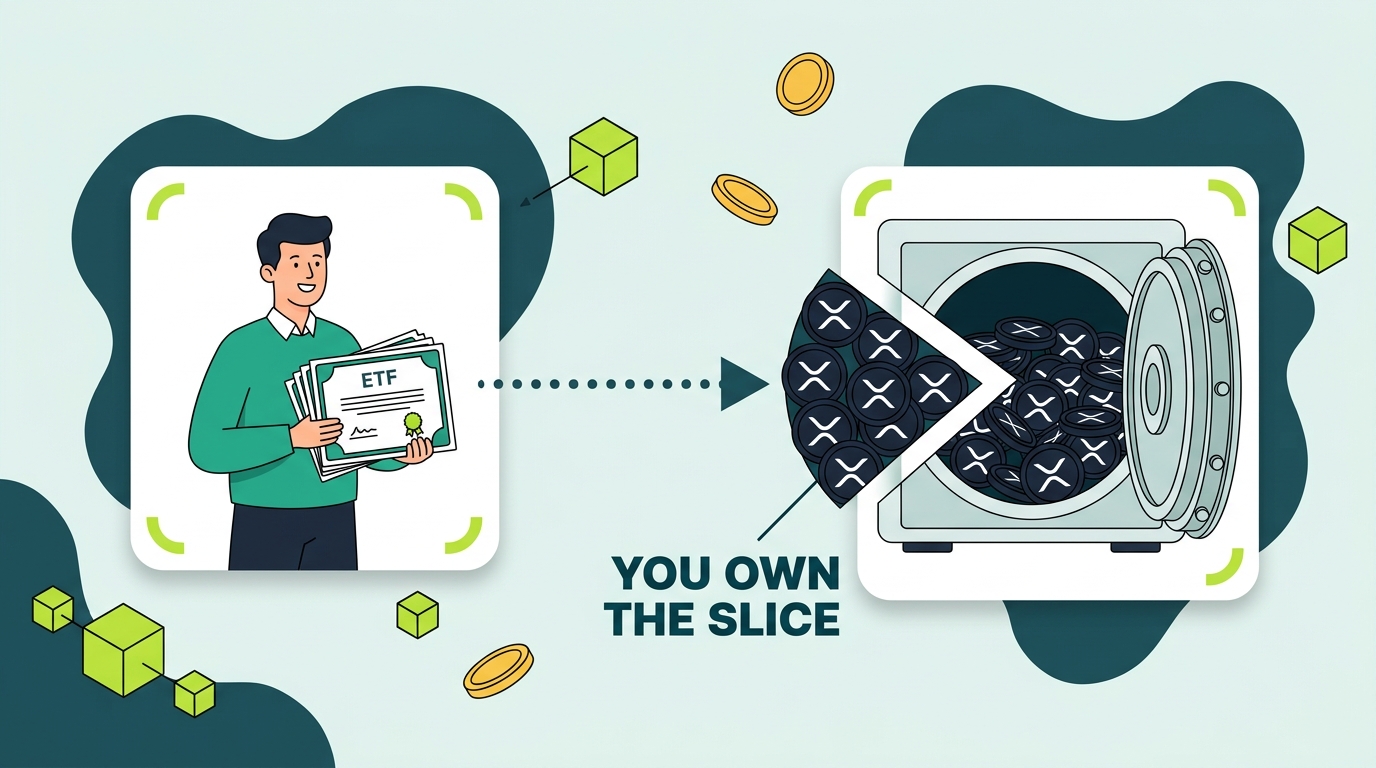
Three consequences fall out of the look-through:
Selling shares is selling XRP. Your gain or loss is proceeds minus basis. Short-term at ordinary rates up to 37% if held a year or less, long-term at 0%, 15%, or 20% if held longer, plus 3.8% NIIT for high earners. For 2026, the long-term brackets run 0% up to $49,450 of taxable income for single filers ($98,900 married filing jointly), 15% up to $545,500 ($613,700 MFJ), and 20% above. The full bracket tables and worked examples live in our selling XRP guide; the math is identical, only the reporting plumbing differs.
The trust’s transactions are your transactions. When the trust sells XRP for any reason, each shareholder is treated as selling a fractional slice. In practice the trusts do not trade; they sit on XRP. The one recurring exception is the sponsor fee, and it gets its own section below because it generates the strangest lines on your tax forms.
No distributions, no dividends, no K-1s. Grantor trusts of this type do not pay dividends and do not issue Schedule K-1s. Your only taxable events are share sales and the flow-through expense sales. Compared to the RIC structure, the grantor trust is quieter, right up until you meet the fee sales.
The wrapper is disregarded, the XRP is not. Every tax consequence of a spot XRP ETF flows from that one sentence.
Sponsor-Fee Micro-Sales: The Phantom Transactions on Your 1099-B
Spot XRP ETFs charge a sponsor fee, generally a few tenths of a percent per year, accrued daily and paid in kind: the trust periodically sells a small amount of XRP to cover it. Under grantor trust look-through, every one of those sales is partly yours. You are treated as having sold your fractional share of the XRP the trust disposed of, at the price it got, on the date it sold.
The result is a stack of tiny transactions you never initiated. Hold shares of a spot XRP fund for a full year and your broker’s tax package will show a series of small proceeds entries, often one per month, labeled with the fund’s name. Investors see them and panic, assuming their account was hacked or their shares were partially liquidated. Neither. It is the fee, expressed the only way a look-through structure can express it.
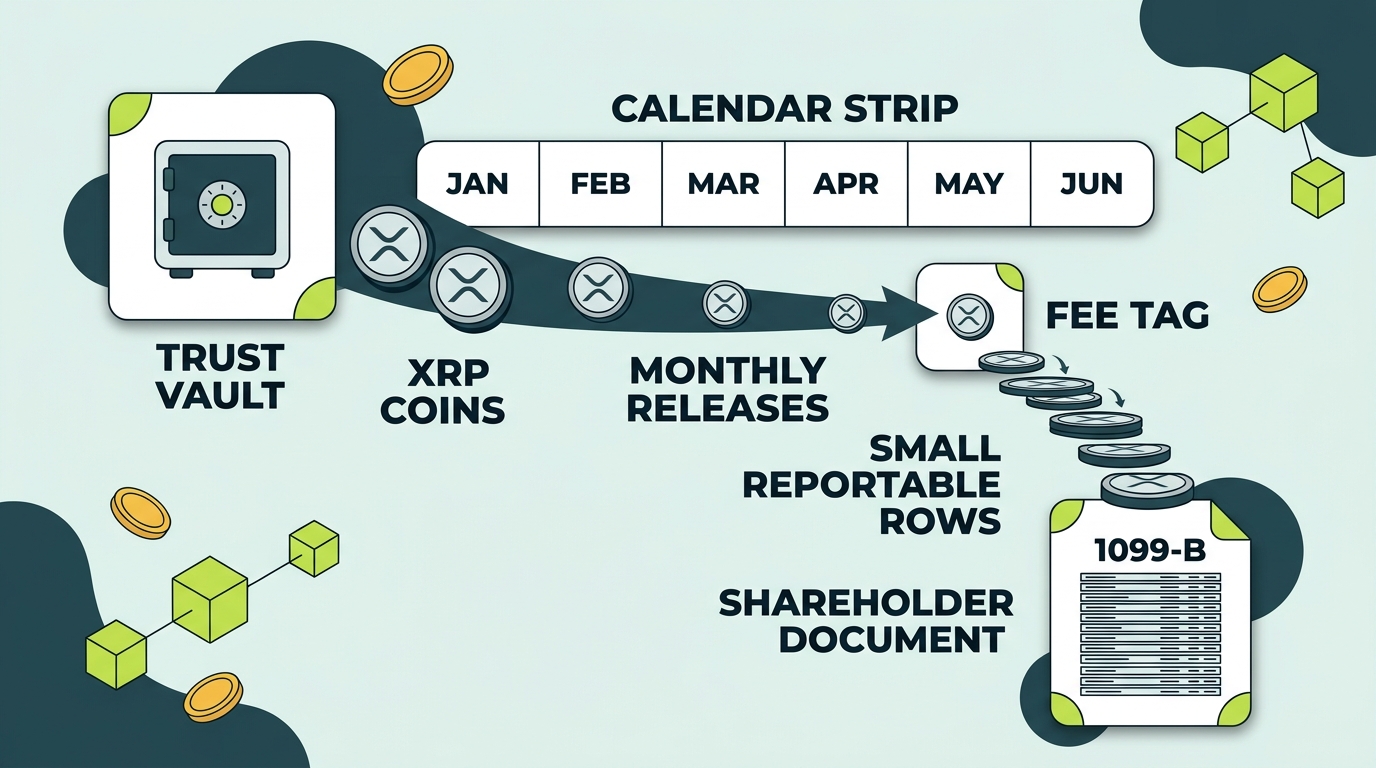
Here is the part that actually requires work. Brokers report the gross proceeds of each expense sale but frequently leave the basis blank, because your allocable basis depends on when you bought your shares and at what price. Each fund publishes a year-end grantor trust tax information letter with per-share tables: XRP quantities sold, proceeds per share, and the factors needed to compute your allocable basis for each sale. You, your software, or your CPA works through the table to produce a gain or loss for each line.
A Year of Fee Sales on a $50,000 Position
Ana buys $50,000 of a spot XRP ETF in January and holds all year. The fund’s sponsor fee runs 0.35%, so roughly $175 of her position is sold off across twelve monthly expense sales. Each sale’s proceeds are reported on her 1099-B; her allocable basis in each slice, computed from the tax letter, is nearly identical to the proceeds because the XRP was held briefly at the trust level relative to her purchase. Her net taxable result is a few dollars of gain. The tax cost is trivial. The reporting obligation, twelve lines on Form 8949 with basis she has to supply, is not optional.
Two practical notes. First, the gain or loss on expense sales is usually tiny relative to the position, because the trust sells XRP that has moved only modestly since your purchase date on an allocable basis. Do not fear the tax; handle the paperwork. Second, do not report zero basis on these lines just because the broker’s box is blank. Zero basis converts a few dollars of true gain into the full proceeds as gain. Small numbers, wrong principle, and across years of holding it compounds.
1099-B vs 1099-DA: Two Reporting Worlds
One of the least appreciated differences between ETF shares and direct XRP is which reporting system you live in.
ETF shares live on Form 1099-B. They are traditional securities. Your broker tracks your basis, reports covered-lot sales with both proceeds and basis, applies wash sale adjustments automatically, and delivers a consolidated tax package the IRS has matched against returns for decades. The system is mature, and for buy-and-hold investors it mostly just works.
Direct XRP lives on Form 1099-DA. The digital asset reporting form debuted for 2025 transactions, and it is a system in mid-construction: gross proceeds reporting came first, basis reporting only applies to coins acquired on the same platform starting January 1, 2026, and transferred-in coins arrive with no basis at all. Long-time XRP holders who migrated coins across platforms during the delisting era face a genuine reconstruction project, which we cover in depth in the selling XRP guide and our 1099-DA explainer.
For investors who want XRP exposure with the least reporting friction, this is the ETF route’s quiet superpower: your basis problem is the broker’s problem. No wallet imports, no transfer matching, no Rev. Proc. 2024-28 allocations, no XRPL history archaeology. The trade-off is everything else in this guide.
The Wash Sale Rule: Where the Wrapper Bites Back
Here is the asymmetry every XRP investor should tattoo somewhere visible. Directly held XRP is property, and the wash sale rule in Section 1091 does not currently apply to it. Sell XRP at a loss, rebuy it the same hour, keep the loss. ETF shares are securities, and the wash sale rule applies to them. Sell XRPC at a loss, rebuy XRPC within 30 days before or after, and the loss is disallowed, rolled into the basis of the replacement shares instead. Your broker tracks this automatically and prints the disallowance on your 1099-B.
Same underlying asset. Same price chart. Opposite loss-harvesting rules, purely because of the wrapper.
The interesting questions live between the extremes:
Fund to fund. Selling XRPC at a loss and buying XRPZ the same day raises the “substantially identical” question. The statute disallows losses when you reacquire substantially identical securities, and two grantor trusts holding nothing but XRP are uncomfortably similar even with different issuers, fees, and exchanges. There is no direct authority on crypto fund pairs. Many advisors treat fund-to-fund swaps as defensible today, pointing to the different issuers and trust agreements; conservative ones wait 31 days or change exposure types. If the loss is large, get advice before you trade.
ETF to coin. Selling ETF shares at a loss and buying XRP on an exchange is the cleaner harvest. Spot XRP is not a security, and a court would have to stretch “substantially identical securities” across the property line to disallow it. This is the route many advisors prefer for meaningful harvests: bank the loss on the securities side, hold the exposure on the property side, and mind the reporting differences you just adopted.
Coin to ETF. Selling directly held XRP at a loss and immediately buying ETF shares does not even need the analysis above under current law, because the wash sale statute does not reach the property you sold. The loss stands. Congress has proposed closing the digital asset wash sale gap repeatedly, so document harvests carefully and check the state of the law before repeating old playbooks.
For the broader framework, including the pending legislative proposals, see our crypto wash sale guide.
XRP ETFs in IRAs and 401(k)s: Where the Complexity Evaporates
Every complication in this guide so far, the expense-sale line items, the tax letters, the wash sale tracking, the NIIT layer, shares one property: it only exists in a taxable account. Put the same ETF shares inside a retirement account and all of it disappears.
- Traditional IRA or 401(k). No capital gains when you sell shares. No expense-sale reporting; the trust’s fee sales happen, but nobody computes them because nothing inside the account is currently taxed. Withdrawals in retirement are ordinary income, whatever the source.
- Roth IRA or Roth 401(k). Same silence during the holding period, and qualified withdrawals are tax-free entirely. A volatile asset with a decade of runway inside a Roth is the most tax-efficient version of XRP exposure that exists under current law.
- No wash sale tracking, no NIIT, no 8949 lines. The account is the taxpayer’s shelter; the forms simply do not apply.
This is why ETFs, not coins, are the standard way to hold crypto exposure in retirement accounts. Direct XRP requires a specialized self-directed IRA custodian, with its own fees and custody questions. ETF shares drop into the brokerage IRA you already have, in two clicks, and convert the messiest tax profile in this guide into no profile at all.
Placement logic follows from the profiles. If you hold XRP exposure in both account types, the high-turnover trading belongs in the IRA where short-term gains are invisible, and the patient long-term stack can sit in taxable where it eventually earns the 0/15/20 rates and a potential basis step-up. And a caution for the enthusiastic: do not harvest a taxable ETF loss and repurchase the same fund in your IRA within the window. That specific combination permanently destroys the loss, per the warning above.
ETF Shares vs Holding XRP Directly: The Tax Scorecard
Both routes give you XRP price exposure. Here is how they compare on everything the IRS cares about:
| Dimension | Spot XRP ETF shares | XRP held directly |
|---|---|---|
| Legal character | Security (grantor trust shares) | Property |
| Sale reporting | Form 1099-B, broker-tracked basis | Form 1099-DA, gross proceeds; basis only for same-platform 2026+ buys |
| Capital gains rates | Same: 0/15/20 long-term, ordinary short-term | Same: 0/15/20 long-term, ordinary short-term |
| Wash sale rule | Applies | Does not apply under current law |
| Phantom taxable events | Sponsor-fee expense sales each year | None from holding |
| Ongoing fee drag | Sponsor fee, a few tenths of a percent | None (network fees negligible) |
| Basis tracking burden | Broker handles it | Yours: per-wallet under Rev. Proc. 2024-28 |
| IRA eligibility | Any brokerage IRA | Specialized self-directed custodian only |
| On-ledger utility | None: no payments, no DEX, no airdrop eligibility | Full: spend, trade, earn (see our XRPL guides) |
| Loss harvesting | 30-day windows, substantially identical questions | Sell and rebuy immediately, loss stands |
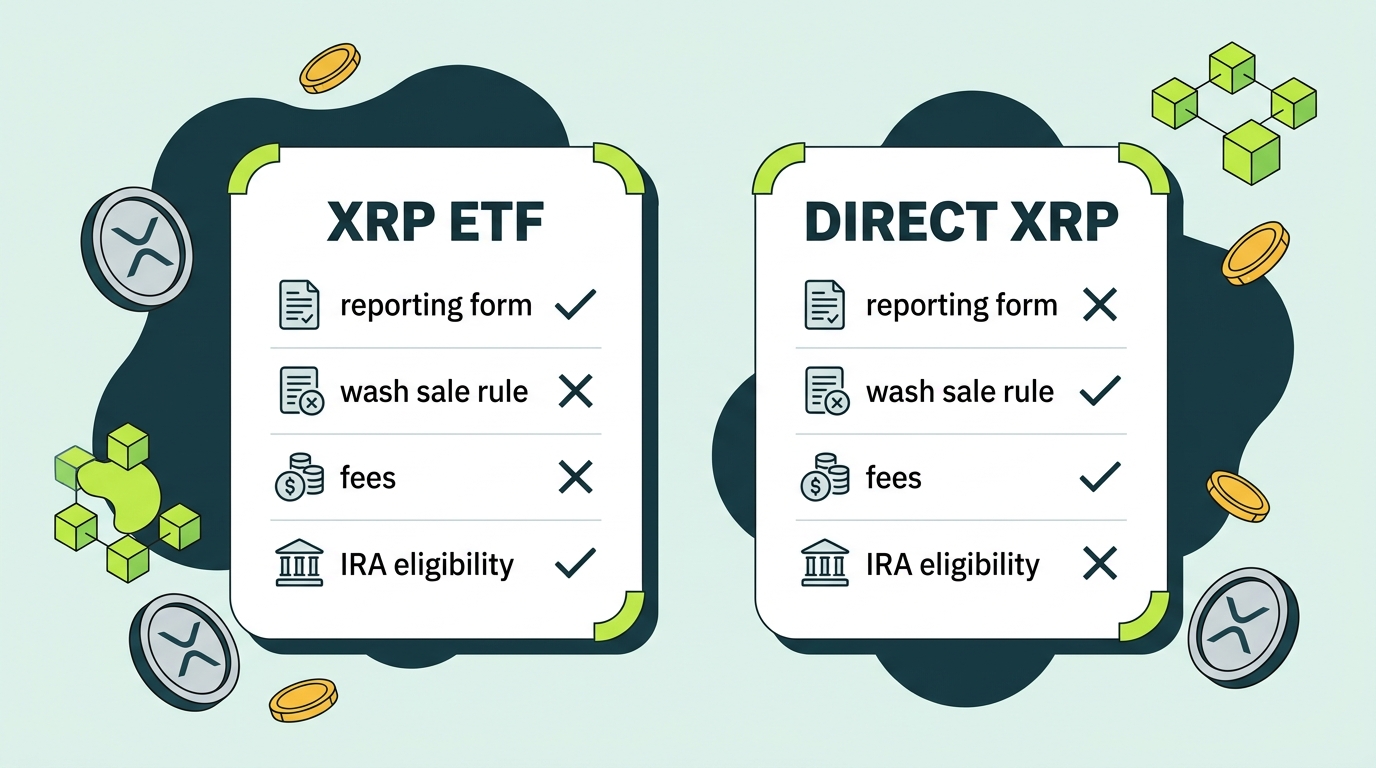
The honest summary: the ETF trades tax flexibility for reporting simplicity. If the right side of that table describes your holdings, our XRP tax guide maps everything the coin route requires. Direct XRP gives you the wash sale exemption, zero fee drag, and the full utility of the ledger, priced in record-keeping burden and 1099-DA exposure. The ETF gives you clean forms and IRA access, priced in phantom fee sales, wash sale handcuffs, and a management fee that compounds against you forever. Neither dominates. Buy-and-hold investors in retirement accounts should almost always prefer the ETF. Active harvesters and on-ledger users should almost always prefer the coin. Most serious XRP investors end up with both, deliberately placed.
One transition trap deserves its own paragraph. You cannot convert XRP into ETF shares. Retail investors cannot contribute coins to the trust; only authorized participants create shares, and even in-kind creation does not involve your personal stack. Moving from coins to shares means selling your XRP, which is a fully taxable disposal of every lot you touch. A holder with a large appreciated position from 2017 who “switches to the ETF for simplicity” can trigger a six-figure gain for the privilege. Run the number first, review your crypto cost basis options, harvest what can be harvested, and consider whether new money, rather than old coins, should be what buys the wrapper.
The Expensive Switch to Simplicity
Rob holds 100,000 XRP bought in 2017 for $20,000. In 2026, with XRP at $2.75, he sells everything to buy XRPC shares because he is tired of tracking wallets. The sale realizes a $255,000 long-term gain. At 15% plus NIIT on the portion above his threshold, the switch costs roughly $40,850 in federal tax, before state. The ETF’s simplicity is real, but it did not need to cost that: he could have moved new contributions into the ETF, held the legacy coins, and paid nothing today.
Common XRP ETF Tax Mistakes
The errors we expect to dominate the first full filing seasons of this asset class, based on a decade of Bitcoin fund precedent:
Ignoring the Expense-Sale Lines
Twelve small 1099-B entries you never initiated are still twelve reportable transactions. Leaving them off invites an automated mismatch notice over amounts too small to justify the headache.
Reporting Zero Basis on Fee Sales
The broker’s blank basis box is an invitation to compute, not a value of zero. The fund’s tax letter exists precisely to fill it.
Harvesting a Loss into the Same Fund
Selling and rebuying the same ticker inside 30 days is the textbook wash sale, and the broker will flag it automatically. The disallowed loss is not gone forever in a taxable account, but the harvest accomplished nothing this year.
Repurchasing in an IRA After a Taxable Loss
The one configuration that destroys a loss permanently. The wash sale window does not care that the accounts are different; it cares that you reacquired the position.
Assuming Coin Rules Apply to Shares
The no-wash-sale flexibility, the 1099-DA regime, the per-wallet basis rules: all of it belongs to direct XRP. Investors who read coin-focused advice and applied it to their ETF shares get the law backwards on nearly every point.
Switching Coins to Shares Without Running the Number
The wrapper swap is a taxable liquidation of your XRP. Calculate before you simplify.
Your XRP ETF Tax Checklist
- Know your fund’s structure: grantor trust for XRPC, XRPZ, GXRP, TOXR, and Bitwise’s XRP; RIC mechanics for XRPR.
- Download the grantor trust tax letter each January and compute basis for every expense-sale line.
- Report all 1099-B lines, including the phantom fee sales, on Form 8949 and Schedule D.
- Track your share lots for the one-year long-term boundary, same as any stock.
- Pause automatic purchases across all household accounts before harvesting a loss in any XRP fund.
- Never rebuy a harvested position in an IRA within the 61-day window.
- Place deliberately: ETFs in retirement accounts for silence, direct XRP in taxable for harvesting flexibility.
- Run the tax cost before converting coins to shares, and consider funding the ETF with new money instead.
- Check NIIT exposure in any year with meaningful gains from shares or fee sales.
- Keep coin-side records anyway if you hold both: the per-wallet basis rules still govern your direct XRP.
Bottom Line
XRP ETF taxes are stock-like with an asterisk on each end. The middle is familiar: buy shares, hold, sell, report capital gains on a 1099-B your broker mostly fills out for you. The asterisks are the grantor trust look-through, which makes you a fractional seller of XRP every time the trust pays its own fee, and the securities classification, which imports the wash sale rule that directly held XRP escapes. Add the IRA option, where every complication vanishes, and the real skill is placement: which version of XRP exposure belongs in which account, and what it costs to move between them. The investors who get this right decide once, deliberately, and file clean. The ones who do not will meet the expense-sale lines and the wash sale flags one notice at a time.
If you hold XRP in both wrappers, came into the ETFs from a large legacy coin position, or just want the fee-sale math done right the first time, this is exactly what we do. Count On Sheep reconciles the coin side, decodes the fund tax letters, and hands you and your preparer CPA-ready numbers. A 15-minute call with a crypto tax specialist is the fastest way to find out where you stand, or reach out to our team for a full XRP portfolio review.
Related Reading
- XRP Tax Guide: The Complete Picture
- Selling XRP Taxes: Rates, Basis, and the 1099-DA Trap
- XRP Flare Airdrop Taxes
- XRP Ledger DeFi Taxes
- XRP Staking and Lending Taxes
- Bitcoin ETF Taxes: The GBTC-Era Precedent
- Crypto Wash Sale Rule
- Form 1099-DA Explained
Frequently Asked Questions
How are spot XRP ETFs taxed?
The major spot XRP ETFs are structured as grantor trusts, so tax law treats you as directly owning your pro rata slice of the trust's XRP. Selling shares is a capital gain or loss, short-term or long-term based on your holding period, just like a stock. The twist is that the trust's own XRP sales to pay its sponsor fee flow through to you as small taxable events even when you sell nothing.
Which spot XRP ETFs exist in 2026?
The wave began with the REX-Osprey XRP ETF (XRPR) in September 2025, followed by the Canary XRP ETF (XRPC) in November 2025, the Bitwise XRP ETF (ticker XRP), the Franklin XRP ETF (XRPZ), the Grayscale XRP Trust ETF (GXRP), and the 21Shares XRP ETF (TOXR). By mid-2026 seven US-listed spot XRP funds were trading. Most are grantor trusts; XRPR uses a 1940 Act structure with different tax mechanics.
Why does my 1099-B show sales from an XRP ETF I never sold?
Those are the trust's expense sales. The trust periodically sells a small amount of XRP to pay its sponsor fee, and as a grantor trust owner you are treated as having sold your fractional share of that XRP. Your broker reports the proceeds, often as many small line items. You compute the gain or loss on each using the fund's grantor trust tax letter, and the amounts are usually tiny.
Do XRP ETFs show up on Form 1099-DA?
No. ETF shares are traditional securities, so sales are reported on Form 1099-B like any stock, generally with basis tracked by your broker. Form 1099-DA covers direct digital asset sales through crypto brokers. Staying inside the mature 1099-B system is one of the ETF route's quiet advantages over holding XRP directly.
Does the wash sale rule apply to XRP ETFs?
Yes, treat it as applying. ETF shares are securities trading on national exchanges, and brokers apply wash sale tracking to them. Sell an XRP ETF at a loss and rebuy the same fund within 30 days and expect the loss to be disallowed. Directly held XRP is property, not a security, so the wash sale statute does not currently reach it. The same exposure gets opposite treatment depending on the wrapper.
Can I sell one XRP ETF at a loss and buy a different XRP ETF the same day?
This is a genuine gray area. The wash sale rule blocks repurchasing substantially identical securities, and two grantor trusts holding nothing but XRP are uncomfortably similar even with different issuers and fees. Many advisors treat fund-to-fund swaps as defensible today; conservative ones wait 31 days or switch to direct XRP. Get advice before doing it in size.
Can I harvest a loss in an XRP ETF and buy XRP directly?
This is the cleaner move. Directly held XRP is property rather than a security, and the wash sale rule disallows losses only when you reacquire substantially identical securities. Swapping from ETF shares to on-ledger XRP changes the legal form of what you own, which is why many advisors view it as the stronger harvesting path. Document the reasoning and get advice for large positions.
How are XRP ETFs taxed inside an IRA or 401(k)?
They are not, until money comes out. Traditional accounts defer everything: no capital gains on sales, no sponsor-fee expense sales to compute, no wash sale tracking. Roth accounts eliminate the tax entirely for qualified withdrawals. Every piece of grantor trust complexity in a taxable account simply does not exist inside a retirement account, which is why ETFs are the standard way to hold XRP exposure in one.
Is converting my XRP into ETF shares taxable?
You cannot deposit your own XRP into an ETF as a retail investor, so the question usually means selling XRP and buying ETF shares. That sale is a fully taxable disposal of your XRP at fair market value, with gain or loss measured against your basis. Moving a large appreciated XRP position into a fund wrapper has a real tax cost that should be calculated before you trade.
Are XRP ETFs better than holding XRP directly for taxes?
They trade different problems. ETFs give you clean 1099-B reporting with broker-tracked basis, easy IRA eligibility, and no wallet-level record keeping, but bring sponsor-fee phantom sales, wash sale exposure, and management fees. Direct XRP currently has no wash sale rule and no fund fees, but requires wallet-by-wallet basis tracking under Rev. Proc. 2024-28 and lives in the newer 1099-DA reporting system. The right answer depends on account type and how actively you trade.
Do sponsor-fee sales really matter if the amounts are tiny?
Individually, no; a year of expense sales on a mid-size position often nets to a few dollars of gain or loss. But they must still be reported, brokers often leave the basis boxes blank, and unreported line items generate automated mismatch notices regardless of size. Fifteen minutes with the fund's tax letter, or software that ingests it, keeps your return matching what the IRS received.
Does the 3.8% net investment income tax apply to XRP ETF gains?
Yes. Capital gains from selling ETF shares and the flow-through expense-sale gains are investment income for NIIT purposes. Filers above $200,000 (single) or $250,000 (married filing jointly) modified AGI pay the extra 3.8% on top of capital gains rates.