
In the UK, you do not pay tax simply for holding crypto. You may owe Capital Gains Tax when you sell, swap, spend or gift cryptoassets, and Income Tax when you receive crypto from staking, mining, airdrops or employment. For 2025/26, CGT rates are 18% and 24%, the annual exempt amount is £3,000, and the online filing deadline is 31 January 2027.
UK crypto tax at a glance
Is cryptocurrency taxable in the UK?
Crypto is not taxed simply because you hold it. HMRC treats cryptoassets as property, not as money, so a tax charge arises only when something happens to that property. A taxable event can be a disposal for Capital Gains Tax, or a receipt that counts as income.
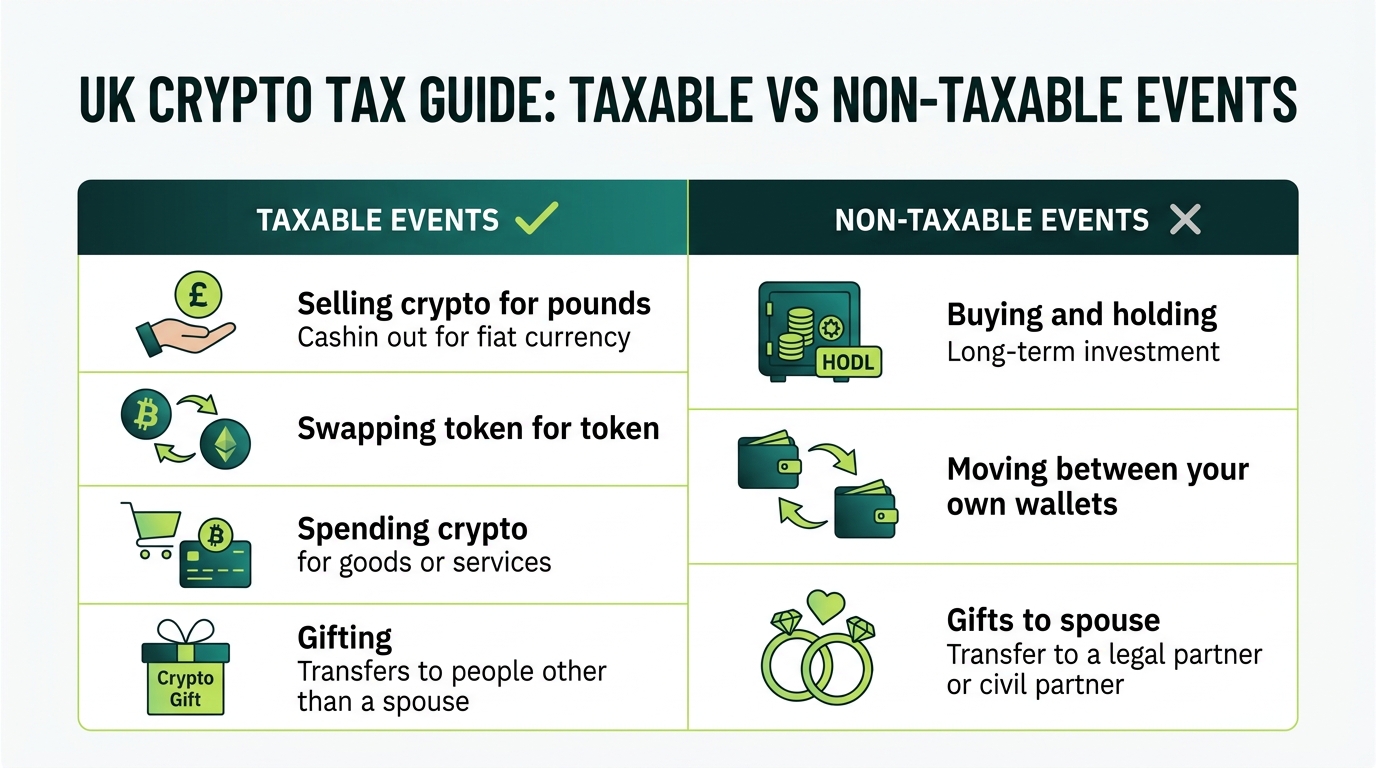
You may owe Capital Gains Tax when you sell crypto for pounds, swap one token for another, spend crypto on goods or services, or give it away to anyone other than your spouse, civil partner or a qualifying charity. You may owe Income Tax when you receive crypto from staking, mining, airdrops, or as payment for work.
Capital Gains Tax or Income Tax?
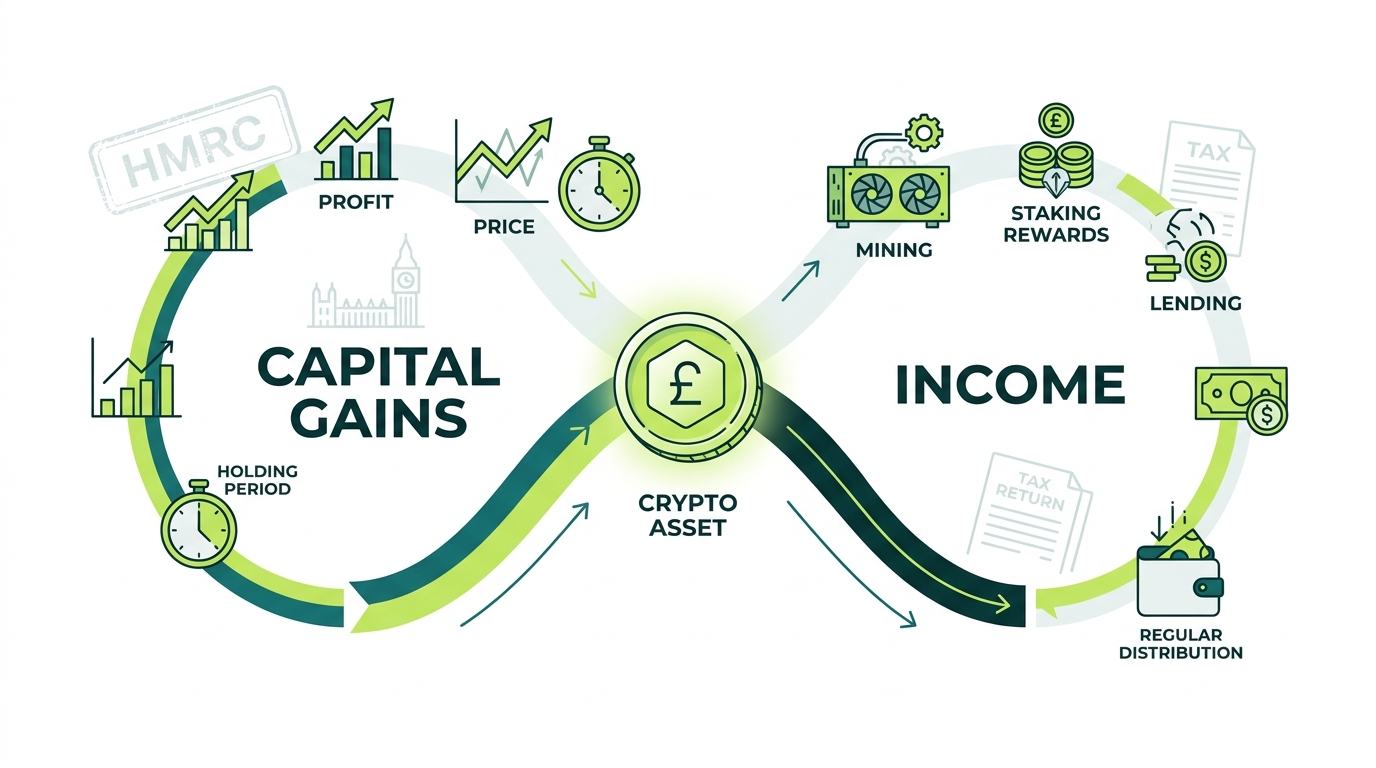
The first question for any crypto activity is which tax applies. Most ordinary investing sits under Capital Gains Tax. You buy, you hold, and when you dispose of the asset you measure the gain. Income Tax applies when crypto is earned rather than bought, for example through staking rewards, mining, airdrops received for doing something, or being paid in crypto for employment or freelance work.
HMRC only treats crypto activity as a financial trade in exceptional circumstances. Trading frequently does not by itself make you a trader. The facts of your activity decide it, so do not assume a busy account is automatically taxed as trading income.
Taxable and non-taxable events
This is where most UK crypto investors get tripped up. Use the matrix below as a fast reference, then read the detailed sections for the cases that apply to you.
CGT rates and allowances for 2025/26
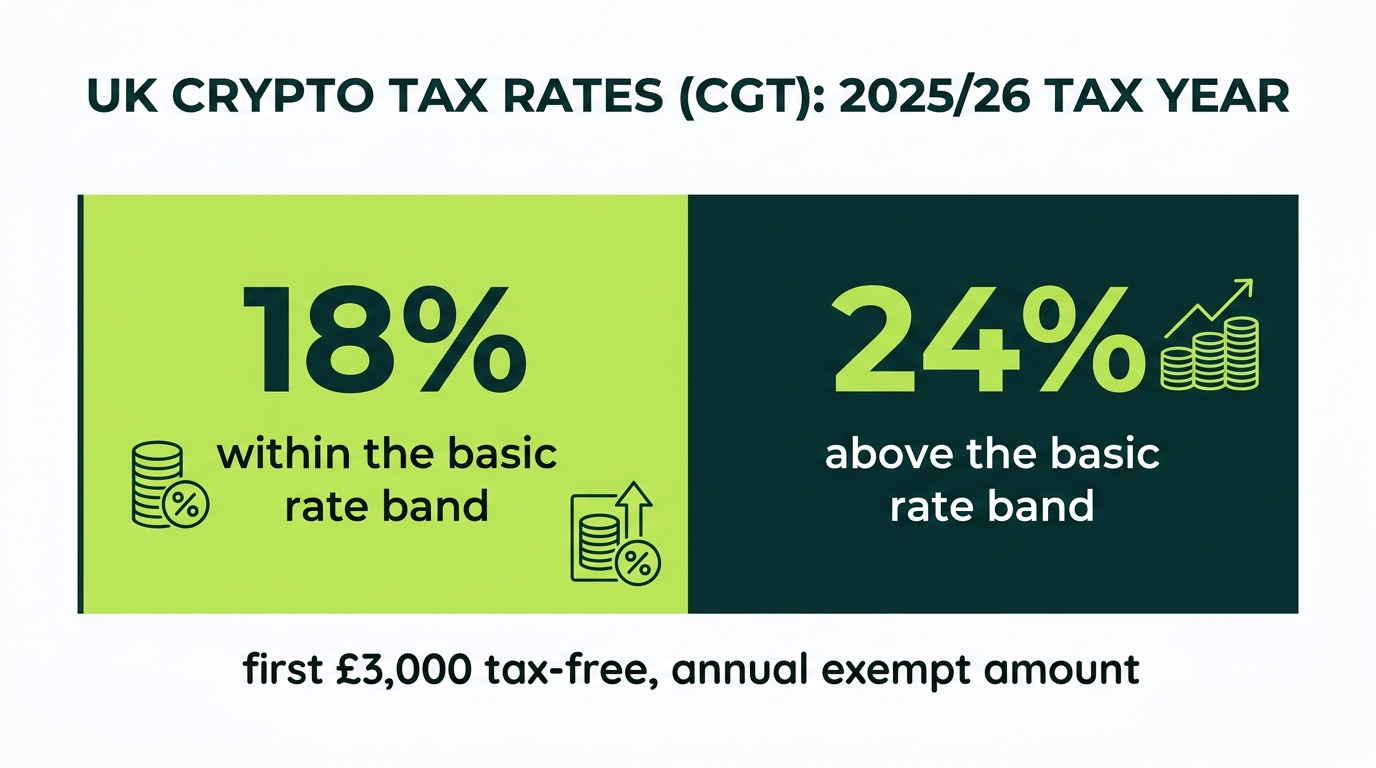
For the 2025/26 tax year, Capital Gains Tax on crypto is charged at 18% where the gain falls within your basic rate band and 24% above it. Your income for the year decides how much of any gain is taxed at each rate. The annual exempt amount is £3,000, so the first £3,000 of net gains across all your chargeable assets is tax free.
If you are a Scottish taxpayer, your Income Tax bands differ from the rest of the UK, which affects crypto you receive as income and can change how much of a gain falls in each CGT band. Do not rely on a single UK-wide income table without checking the Scottish position.
How UK crypto gains are calculated
A gain is your disposal proceeds in pounds, minus the allowable cost of what you disposed of, minus the direct costs of the transaction such as exchange fees. Where you dispose of part of a holding, you take a proportionate slice of the pooled cost. Where there is no sterling price, you convert using a consistent, defensible exchange rate at the time of the transaction.
Fees matter in two directions. A fee paid to acquire crypto adds to your allowable cost. A fee paid to dispose of crypto reduces your proceeds. If you pay a fee in tokens, paying that fee can itself be a disposal of those tokens, with its own small gain or loss.
Here is the full calculation for a basic rate taxpayer who sells some Bitcoin during 2025/26. Assume an annual salary of £40,000, leaving room in the basic rate band, and a single disposal.
If part of that gain pushed you above the higher rate threshold, the portion above the threshold would be taxed at 24% instead of 18%. Your other income for the year is what fills the basic rate band first, so a large salary leaves less room and pushes more of the gain into the 24% band. You can model your own numbers with our UK crypto tax calculator.
Section 104 pooling, same-day and 30-day rules
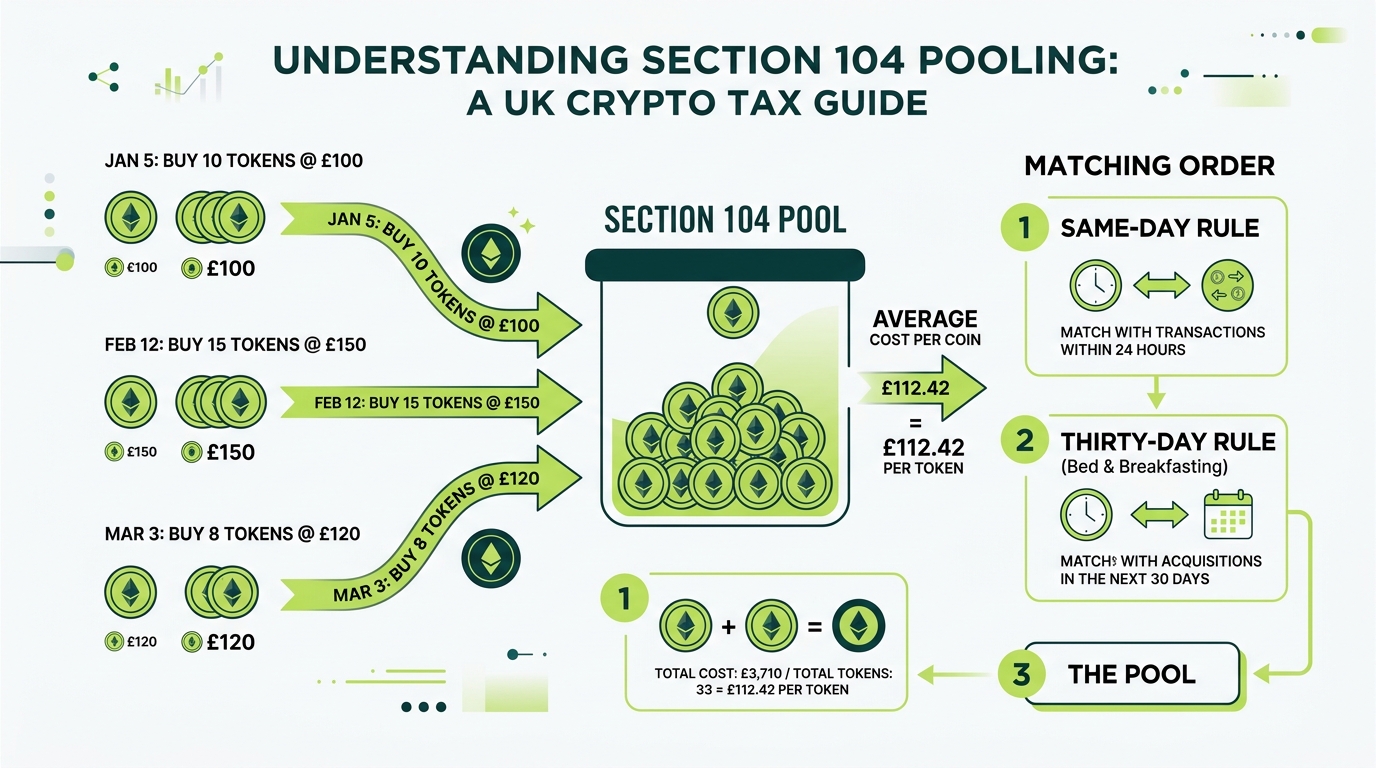
The UK does not let you simply pick which coins you sold. Instead, HMRC uses share pooling. Each token type has its own Section 104 pool that holds the total quantity and the total allowable cost. When you dispose, you match in a strict order.
- First, match against any acquisitions made on the same day.
- Next, match against any acquisitions made in the following 30 days (the bed and breakfasting rule).
- Finally, match against the Section 104 pool at its average cost.
NFTs are separately identifiable assets, so they are not pooled like interchangeable tokens. Each NFT is tracked on its own. Getting the matching order right is one of the most common places a self-prepared UK crypto return goes wrong, and it is exactly the reconstruction work we handle.
A short pooling example shows why you cannot just use the price you paid for one specific batch. Suppose you bought Ether twice, then sold part of the holding.
The 3 ETH left in the pool keep a cost of £7,800, ready for the next disposal. Same-day and 30-day acquisitions are matched before the pool, which can change the answer, and that is exactly where manual spreadsheets tend to break.
Crypto received as income
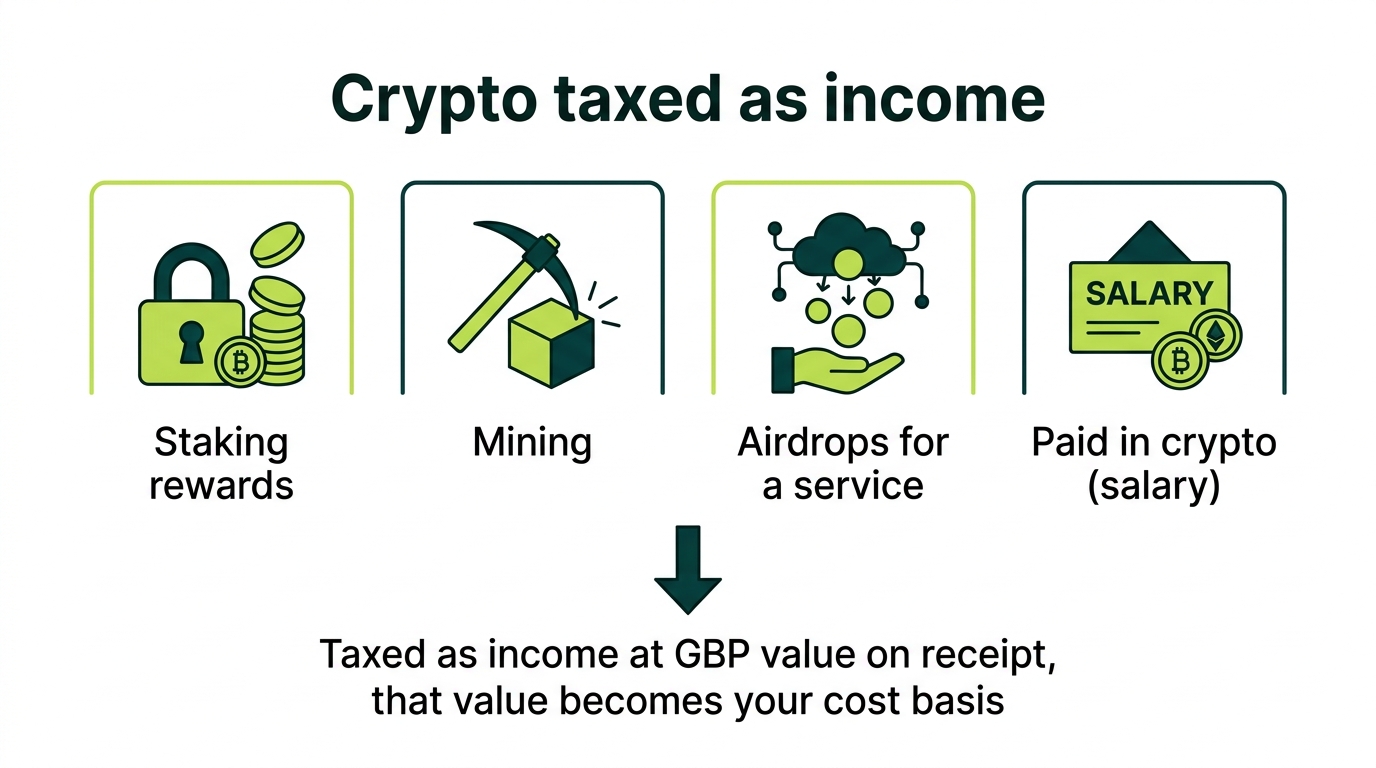
When you receive crypto for doing something, the pound value at the moment you receive it is usually income. Staking rewards that do not amount to a trade are generally taxed as miscellaneous income at their GBP value on receipt. Mining, employment paid in crypto, and freelance crypto payments are also income. Airdrops depend on the facts: an airdrop received in return for a service or activity is income, while one received for nothing may not be income on receipt but still sets your cost basis for a later disposal. There is no fixed tax-free amount for crypto income, but your allowances still matter, as we explain in how much crypto is tax free in the UK.
Whatever value is taxed as income on receipt becomes the cost basis of those coins. When you later sell or swap them, you measure the capital gain against that value, so good records prevent you being taxed twice on the same coins.
DeFi tax: the area most guides get vague about
Decentralised finance is where generic guides stop being useful, because the right answer depends on the specific transaction pattern. HMRC does not treat every deposit or withdrawal as automatically taxable. The key questions are whether beneficial ownership of your tokens actually changed, and whether the return you earn looks more like income or more like a capital return.
Lending, liquidity pools, governance rewards, auto-compounding vaults, yield-bearing tokens, collateral, liquid staking tokens, and wrapped or bridged assets each need to be assessed on their own facts. A deposit into a protocol that issues you a new token in exchange may be a disposal. A deposit that leaves you as the beneficial owner may not be. This is the single biggest accuracy gap across the UK crypto tax SERP, and it is where careful reconciliation earns its keep.
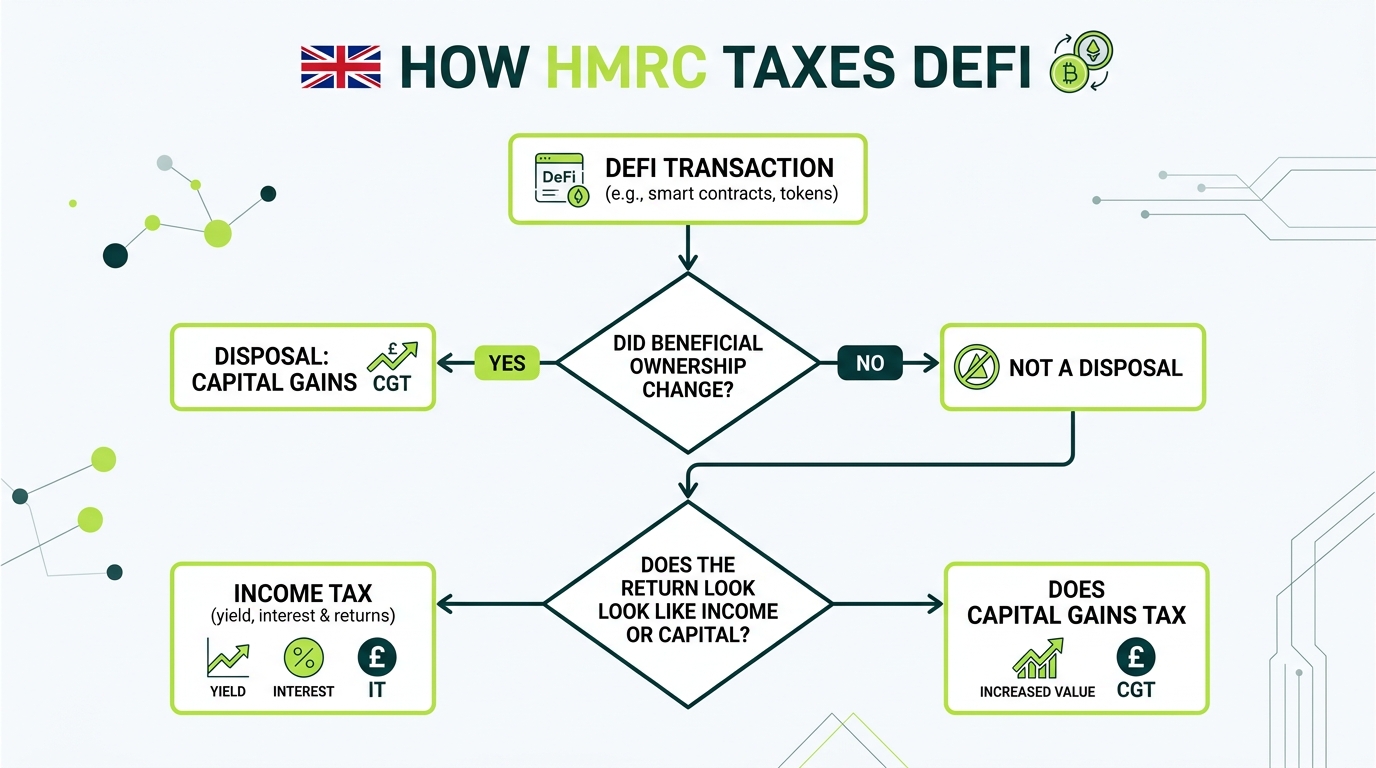
For the pattern-by-pattern detail, with worked GBP examples for lending, liquidity pools, liquid staking, wrapped tokens and yield, see our full guide to DeFi tax in the UK.
Transfers, fees and gas
Moving crypto between two wallets you own is not a disposal, because beneficial ownership has not changed. However the network fee or gas you pay to make that move can be a disposal of the tokens used to pay it. Exchange withdrawal fees, gas paid in ETH, and fees connected to an acquisition or disposal all need to be recorded so the cost basis and proceeds are right.
How NFTs are taxed in the UK
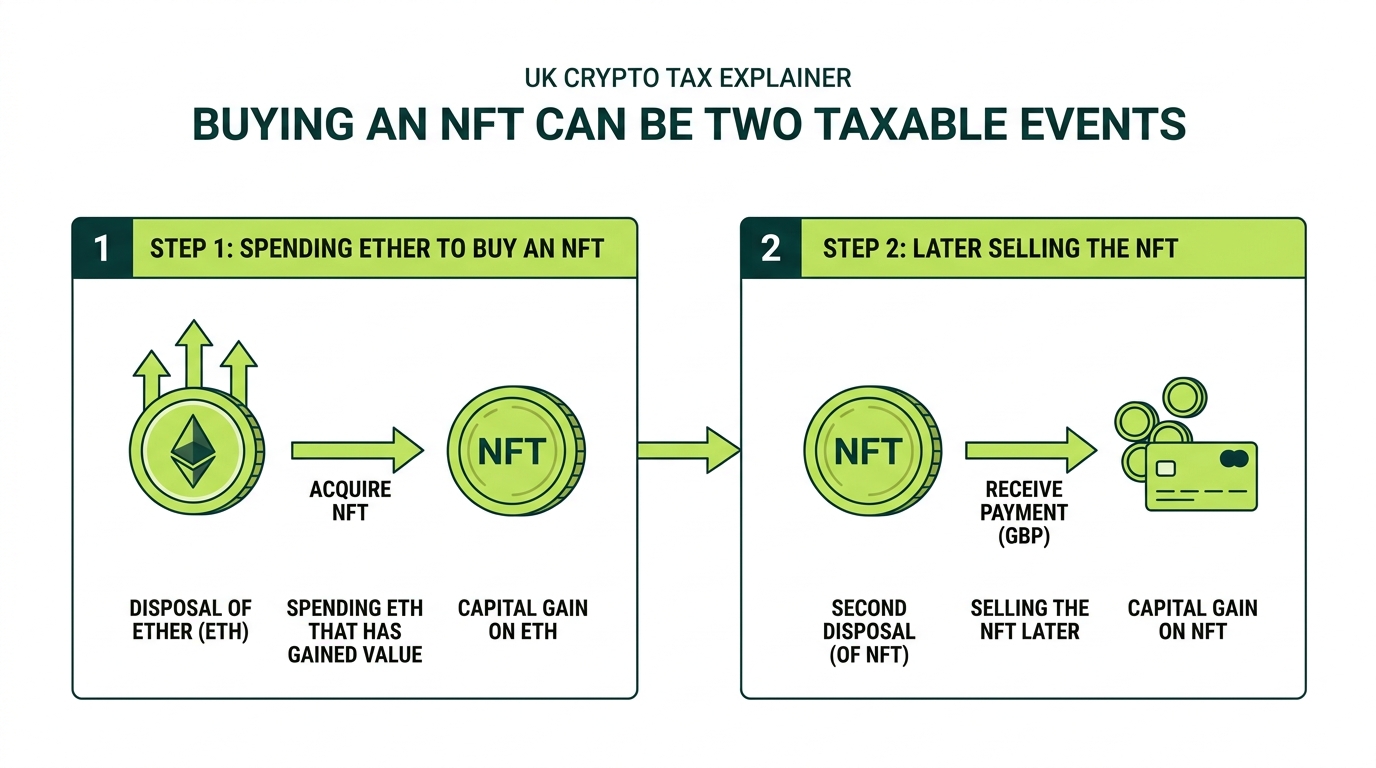
Non-fungible tokens are treated as separate, individually identifiable assets rather than pooled like ordinary tokens. Buying an NFT with crypto is itself a disposal of the crypto you spent, measured in GBP at the time. Selling or swapping the NFT later is a second disposal, with the gain measured against what the NFT cost you, including the value of the crypto used to buy it plus minting or gas fees.
Two events on one purchase is the part people miss. If you spend Ether that has risen in value to buy an NFT, you can owe Capital Gains Tax on the Ether even before the NFT does anything. Royalties or income from creating and selling NFTs as an activity can fall under Income Tax instead, depending on the facts.
Gifts, spouses and charity
Giving crypto to your spouse or civil partner does not trigger a gain. It transfers at your cost, and they take it on. Gifts to anyone else are treated as a disposal at market value, even though you received nothing, so a gain can arise. Gifts to a qualifying charity have their own treatment. Avoid the common myth that all crypto donations are automatically deductible.
Losses, scams and lost keys
Capital losses on crypto can be set against gains, which is one of the most overlooked ways to reduce a UK crypto tax bill. Lost private keys, exchange insolvency, rug pulls, fraud and worthless tokens may support a claim, often through a negligible value claim, but each needs evidence and the right process. A loss is not automatic just because crypto became inaccessible, so keep records of what happened.
Records HMRC expects you to keep
HMRC can ask you to support every figure on your return, and the responsibility to keep records sits with you, not your exchange. Many exchanges only let you download a limited window of history, and some close or lose data, so waiting until filing season to gather records is risky. For each transaction you should be able to show:
- The type of cryptoasset and the date of the transaction.
- Whether it was a buy, sell, swap, gift, or income receipt.
- The number of units and the value in pounds at the time.
- The running pooled cost for each asset.
- Bank statements and wallet addresses that tie the activity to you.
Pulling all of that together across multiple exchanges, wallets and chains, then reconciling it into one consistent ledger, is the core of what Count On Sheep does before any figure reaches your return. If you would rather hand this to a specialist, see how our UK crypto tax service works alongside your accountant.
Common UK crypto tax mistakes
- Assuming crypto to crypto swaps are tax free. Swapping one token for another is a disposal.
- Confusing the £3,000 allowance with the £50,000 proceeds reporting threshold.
- Forgetting that converting to a stablecoin is a taxable disposal.
- Ignoring small staking and airdrop income because no pounds were received.
- Picking which coins were sold instead of applying Section 104 pooling.
- Missing claimable losses from scams, worthless tokens or exchange failures.
- Treating every DeFi transaction as taxable, or none of them, instead of by pattern.
How to report crypto on your 2025/26 return (SA108 box by box)
This is the step most guides skip. UK crypto capital gains are reported on the SA108 Capital Gains Summary, filed alongside your SA100 Self Assessment return. For 2025/26 the SA108 includes a dedicated cryptoassets section. Here is what each box is for.
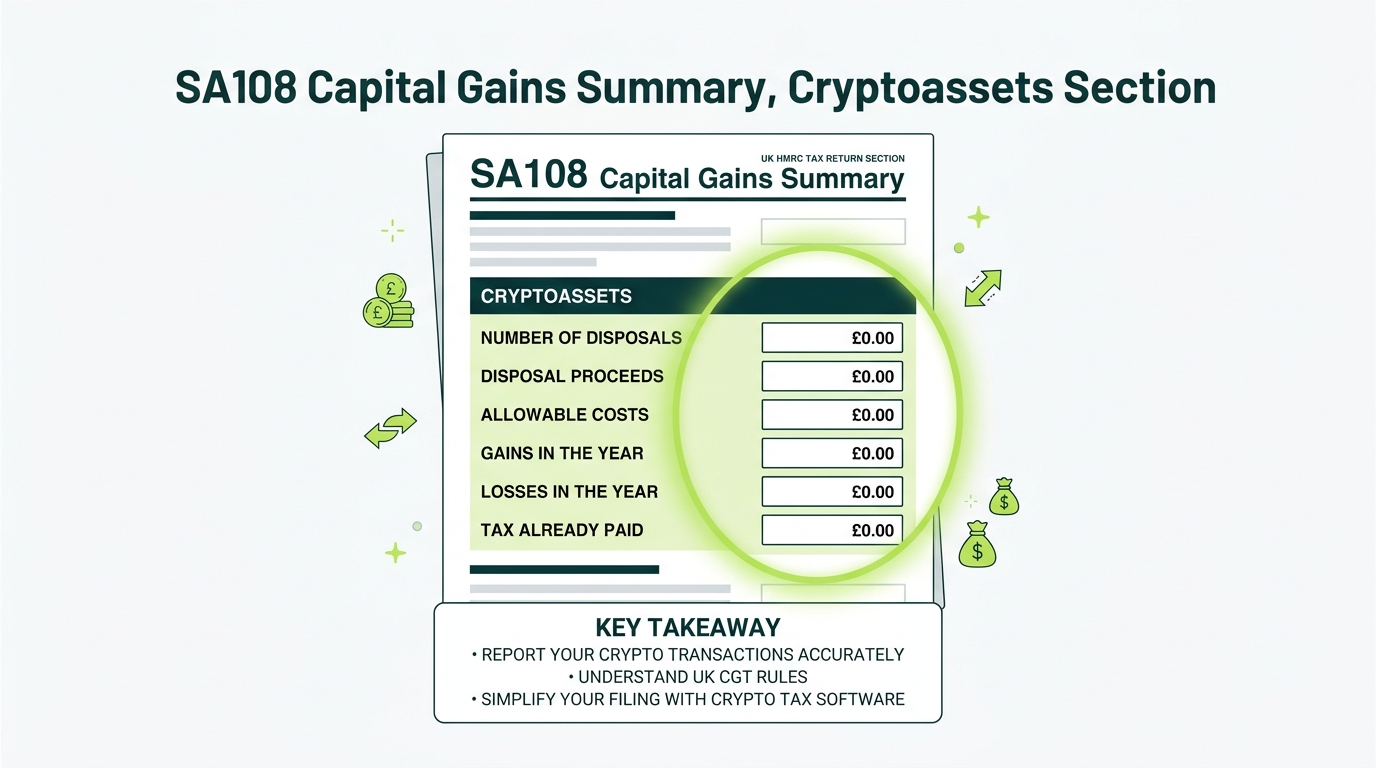
Crypto income, such as staking or mining, is reported through the income side of your Self Assessment rather than the SA108. Where your figures need supporting calculations or valuations, keep the workpapers ready in case HMRC asks. Our deliverable gives you each of these numbers with the reconciliation behind it.
Does HMRC know about your crypto? CARF and exchange reporting
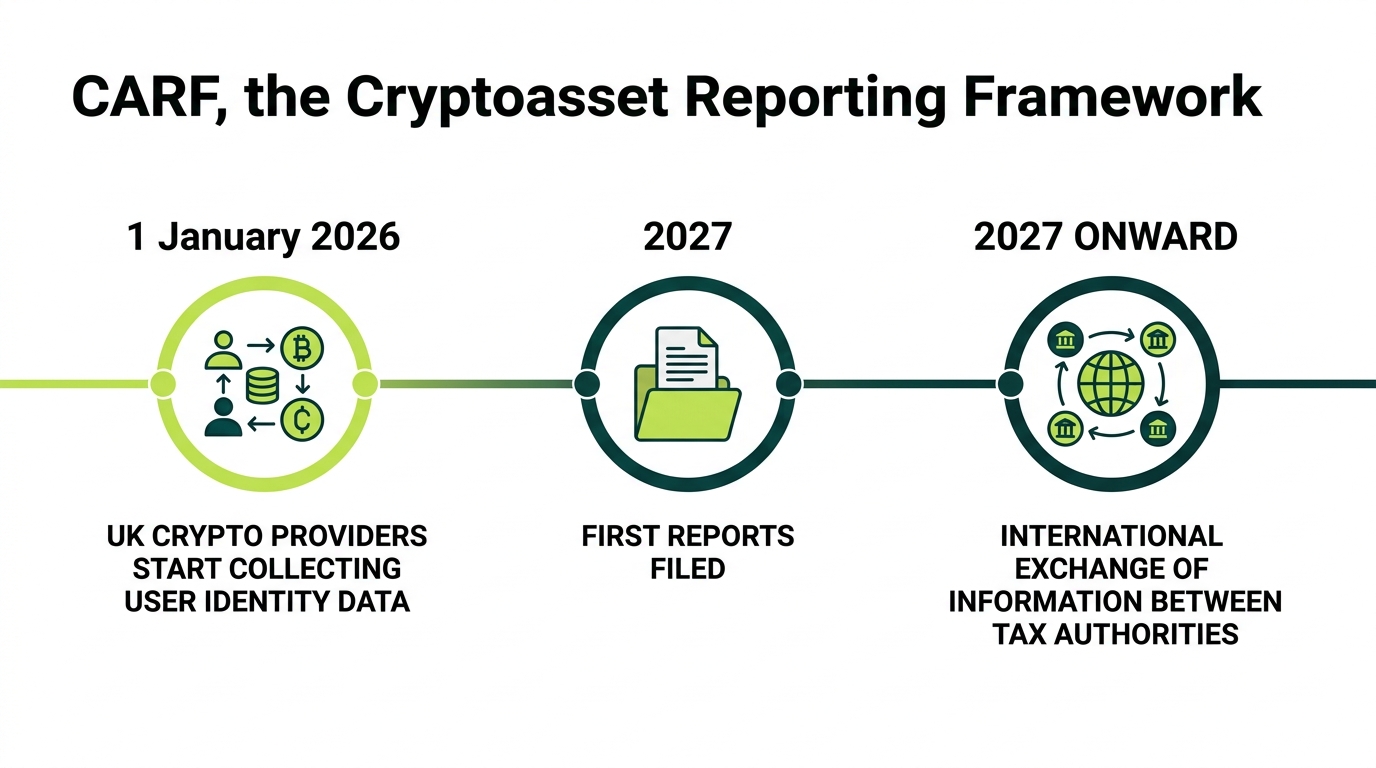
HMRC already receives data from exchanges and holds statutory information powers. From 1 January 2026 the Cryptoasset Reporting Framework requires UK cryptoasset service providers to collect identifying information about their users, including tax residence and identifiers. Providers make their first reports for 2026 during 2027, with international exchange of information following. The practical takeaway is simple: assume HMRC can connect identity-verified accounts to you, and report accurately. For the full picture of what HMRC can see, and what to do if you have prior years to fix, read does HMRC know about your crypto.
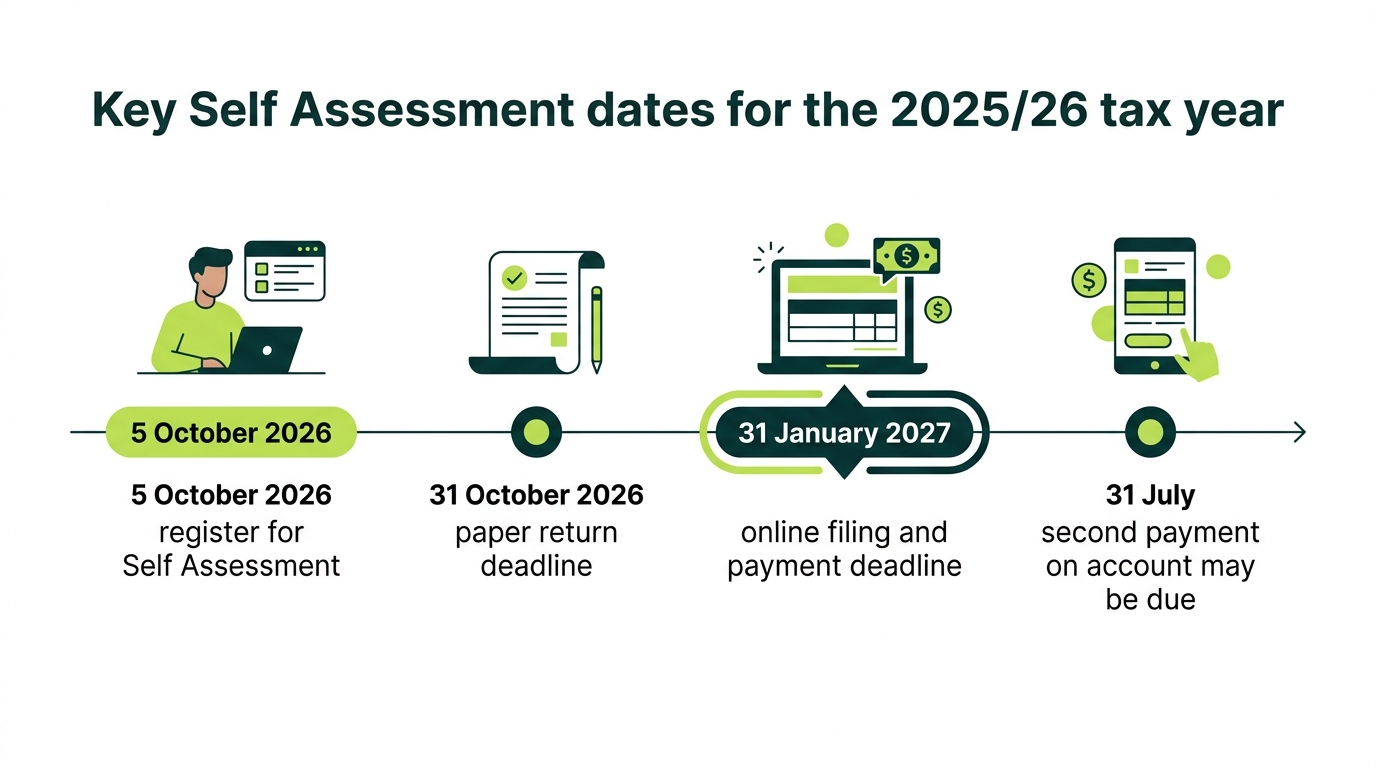
Key dates for the 2025/26 return
- 5 October 2026: tell HMRC you need to file if you are not already in Self Assessment.
- 31 October 2026: paper return deadline.
- 31 January 2027: online filing deadline and the date your balancing payment is due.
- 31 July: a second payment on account may fall due, depending on your liability.
Get HMRC-ready figures for your accountant
Count On Sheep is a universal digital-asset reconciliation service. We rebuild your full crypto and DeFi transaction history across every exchange, wallet, and chain, then produce HMRC-ready figures your UK accountant or your Self Assessment return can rely on. We do not file UK tax returns. We are the reconciliation layer that hands clean, defensible numbers to the tax professional who completes your return.
Work with our UK crypto tax teamUK crypto tax FAQs
How much tax do I pay on crypto in the UK?
It depends on whether the gain falls in your basic or higher rate band. For 2025/26, Capital Gains Tax on crypto is charged at 18% within the basic rate band and 24% above it, after your £3,000 annual exempt amount. Crypto received as income (staking, mining, airdrops, employment) is taxed at your Income Tax rate instead.
Does HMRC know about my crypto?
Increasingly, yes. HMRC receives data from exchanges and has statutory information powers. From 1 January 2026 the Cryptoasset Reporting Framework (CARF) requires UK service providers to collect identifying information about users, with the first reports due in 2027 and international exchange of information following. Assume HMRC can see activity tied to identity-verified accounts.
Do I need to declare crypto to HMRC?
You must declare it if you have a taxable event, such as a disposal that uses up your annual exempt amount or produces a gain, or crypto income. You report capital gains on the SA108 cryptoassets section and income through Self Assessment. Simply buying and holding crypto in GBP does not need to be declared.
Is converting crypto to a stablecoin like USDT taxable in the UK?
Yes. Swapping one cryptoasset for another, including converting Bitcoin or Ether into USDT or USDC, is a disposal for Capital Gains Tax. You calculate the gain or loss using the GBP value at the moment of the swap, even though no pounds changed hands.
What happens if I do not report my crypto on my tax return?
Undeclared gains can lead to interest and penalties, and HMRC runs a dedicated cryptoassets disclosure route. The longer a liability is left unreported, the higher the potential penalty. If you have prior years to fix, reconstruct each year in order, then disclose through the correct route. Count On Sheep rebuilds the history so the figures are defensible.
Is swapping one crypto for another taxable in the UK?
Yes. A crypto to crypto swap is a disposal of the token you give up, even though you never touch pounds. You work out the gain or loss using the GBP value at the time of the swap. This catches a lot of UK investors who assume tax only applies when they cash out to a bank account.
How are staking rewards taxed in the UK?
Staking rewards that do not amount to a trade are generally taxed as miscellaneous income at their GBP value when you receive them. That value then becomes the cost basis of those coins, so when you later sell or swap them you measure the capital gain against it. Liquid staking adds disposal questions on the wrap and unwrap.
How much crypto can I sell without paying tax in the UK?
There is no fixed amount you can sell tax free. What matters is your net gain. For 2025/26 the first £3,000 of net gains across all your assets is covered by the annual exempt amount. Separately, if your total disposal proceeds for the year exceed £50,000 you may need to report even when little or no tax is due.
Does Count On Sheep file my UK tax return?
No. Count On Sheep is a digital-asset reconciliation service. We rebuild your full crypto and DeFi history across every exchange, wallet and chain, then produce HMRC-ready gains and income figures, including SA108 cryptoassets numbers, that your UK accountant or your own Self Assessment can rely on. You or your accountant file the return.