
Yes, increasingly. HMRC already receives data from crypto exchanges and has statutory information powers. From 1 January 2026, the Cryptoasset Reporting Framework requires UK cryptoasset providers to collect identifying information about users, with reporting from 2027. Assume HMRC can connect identity-verified accounts to you, and report accurately.
How HMRC already sees crypto
HMRC does not need to watch the blockchain to know about your crypto. It receives information directly from exchanges, can issue information notices, and matches data across the tax system. Where your name, address and bank details sit behind a verified exchange account, that account is not anonymous to HMRC.
What CARF changes from January 2026
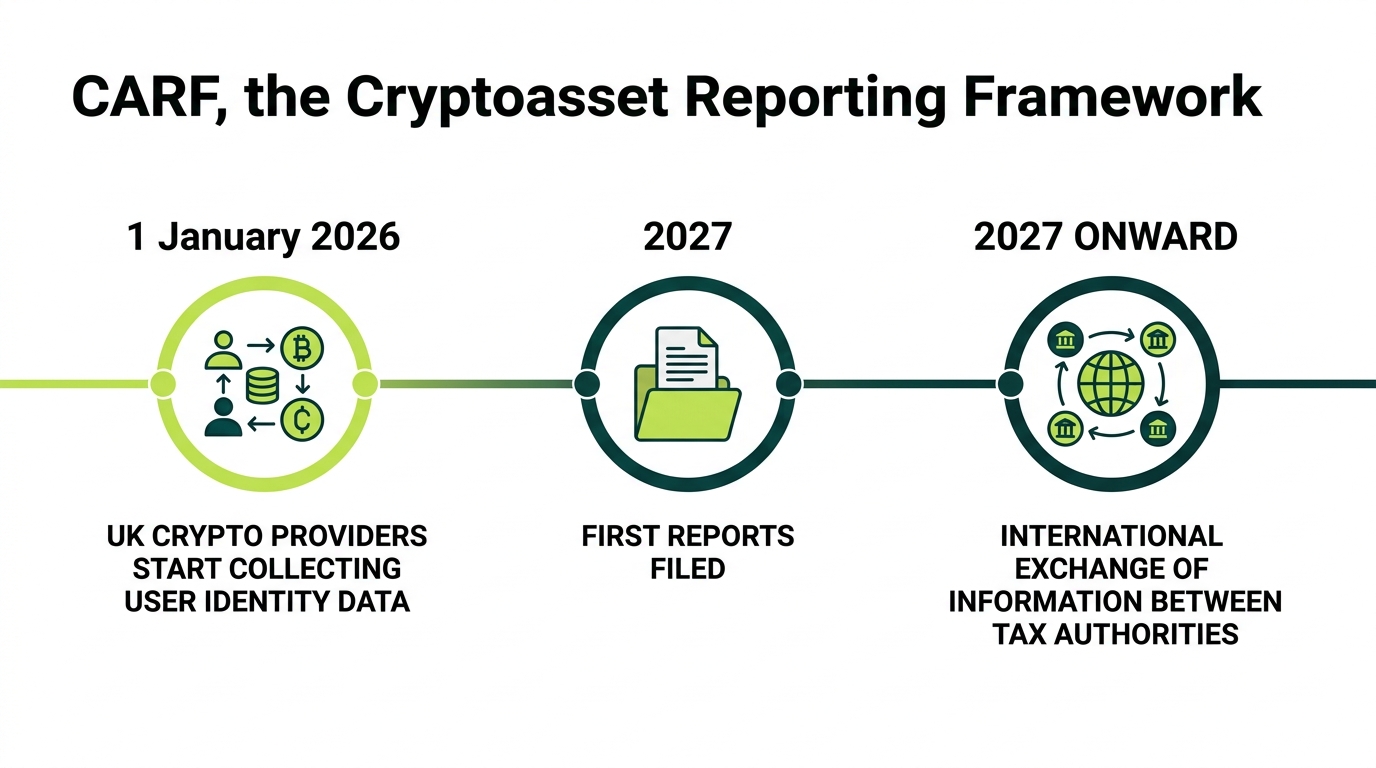
The Cryptoasset Reporting Framework is the crypto equivalent of the bank-account reporting that already exists between countries. From 1 January 2026, UK cryptoasset service providers are required to collect identifying information from their users, including tax residence and tax identifiers. Providers make their first reports for 2026 during 2027, and tax authorities then exchange that information across borders.
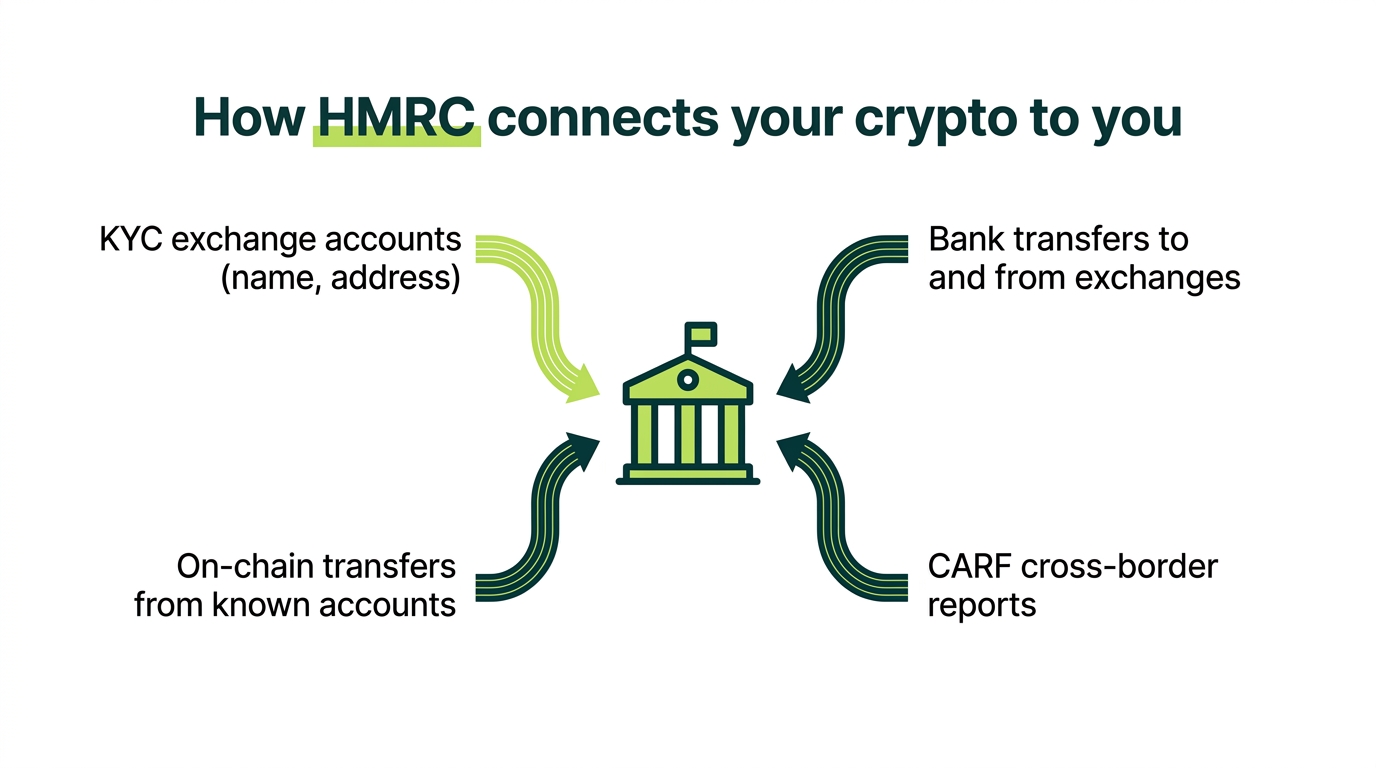
How HMRC connects crypto activity to you
There are several threads HMRC can pull, and they increasingly join up. Identity-verified exchange accounts carry your name, address and often bank details. Bank transfers in and out of exchanges show on the financial data HMRC already sees. On-chain transfers from a known exchange account to your own wallets can be followed from that starting point. Information notices let HMRC compel data from providers. CARF then layers automatic, cross-border reporting on top of all of it.
HMRC is actively chasing undeclared crypto
HMRC has run nudge-letter campaigns aimed at crypto holders it believes have undeclared gains, and it operates a dedicated route to disclose unpaid tax on cryptoassets. The direction of travel is clear: more data, more matching, and less room for activity to go unreported. Paired with CARF from January 2026, this is what many investors are calling the UK crypto tax crackdown.
If you have prior years to fix
The worst move is to ignore it. The right move is to reconstruct each affected year in order, calculate the gains and income correctly, and disclose through the appropriate HMRC route. That starts with a clean, complete reconciliation of your full history, which is exactly what Count On Sheep produces. We rebuild the numbers so a disclosure or a current-year return is defensible. We do not file the return.
For the full rules behind reporting, see the UK Crypto Tax Guide for 2025/26. If several years and wallets need rebuilding before you can disclose, that is exactly what our UK crypto tax service is built to do.
Get HMRC-ready figures for your accountant
Count On Sheep is a universal digital-asset reconciliation service. We rebuild your full crypto and DeFi transaction history across every exchange, wallet, and chain, then produce HMRC-ready figures your UK accountant or your Self Assessment return can rely on. We do not file UK tax returns. We are the reconciliation layer that hands clean, defensible numbers to the tax professional who completes your return.
Talk to a UK crypto tax specialistUK crypto tax FAQs
Does HMRC know about my crypto?
Increasingly, yes. HMRC already receives data from cryptoasset exchanges and holds statutory information powers. From 1 January 2026, the Cryptoasset Reporting Framework requires UK service providers to collect identifying information about users, with the first reports due in 2027 and international exchange of information following. Assume HMRC can link identity-verified accounts to you.
Does Coinbase report to HMRC?
UK-facing exchanges have shared customer data with HMRC in the past, and under the Cryptoasset Reporting Framework, providers operating in the UK are required to collect and report user information from 2026 onward. You should assume that activity on identity-verified exchange accounts is visible to HMRC.
What happens if I do not declare my crypto?
Undeclared gains or income can lead to interest and penalties, and the longer a liability goes unreported the higher the potential penalty. HMRC runs a dedicated route to disclose unpaid tax on cryptoassets. If you have prior years to fix, reconstruct each year in order, then disclose through the correct route.
What is CARF?
The Cryptoasset Reporting Framework is an international standard for the automatic exchange of crypto account information between tax authorities. In the UK it means cryptoasset service providers must collect identifying details such as tax residence and identifiers from users starting January 2026, then report them, with cross-border information sharing beginning in 2027.
Does Binance report to HMRC?
Like other UK-facing providers, exchanges operating in or marketing to the UK fall within the Cryptoasset Reporting Framework, which requires them to collect and report user information from 2026. Using an offshore or international exchange does not put you out of reach, because CARF is built to send that data back to your home tax authority.
Can HMRC see my crypto wallet?
HMRC does not monitor every wallet on the blockchain, but it does not need to. Once your identity is linked to an exchange account, on-chain transfers to and from your own wallets can be followed from that known point. Self-custody is not anonymity once a verified account sits anywhere in the chain of activity.
Is there a UK crypto tax crackdown in 2026?
HMRC has stepped up activity, sending nudge letters to suspected crypto holders and pairing that with new CARF reporting from January 2026. The combination of more data and active outreach is why 2026 is widely described as a crackdown. The safe response is to get your history reconciled and report accurately.