
For the 2025/26 tax year, the first £3,000 of net crypto gains is tax free through the annual exempt amount. Above that, gains are taxed at 18% within your basic rate band and 24% above it. Buying and holding is never taxed. You pay only when you dispose of crypto at a gain or receive it as income.
The £3,000 annual exempt amount
Every individual has an annual exempt amount for Capital Gains Tax. For 2025/26 it is £3,000, and it covers net gains across all your chargeable assets, not just crypto. If your total gains after losses are £3,000 or less, there is no Capital Gains Tax to pay, although you may still need to report depending on your proceeds.
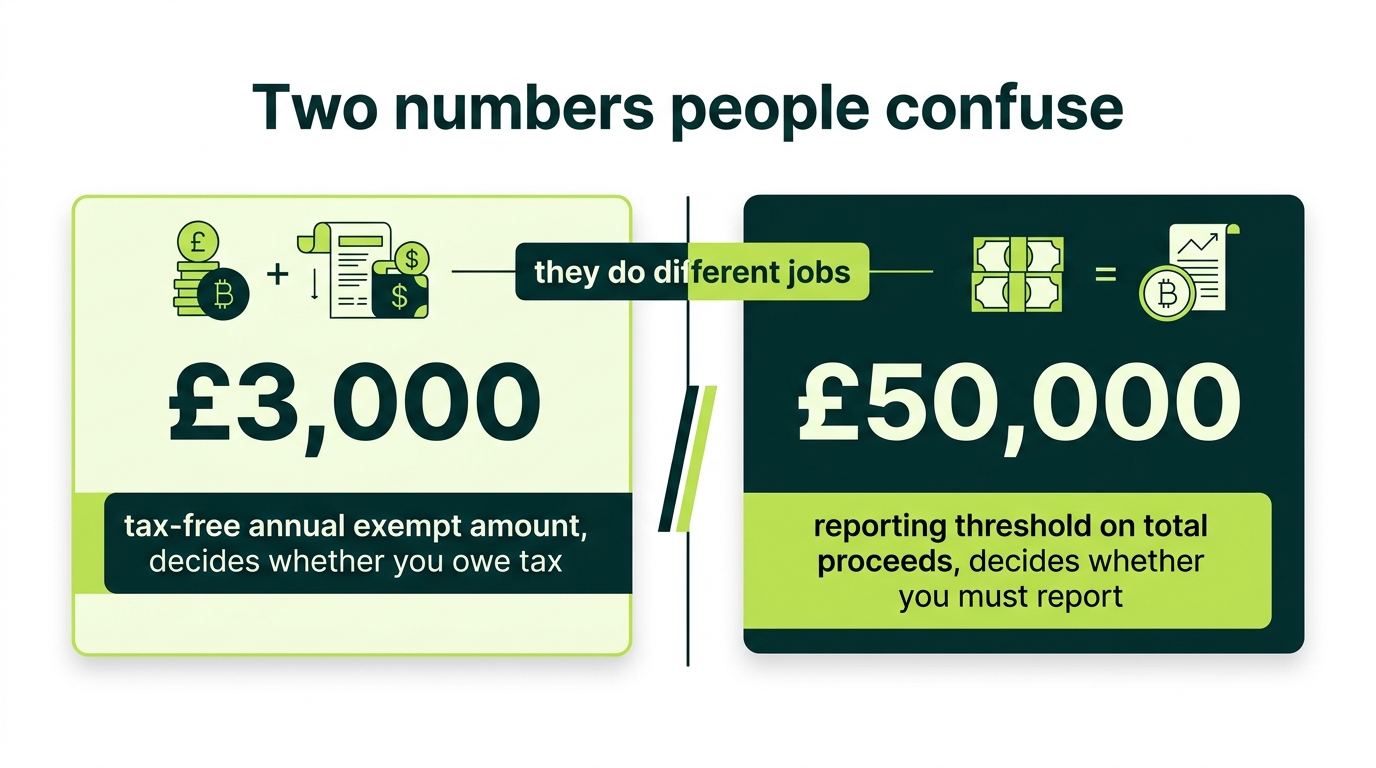
The £3,000 allowance and the £50,000 threshold are different
This distinction trips up a lot of UK investors, partly because several popular guides blur the two. They do different jobs. One decides whether you owe tax. The other can decide whether you must report.
When you actually pay
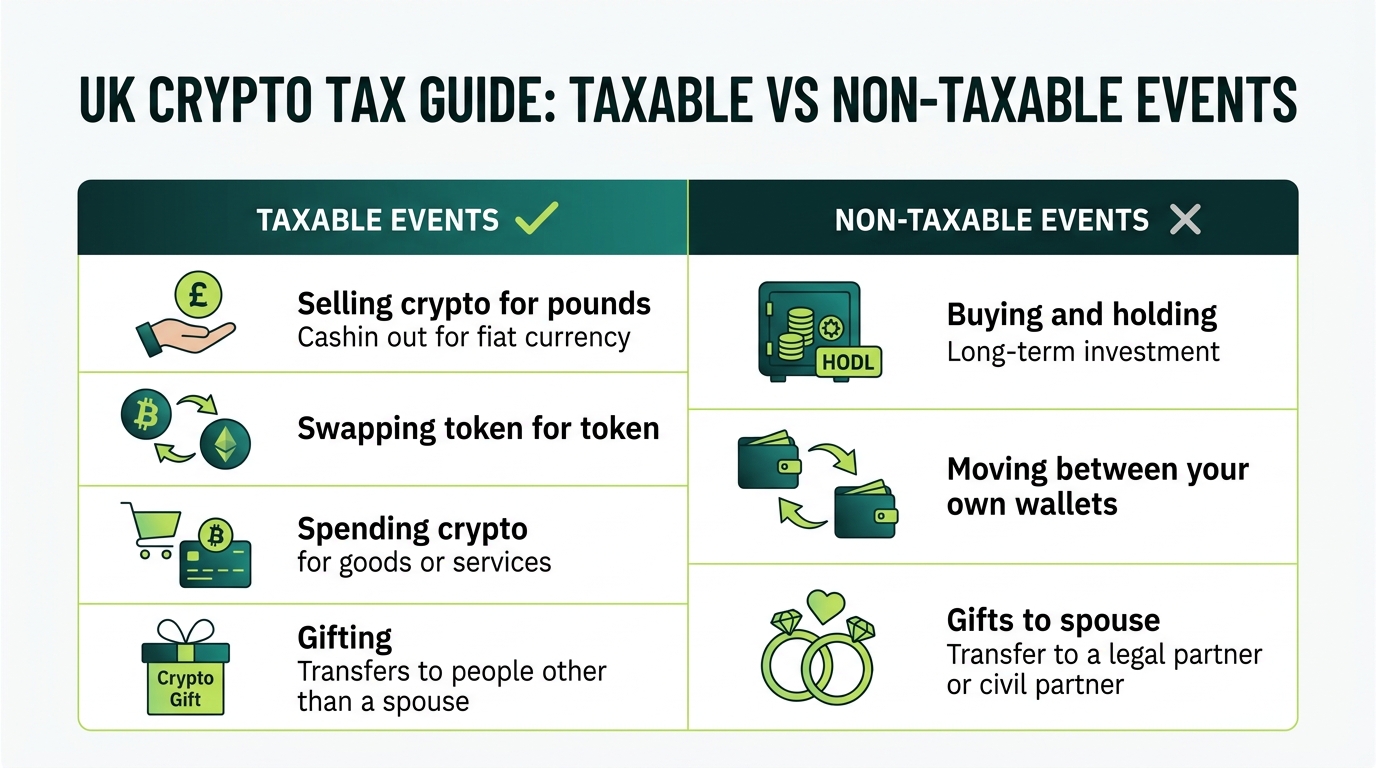
You have a taxable event, and may owe tax, when you:
- Sell crypto for pounds at a gain above your allowance.
- Swap one token for another, including converting to a stablecoin.
- Spend crypto on goods or services.
- Gift crypto to someone other than your spouse, civil partner or a charity.
- Receive crypto as income from staking, mining, airdrops or employment, taxed at your Income Tax rate.
Buying crypto with pounds and simply holding it is never a taxable event on its own. Swapping into a stablecoin like USDT or USDC counts as a disposal, even though it does not feel like cashing out.
How much can you actually sell without tax?
This is the question most people really mean, and the honest answer is that there is no fixed pound amount. What is taxed is your gain, not the size of the sale. You could sell £40,000 of crypto and owe nothing if it barely rose in value, or sell £6,000 and owe tax if most of it is gain. Two worked cases show the difference.
The pooled cost in both examples comes from Section 104 pooling, explained in the full UK crypto tax guide.
How to legally reduce your UK crypto tax
- Use your full £3,000 allowance each tax year rather than letting it go to waste.
- Realise available losses to offset gains, with the evidence to support them.
- Transfer assets to a spouse or civil partner so both allowances are used.
- Time disposals across tax years where it makes sense.
- Keep complete records and avoid accidental 30-day rematching that undoes planning.
Try the UK crypto tax calculator to estimate your position, read the full UK Crypto Tax Guide, or if your gains are larger and span several years and wallets, see how our UK crypto tax service produces HMRC-ready figures.
Get HMRC-ready figures for your accountant
Count On Sheep is a universal digital-asset reconciliation service. We rebuild your full crypto and DeFi transaction history across every exchange, wallet, and chain, then produce HMRC-ready figures your UK accountant or your Self Assessment return can rely on. We do not file UK tax returns. We are the reconciliation layer that hands clean, defensible numbers to the tax professional who completes your return.
Get UK crypto tax helpUK crypto tax FAQs
How much crypto is tax free in the UK?
For the 2025/26 tax year, the first £3,000 of net capital gains across all your assets is free of Capital Gains Tax through the annual exempt amount. Gains above that are taxed at 18% within your basic rate band and 24% above it. Crypto received as income is taxed separately at your Income Tax rate.
When do I pay tax on crypto in the UK?
You pay when you have a taxable event that produces a gain above your £3,000 allowance, or when you receive crypto as income. Disposals include selling for pounds, swapping tokens, spending crypto and gifting it to anyone other than your spouse or a charity. Simply buying and holding is not taxed.
What is the £50,000 crypto threshold?
The £50,000 is a reporting threshold based on your total disposal proceeds, not a tax-free amount. If your total proceeds for the year exceed £50,000 you may need to report to HMRC even where your actual gain is small or within your allowance.
How can I legally reduce my UK crypto tax?
Lawful options include using your full £3,000 annual exempt amount each year, realising available losses to offset gains, transferring assets to a spouse or civil partner to use both allowances, and timing disposals across tax years. Good records are essential, and accidental 30-day rematching can undo planning.
How much crypto can I sell without paying tax in the UK?
There is no fixed amount of crypto you can sell tax free, because what matters is your net gain, not the sale value. You could sell a large amount and owe nothing if there is little gain, or sell a small amount and owe tax if the gain is large. For 2025/26 the first £3,000 of net gains is covered by the annual exempt amount. Separately, proceeds above £50,000 can trigger a reporting requirement.
Is there a tax-free allowance for crypto income in the UK?
Crypto income such as staking or mining is taxed under Income Tax, not Capital Gains Tax, so the £3,000 capital gains allowance does not apply to it. It is set against your personal allowance, which is £12,570 for 2025/26, alongside your other income. Whether any tax is due depends on your total income for the year.