
HMRC does not treat every DeFi transaction as automatically taxable. The deciding questions are whether beneficial ownership of your tokens changed, and whether a return looks like income or capital. Lending, liquidity pools, liquid staking, wrapped tokens and yield each need assessing on their own facts, in GBP, for the 2025/26 tax year.
The principle that decides DeFi tax
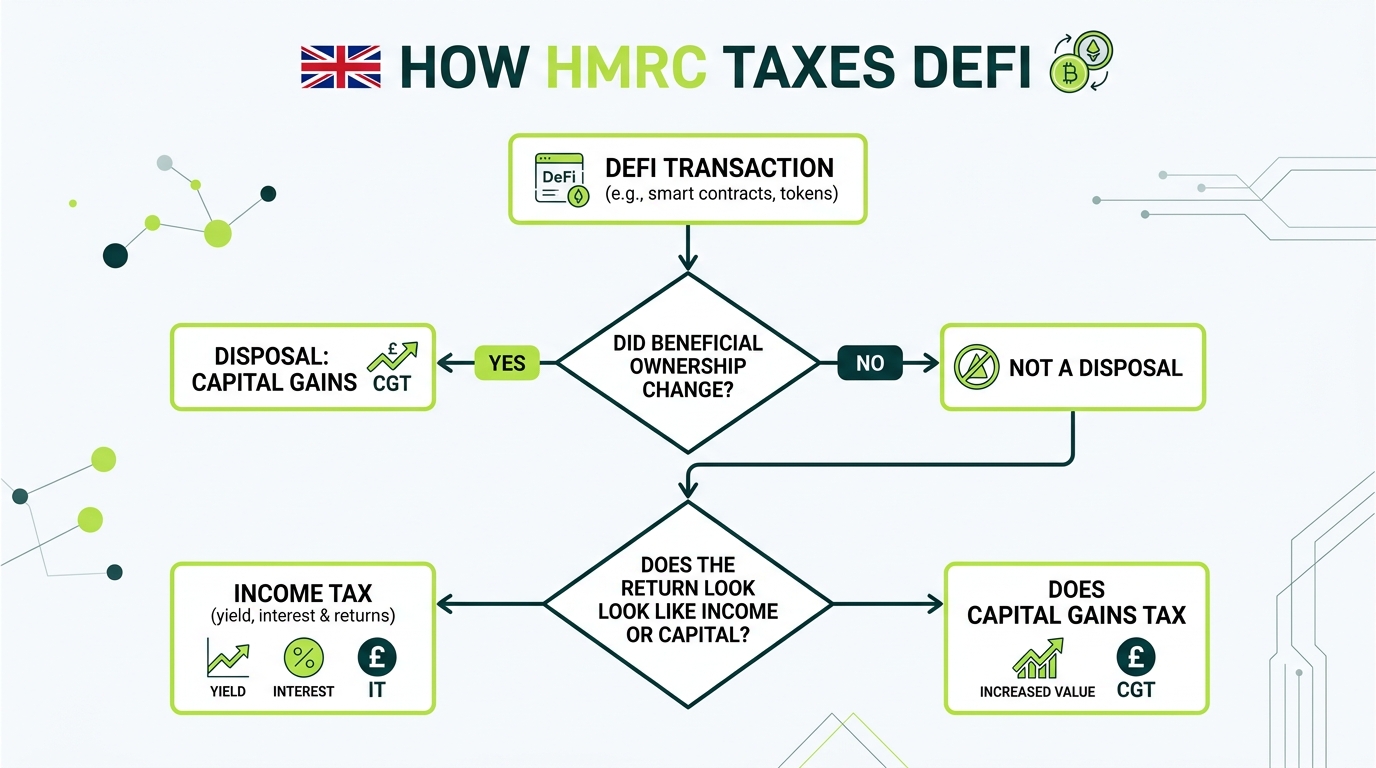
Generic guides tend to say either that all DeFi is taxable or that none of it is. Both are wrong. HMRC analyses DeFi on two questions. First, did beneficial ownership of your tokens actually change when you interacted with the protocol? Second, does the return you earned look more like income or more like a capital gain? Answer those for each transaction pattern and the treatment follows.
HMRC set this out in its DeFi guidance within the Cryptoassets Manual. There is deliberately no blanket rule that every deposit or withdrawal is a disposal. Two people using what looks like the same protocol can get different answers because the underlying mechanics, and what happens to ownership, are different. That is why a careful, transaction-level review beats any one-size-fits-all assumption.
A simple way to read any DeFi transaction
For each interaction with a protocol, work through three questions in order. Most treatment questions resolve here.
- Did beneficial ownership of the tokens leave your control? If you handed assets over and received a different asset that represents a claim, that often points to a disposal of what you gave up, valued in GBP at the time. If you kept ownership throughout, it often does not.
- Did you receive a return, and what does it look like? A reward that is paid to you for providing capital or a service tends to be income at its GBP value on receipt. A change in the value of an asset you still own tends to be capital, taxed only when you dispose of it.
- What is the cost basis of anything new you received? Tokens received as income take a cost basis equal to the GBP value taxed on receipt. A later sale or swap is then measured against that figure for Capital Gains Tax.
The wider mechanics behind step three, Section 104 pooling and the same-day and 30-day matching rules, are covered in the UK crypto tax guide.
DeFi by transaction pattern
Here is how the common DeFi patterns are generally treated under UK rules. Each still turns on the specific facts of the protocol you used.
Worked examples in pounds
Numbers make the principle concrete. These are illustrative and use round figures to show how the treatment lands in GBP.
Why DeFi reconciliation is a specialist job
A single yield strategy can generate hundreds of events across several protocols and tokens. Each one needs a GBP valuation at the right moment and the correct capital or income treatment. Miss a leg and the cost basis is wrong for everything downstream. This is the area where careful reconciliation earns its keep, and where Count On Sheep does the work pattern by pattern rather than waving it through.
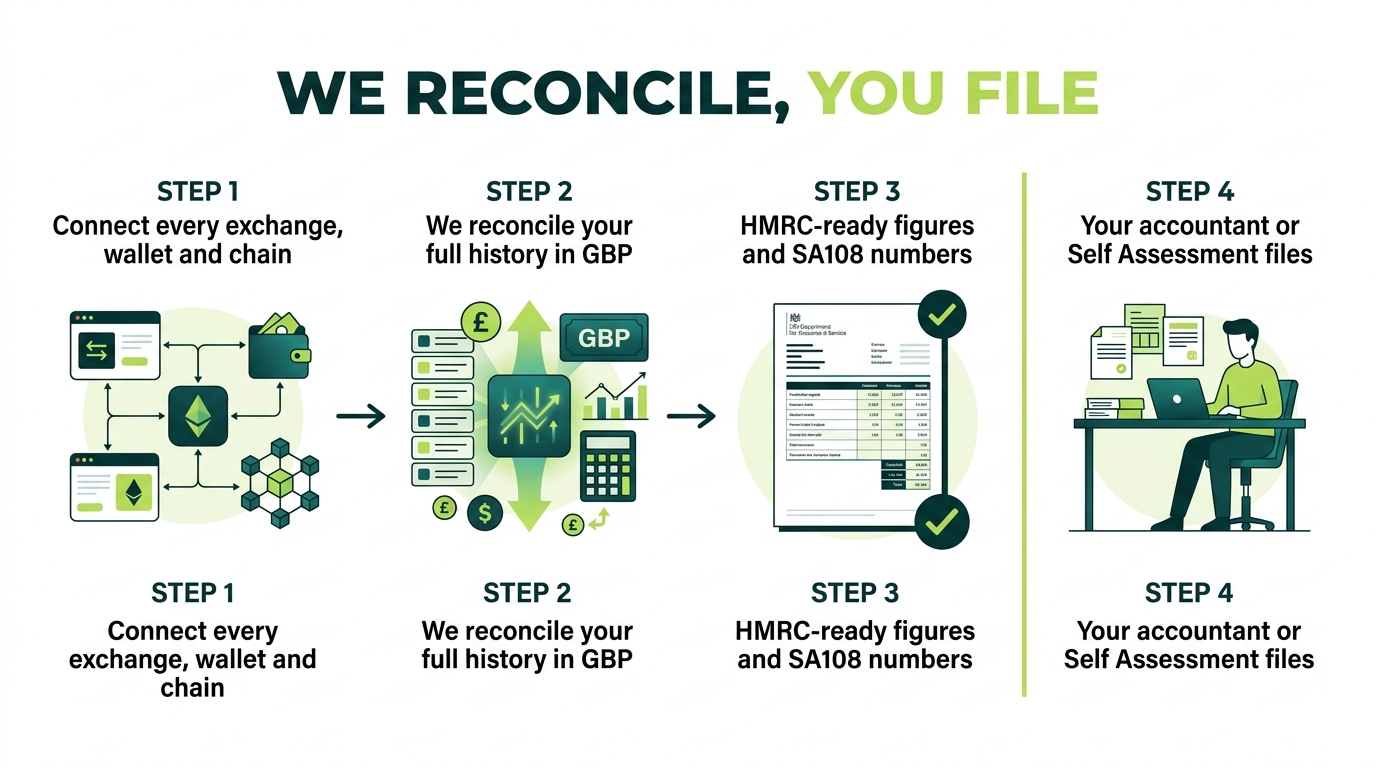
We rebuild your full DeFi history across every wallet, chain and protocol, value each leg in pounds, and classify it as capital or income on the correct UK basis. You receive HMRC-ready figures, including the numbers for your SA108 cryptoassets section, for your accountant or your own Self Assessment. We do not file the return. If you are wondering whether HMRC can even see this activity, the short answer is increasingly yes, as explained in does HMRC know about your crypto.
Get HMRC-ready figures for your accountant
Count On Sheep is a universal digital-asset reconciliation service. We rebuild your full crypto and DeFi transaction history across every exchange, wallet, and chain, then produce HMRC-ready figures your UK accountant or your Self Assessment return can rely on. We do not file UK tax returns. We are the reconciliation layer that hands clean, defensible numbers to the tax professional who completes your return.
Get help with UK DeFi reconciliationUK crypto tax FAQs
Is DeFi taxable in the UK?
It can be, but not automatically on every transaction. HMRC looks at whether beneficial ownership of your tokens changed and whether a return looks like income or capital. Deposits, withdrawals, rewards and swaps each need to be assessed on their own facts rather than assumed taxable or tax free.
How is a liquidity pool taxed in the UK?
Adding liquidity can be a disposal where you receive an LP token in exchange and give up beneficial ownership of the deposited assets, valued in GBP at the time. Fees and rewards earned in the pool, and the later withdrawal, are separate events that also need valuing.
Is staking taxed as income or capital in the UK?
Staking rewards that do not amount to a trade are generally taxed as miscellaneous income at their GBP value on receipt. That value becomes the cost basis, so a later disposal is measured against it for Capital Gains Tax. Liquid staking adds disposal questions on the wrap and unwrap.
How is yield farming taxed in the UK?
Yield farming rewards are generally income at their GBP value when you gain control of them, and that value becomes their cost basis for a later disposal. Where the strategy also involves swapping into LP tokens or vault receipt tokens, those legs can be separate capital disposals. Each protocol leg is assessed on its own facts.
Do I pay tax when I take out a crypto loan in the UK?
Borrowing against your crypto is generally not a disposal while you keep beneficial ownership of the collateral, so taking the loan itself usually is not taxable. Tax can arise if the collateral is liquidated, or if the deposit mechanics mean ownership passed to the protocol. Interest you earn elsewhere remains taxable.
Why is DeFi so hard to report correctly?
A single DeFi strategy can generate hundreds of on-chain events across multiple protocols and tokens, each needing a GBP valuation and the right capital or income treatment. Most software and generalist accountants summarise this generically. Count On Sheep reconciles it pattern by pattern so the figures are defensible.