

“Is CoinTracker legit?” is one of the most common questions we hear, and the honest answer is yes, it is a legitimate, well-established company. But that is rarely what people are actually worried about. What they really want to know is whether they can trust the numbers it produces on their tax return. As a crypto tax team that reviews CoinTracker reports regularly, here is our straight take.
Short version: CoinTracker is legit and safe to use, and it is accurate for clean portfolios on major US exchanges. The risk is not the company. It is filing a report built on incomplete data.
Disclaimer: This is an independent review for informational purposes. We are not affiliated with CoinTracker. Always consult a qualified CPA regarding your specific situation.
Quick verdict (TL;DR): Yes, CoinTracker is legit. It is a SOC 2 Type II compliant crypto tax platform founded in 2017, backed by $100M+ in funding, an official Coinbase partner, using read-only API access that never requests your private keys. It is accurate for clean portfolios on major US exchanges and exports smoothly to TurboTax. It is software, so it does not file your return, and it needs human correction on DeFi and missing cost basis. Rating: 4.1 out of 5. Verdict by Count On Sheep, a crypto tax specialist.
CoinTracker is a crypto tax and portfolio tracking platform founded in 2017 by ex-Google engineers Jon Lerner and Chandan Lodha. It has raised over $100M from investors including Accel, Y Combinator, Coinbase Ventures, and Intuit Ventures. For the current product catalog, see CoinTracker features and supported integrations.
Is CoinTracker Legit? Short Answer: Yes
If CoinTracker is not giving you numbers you trust, here is when to bring in a CoinTracker expert.
CoinTracker is an established crypto tax and portfolio tracking platform with deep integrations into major US exchanges and TurboTax. It is widely used and legitimate. If your question was whether it is a scam, it is not.
The more useful question is whether it will produce a correct tax report for your situation. That depends far less on CoinTracker and far more on whether you have given it complete, correctly labeled data.
Is CoinTracker Safe?
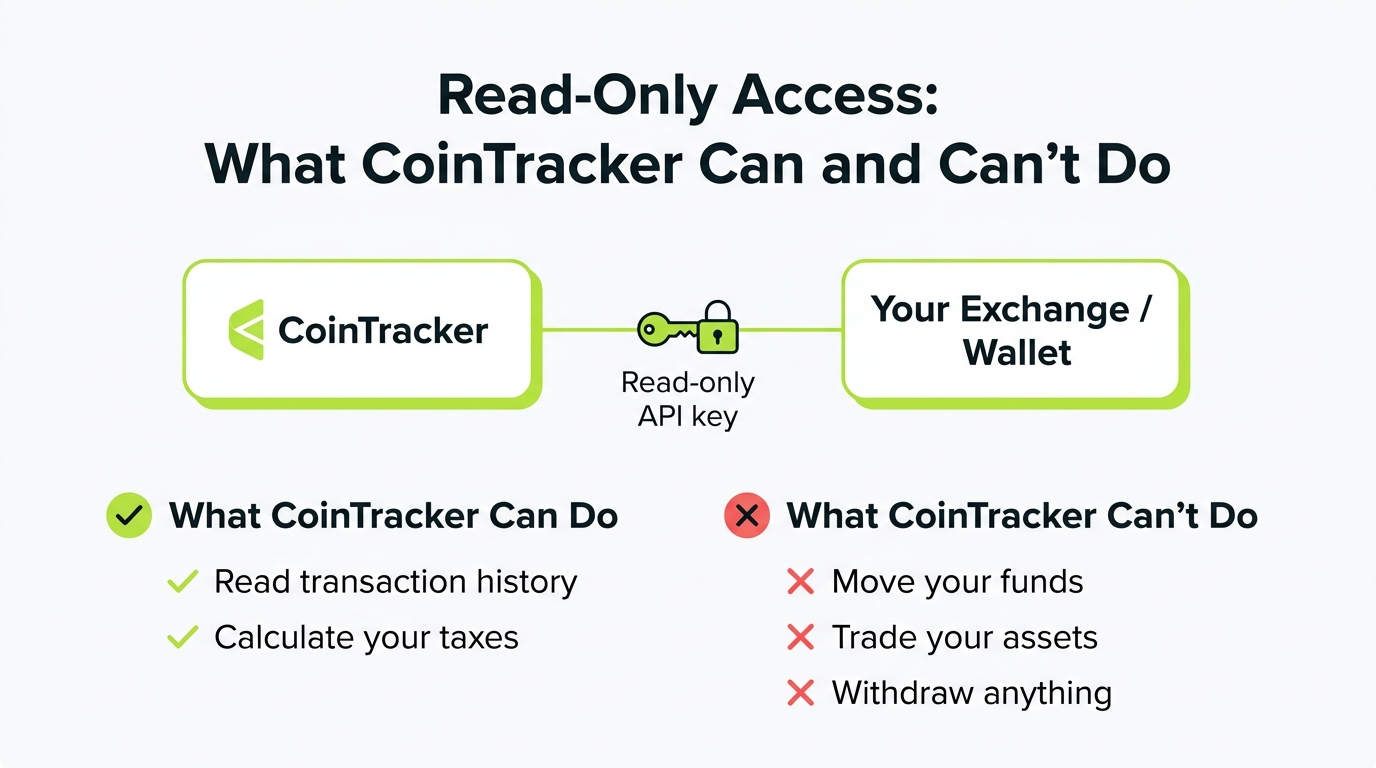
CoinTracker connects to exchanges through read-only API keys. That means it can see your transaction history to calculate taxes, but it cannot trade or withdraw your funds.
Used that way, CoinTracker is safe. The genuine risk is not someone draining your account, it is you filing an inaccurate return because a wallet was missing or a DeFi transaction was mislabeled.
Is CoinTracker Accurate?
CoinTracker is accurate when two things are true: every account is connected, and transfers between your own wallets are matched. For a portfolio that lives mostly on Coinbase, Kraken, and similar major exchanges, it does this well and exports cleanly to TurboTax.
Accuracy breaks in the familiar ways:
- A missing wallet or exchange produces $0 cost basis and inflated gains (here is how to fix wrong CoinTracker cost basis)
- DeFi activity gets auto-labeled incorrectly
- A 1099-DA reports proceeds without your full cost basis, creating a mismatch
CoinTracker Pricing 2026
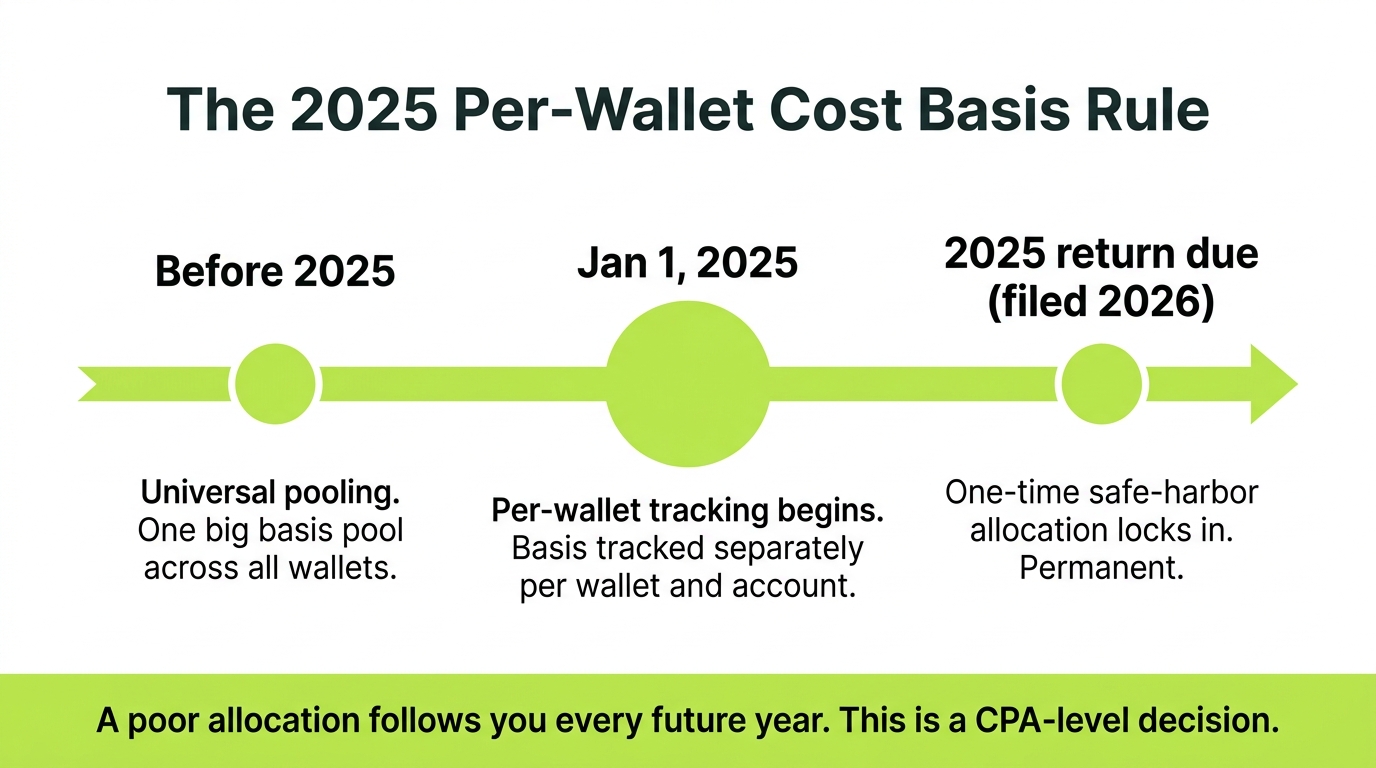
CoinTracker prices by the number of transactions in the prior calendar year. Portfolio tracking is free; you pay when you need downloadable tax forms.
| Plan | Transaction limit | Price (per tax year) | What you get |
|---|---|---|---|
| Free | Tracking | $0 | Portfolio tracking and a tax summary. No form download. |
| Base | 100 (Base+ 250) | $59 ($99 Base+) | 2025 forms + past years, TurboTax and H&R Block, live support |
| Prime | 1,000 (Prime+ 2,500) | $199 ($299 Prime+) | Tax-lot breakdown, tax-loss harvesting, performance tracking, priority support |
| Ultra | 10,000 (Ultra+ 250,000) | $599 ($1,999 Ultra+) | Change cost basis method by year, 24-hour support (Ultra+) |
| Full Service | up to ~300,000 | from $3,499 | Dedicated account manager, up to 15 hours hands-on reconciliation, quarterly reviews |
Pricing as of 2026.
CoinTracker Full Service vs a Done-For-You Crypto Tax Service
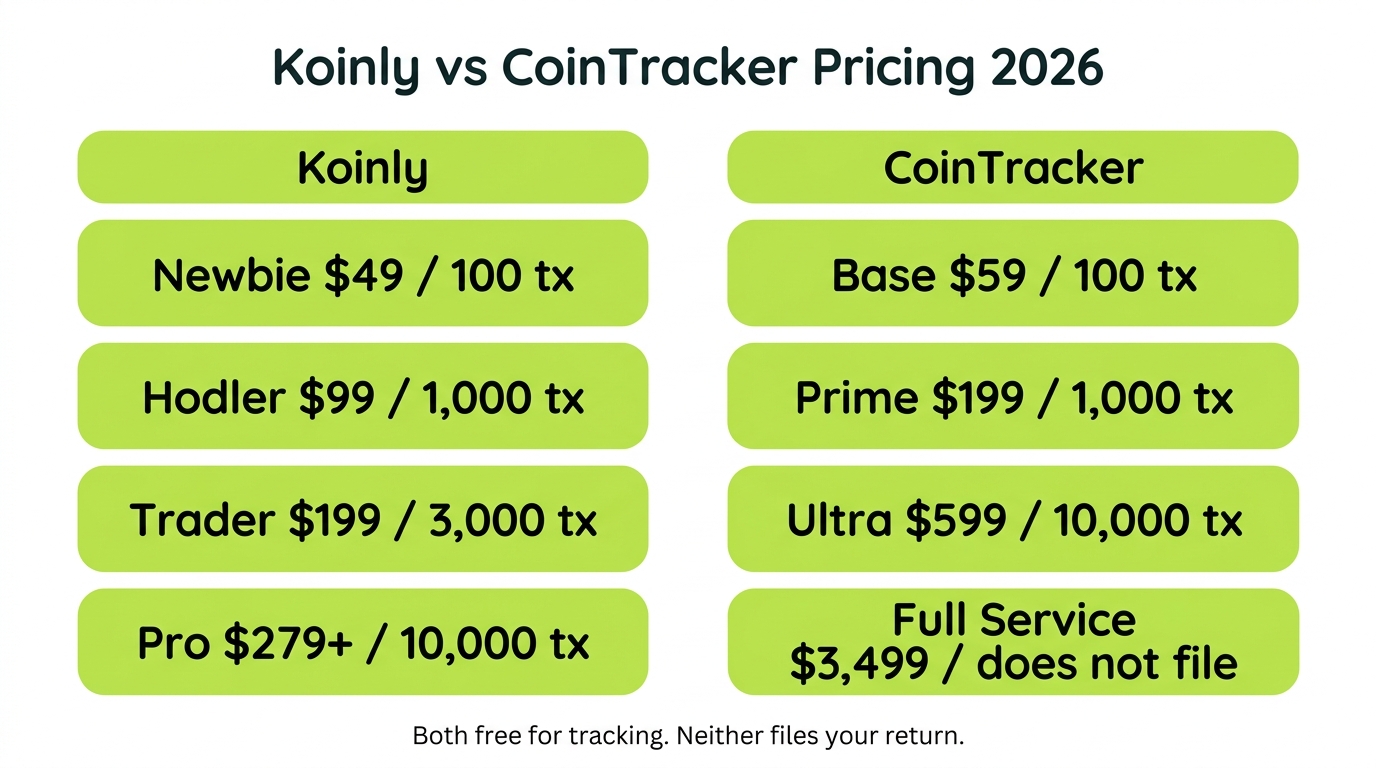
CoinTracker’s top tier, Full Service (from $3,499/year), is the one worth scrutinizing, because people assume it means “a professional does my taxes.” It does not mean that. Read the scope carefully.
| CoinTracker Full Service | Done-for-you crypto tax service | |
|---|---|---|
| Reconciliation | Up to ~15 hours, current tax year | As many hours as the job needs, all years |
| Files your tax return? | No | Yes |
| Audit defense | No | Yes |
| Multi-year cleanup | Limited | Yes |
| Per-wallet 2025 allocation judgment | Software-led | Specialist judgment, documented |
| Who stands behind the numbers | The software | A named crypto tax specialist |
| Price | from $3,499/yr | Quoted by complexity |
Full Service is a premium reconciliation concierge with an hour cap, not a tax preparer. It hands you cleaner data; it does not file your return or defend it in an audit. For a high-volume or DeFi-heavy filer, paying $3,499 for capped reconciliation and then still needing to file is often the worse deal versus a done-for-you CoinTracker tax filing service that reconciles, files, and defends in one engagement.
Where CoinTracker Shines and Where It Doesn’t
Shines: clean interface, strong portfolio tracking, tight integration with major US exchanges, smooth TurboTax export, and a genuinely good experience for straightforward portfolios.
Struggles: deep DeFi and multi-chain activity, where coverage and labeling get shakier, and any situation with missing or messy historical data.
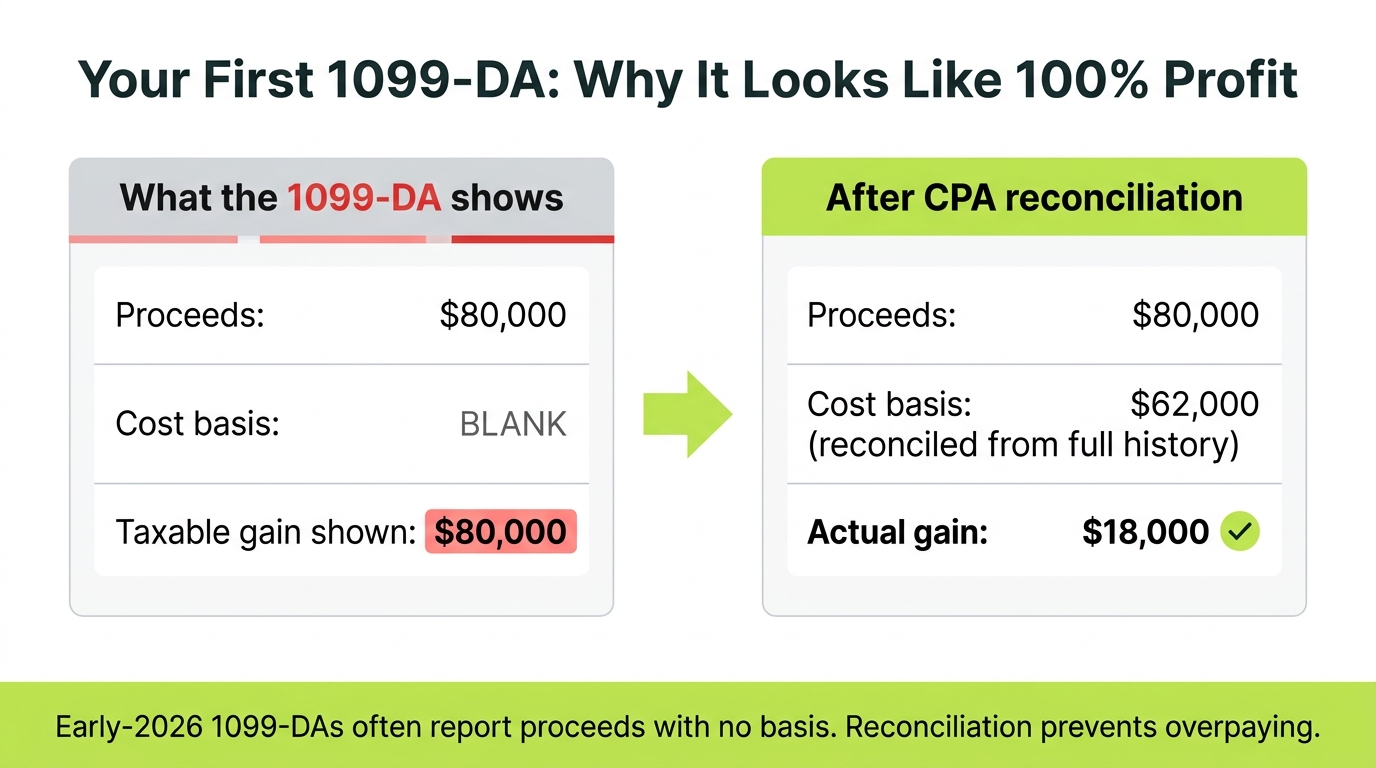
A client panicked that CoinTracker was “broken” because its gains were far lower than the proceeds on his exchange 1099-DA. CoinTracker was right. The exchange only saw his sale, not the original purchase he made years earlier elsewhere, so its implied basis was near zero. With his full history connected, CoinTracker had the real basis. We documented the reconciliation so the difference was defensible. The software was accurate, it just needed the complete picture, and the mismatch needed a professional explanation.
CoinTracker and the 2025 Per-Wallet Rule + 1099-DA
Two 2025/2026 changes matter more than anything else in this review, and most reviews skip both.
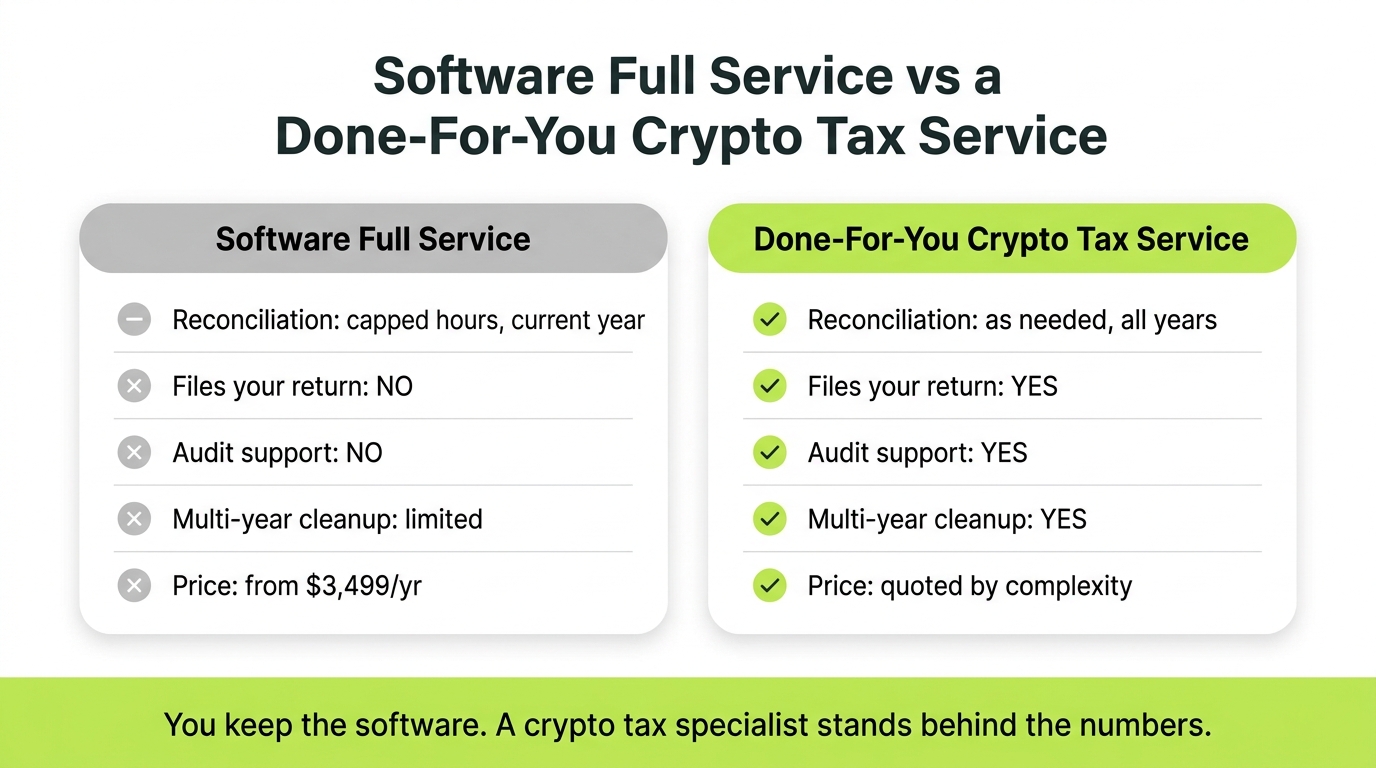
The per-wallet rule (Rev. Proc. 2024-28). Starting January 1, 2025, the IRS requires per-wallet cost basis tracking and ends the old universal pooling method. There is a one-time safe harbor: allocate your unused basis held as of January 1, 2025 across your wallets and lock it in by the due date of your 2025 return (filed in 2026). CoinTracker supports per-wallet tracking, but the allocation is a judgment call the software cannot make for you, and it is permanent.
Form 1099-DA. For 2025 transactions, brokers report gross proceeds only. Cost basis reporting does not begin until covered assets acquired on or after January 1, 2026. So your first 1099-DA, landing in early 2026, will often show proceeds with no cost basis, making a sale look like 100% profit. CoinTracker’s job is to reconcile that form against your real history. That only works if every account is connected.
CoinTracker vs Koinly vs CoinLedger
Weighing the two market leaders? See our full Koinly vs CoinTracker comparison for 2026. For every major tool ranked side by side, start with our best crypto tax software comparison.
| Factor | CoinTracker | Koinly | CoinLedger |
|---|---|---|---|
| Best fit | Coinbase-centric US filers | Active, multi-chain users | Exchange-centric US filers |
| DeFi | Handles mainstream protocols, needs corrections on harder activity | Broader coverage, still needs label checks | Best suited to lighter DeFi |
| Filing handoff | TurboTax and H&R Block | Tax reports for several filing paths | TurboTax and TaxAct |
| Tax-return filing | No | No | No |
| Main distinction | Portfolio tracking and Coinbase connection | Coverage across chains and countries | Simple import-to-download flow |
The Bottom Line
CoinTracker is legit, safe, and accurate for the portfolios it is built for: clean activity on major US exchanges. For that user, it is one of the smoother paths to a finished crypto tax report. For heavy DeFi, high volume, or tangled multi-year history, treat it as the starting point and bring in a crypto tax specialist to reconcile and sign off.
If you are second-guessing your CoinTracker numbers or a 1099-DA mismatch has you worried, that is exactly the kind of review we handle. See when to bring in a CoinTracker expert for the signs it is time.
Key Takeaways
- Bottom line: “is CoinTracker legit” is the wrong worry. The company is established and read-only keys keep your funds safe, so the real question is whether your report is accurate
- For a clean portfolio on major US exchanges with every account connected, you can trust the numbers and file with confidence
- The accuracy risk lives in the gaps: missing wallets create phantom gains, and mislabeled DeFi quietly distorts your basis
- Always connect every account you have ever used before generating a report, or you will tax yourself on coins you never bought
- Decision point: if your activity runs into DeFi, high volume, or a 1099-DA mismatch, the smart move is a crypto tax specialist reviewing the report, not abandoning the tool
Frequently Asked Questions
Is CoinTracker legit?
Yes, CoinTracker is a legitimate, established crypto tax and portfolio tracking company. It integrates with major US exchanges and TurboTax and is widely used. Legitimacy is not the real question for most people, though. The better question is whether it produces an accurate report for your specific situation, which depends on connecting all your accounts and reviewing how it labels complex transactions.
Is CoinTracker safe to use?
CoinTracker uses read-only API connections, which means it can see your transaction history but cannot move or trade your funds. Always connect exchanges with read-only keys and never grant withdrawal permissions to any tax software. Used that way, it is safe. The main risk is not security, it is filing an inaccurate report built on incomplete data.
Is CoinTracker accurate for crypto taxes?
CoinTracker is accurate when every wallet and exchange is connected and transfers are matched. It handles straightforward portfolios on major US exchanges well. Accuracy drops when sources are missing, which causes $0 cost basis and inflated gains, or when DeFi activity is auto-labeled incorrectly. Review the numbers against your own records before filing.
Does CoinTracker support the 2025 per-wallet rule?
Yes, CoinTracker updated for per-wallet cost basis tracking required under Rev. Proc. 2024-28 starting January 1, 2025. Confirm your account settings apply per-wallet basis for 2025 and later, since accounts created under the old universal method can produce unexpected figures.
How much does CoinTracker cost?
CoinTracker prices its tax plans by transaction count, so cost scales with how much you traded. Portfolio tracking has a free tier, and you pay when you need a tax report. Compare the tier that matches your annual transaction volume before buying.
Should I trust CoinTracker or bring in a crypto tax specialist?
For a simple portfolio on major exchanges, CoinTracker plus a careful review is often enough. For high volume, DeFi activity, multiple wallets across chains, or a 1099-DA that conflicts with your records, a crypto tax specialist who uses CoinTracker daily will reconcile it and stand behind the numbers. Many investors use the software and a crypto tax specialist together.