

Most Koinly reviews in 2026 are written by affiliates trying to sell you a subscription. This Koinly review is written by a crypto tax team that cleans up Koinly reports for a living, so we see exactly where it shines and where it quietly produces wrong numbers. Here is the honest version.
Short take: Koinly is one of the best crypto tax tools for active, multi-chain traders, and it is genuinely accurate when its data is complete. The catch is that “when its data is complete” does a lot of work in that sentence.
Disclaimer: This is an independent review for informational purposes. We are not affiliated with Koinly. Always consult a qualified CPA regarding your specific situation.
Quick verdict (TL;DR): Koinly is a strong, accurate crypto tax calculator for active multi-chain investors, with broad exchange coverage and flexible cost basis methods. It is software only, so it does not file your return and it routinely needs human correction on DeFi labeling and missing cost basis. Rating: 4.3 out of 5. Best for active traders who add a review pass before filing. Verdict by Count On Sheep, a crypto tax specialist that reconciles Koinly reports for clients.
Koinly is a crypto tax calculator that imports your wallet and exchange history, classifies each transaction, and generates IRS Form 8949 and Schedule D (plus reports for 100+ countries). It does not file your taxes. You or your crypto tax specialist file the forms it produces.
Quick Verdict
If your Koinly account has problems you cannot untangle yourself, here is when to bring in a Koinly expert.
Koinly earns its reputation for active crypto investors who trade across several exchanges and chains. The capital gains engine is solid, the coverage is broad, and the cost basis options are flexible. Where it struggles is the same place every crypto tax tool struggles: DeFi classification and any coin it cannot trace back to a purchase. If your activity is simple, Koinly is more than enough. If it is complex, Koinly gets you most of the way and a human finishes the job.
Koinly Pricing 2026
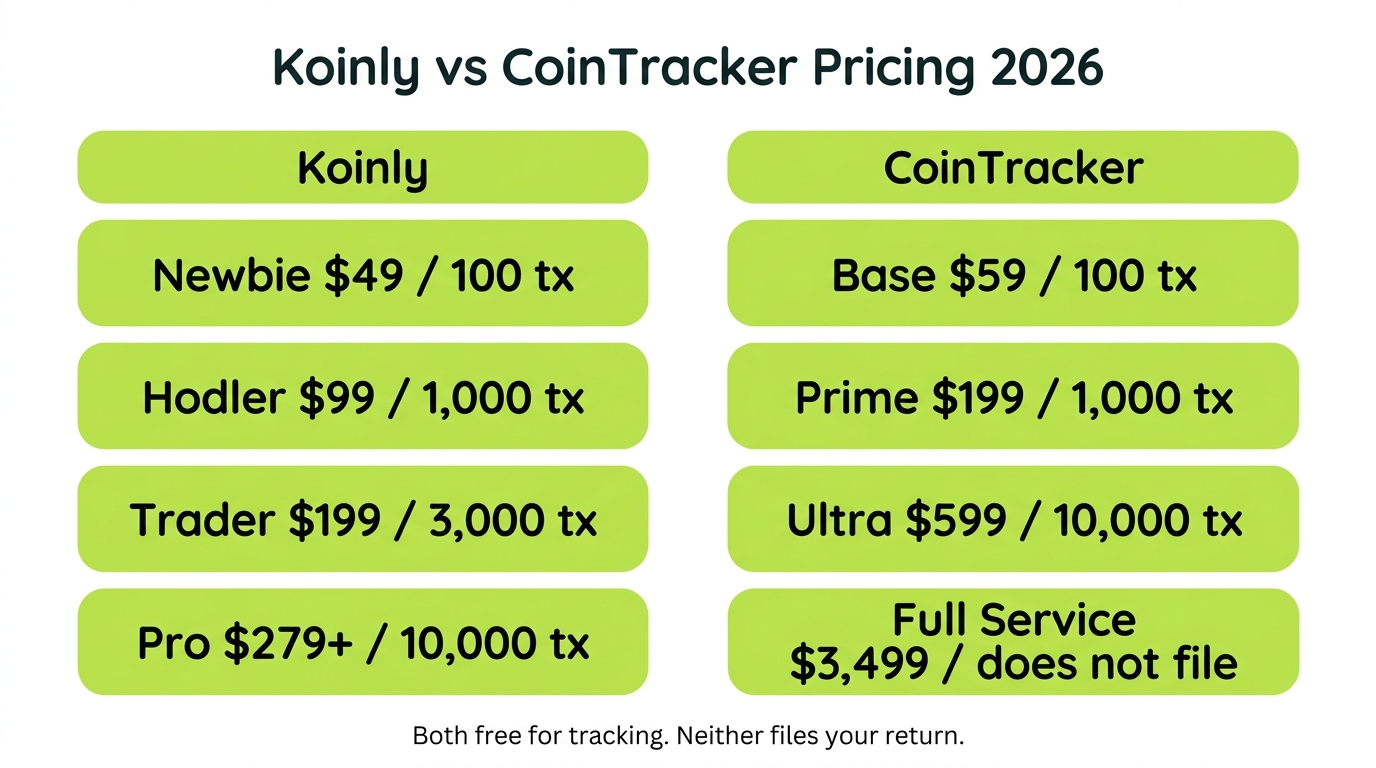
Koinly prices tax reports by transaction count, and portfolio tracking is free. You only pay when you download a tax report. One detail trips up almost everyone: Koinly counts transactions cumulatively across your entire history, not per year, so an old account can land you in a higher tier than this year’s activity suggests.
| Plan | Transaction limit | Price (per tax year) | What you get |
|---|---|---|---|
| Free | Tracking only | $0 | Portfolio tracking and a gains preview. No tax report download. |
| Newbie | 100 | $49 | Form 8949, Schedule D, international reports, unlimited wallet imports |
| Hodler | 1,000 | $99 | Everything in Newbie |
| Trader | 3,000 | from $199 | Priority email support |
| Pro | 10,000 | $279+ | Extra 1,000-transaction packages at $10 each |
Pricing as of 2026. Koinly plans are a one-time charge per tax year, not a recurring subscription.
Hidden cost trap: cumulative transactions
Because Koinly tallies transactions across all years, a wallet you imported once in 2021 still counts against your limit today. If your tier looks higher than expected, the usual cause is duplicate imports or an old wallet, not your current trading. Clean those up before you pay.
What Koinly Does Well
Broad Exchange and Chain Coverage
Koinly connects to a very wide range of exchanges, wallets, and blockchains. For someone with activity spread across many platforms, this breadth is the main reason to choose it.
Flexible Cost Basis Methods
Koinly supports multiple cost basis methods, which matters for matching your accountant’s approach and for legally optimizing gains. Not every tool offers this flexibility at lower tiers.
Clean Capital Gains Math
Once the data is complete and correctly labeled, the actual gain and loss calculations are reliable. The engine is not the problem. The inputs are. Koinly also carries the security credentials you want from a tool holding your full financial history: SOC 2, ISO 27001, and GDPR compliance, with read-only API connections that never touch your funds.
Where Koinly Struggles
This is the part affiliate reviews skip.
DeFi Classification
Koinly imports DeFi activity but routinely mislabels it. Liquidity pool entries get tagged as trades, staking rewards as deposits, and wrapped-token swaps as disposals. Each wrong label changes your tax, and only a human catches them. The Koinly DeFi import guide shows how to re-tag each one correctly.
Missing Source Data Produces Phantom Gains
When Koinly cannot trace a coin to a purchase, it assumes a $0 cost basis and treats the entire sale as profit. A single unconnected wallet can inflate your gains by thousands of dollars. Our guide on fixing wrong Koinly cost basis walks through the repair order step by step.
The Per-Wallet Transition
The 2025 per-wallet rule changed how basis is tracked, and accounts built under the old universal method can show surprising figures this year.
Koinly and the 2025 Per-Wallet Cost Basis Rule
This is the part of crypto tax that almost every software review ignores, and it is the single biggest 2025/2026 trap.
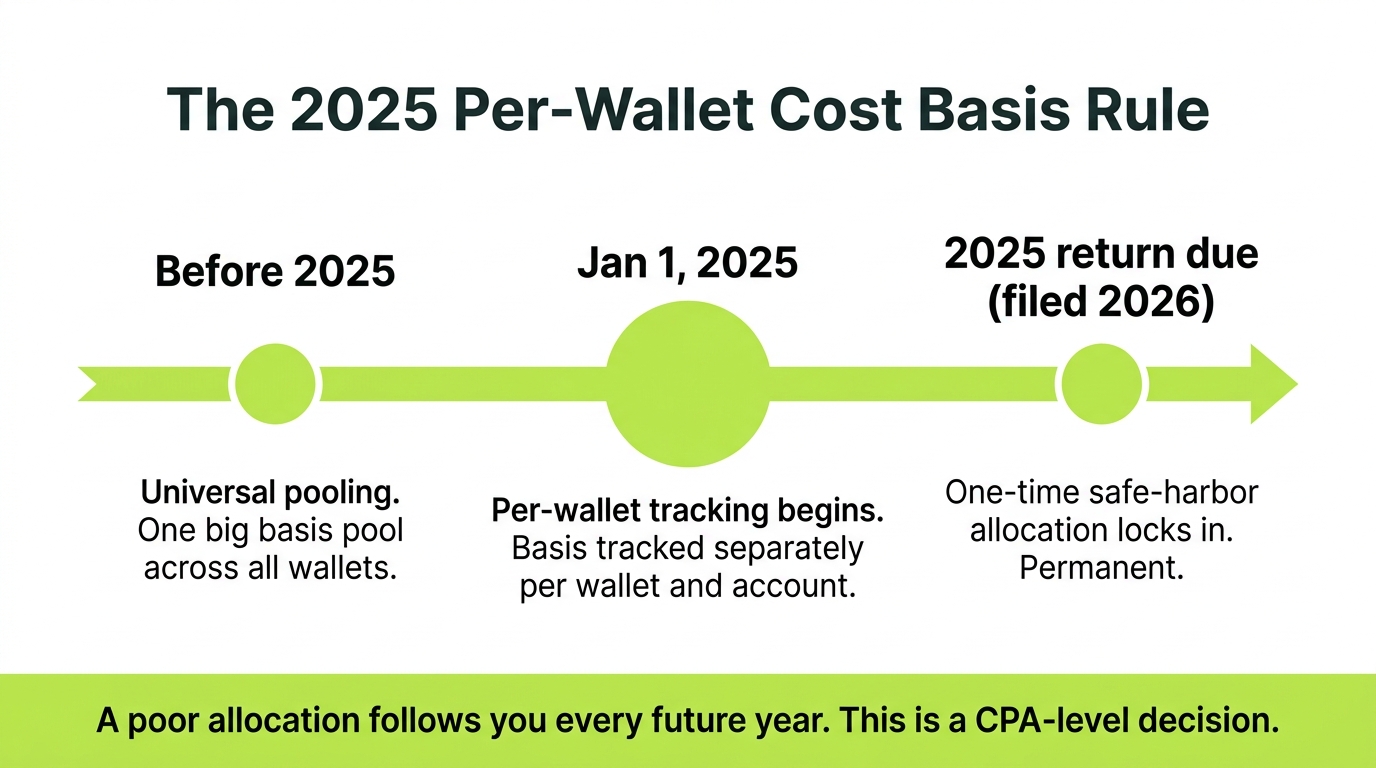
Under Rev. Proc. 2024-28, the IRS now requires per-wallet cost basis tracking for transactions on or after January 1, 2025. The old “universal” method, where you pooled all your basis together, is gone. There is also a one-time safe harbor: you must make a reasonable allocation of your unused cost basis held as of January 1, 2025 across your wallets, and lock it in by the due date of your 2025 return (filed in 2026). Miss that window and you are stuck with whatever allocation defaults you land on, permanently.
Koinly updated for per-wallet tracking, but the software cannot make the allocation judgment for you. It will apply settings; it will not decide the most defensible way to split your basis. That decision affects your gains for every year that follows.
Koinly and Form 1099-DA in 2026
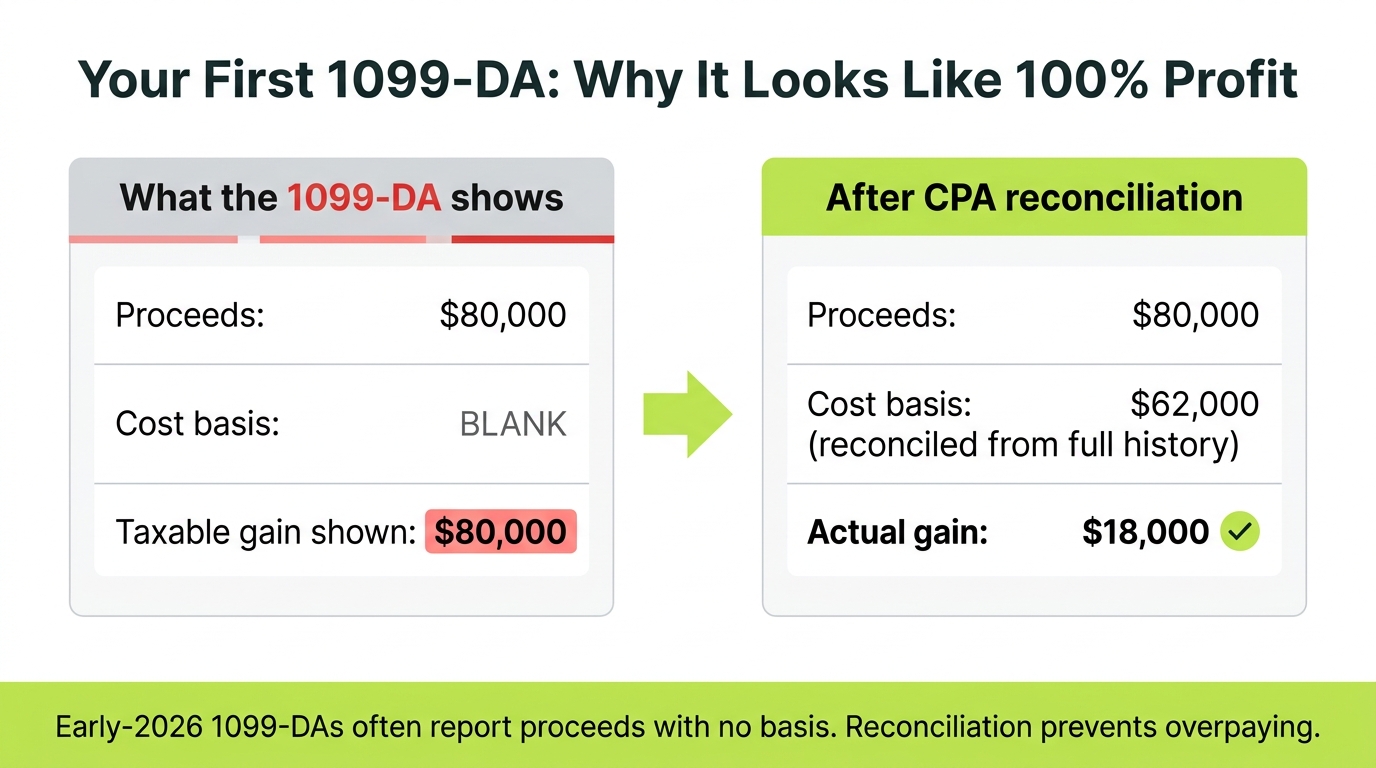
2026 is the first year you may receive Form 1099-DA from exchanges. Here is the catch most people will not see coming: for 2025 transactions, brokers report gross proceeds only. Cost basis reporting does not begin until covered assets acquired on or after January 1, 2026, with those forms landing in 2027.
In plain terms: your early-2026 1099-DA will likely show what you sold for, with a blank or $0 cost basis. To the IRS’s matching system, that can look like the entire sale was profit. Koinly is exactly the tool you use to reconcile the 1099-DA against your real purchase history and prove your actual gain. But it only works if every wallet is connected and the basis is traced. A 1099-DA that conflicts with your records is one of the clearest signals to bring in a crypto tax specialist.
Who Koinly Is Right For
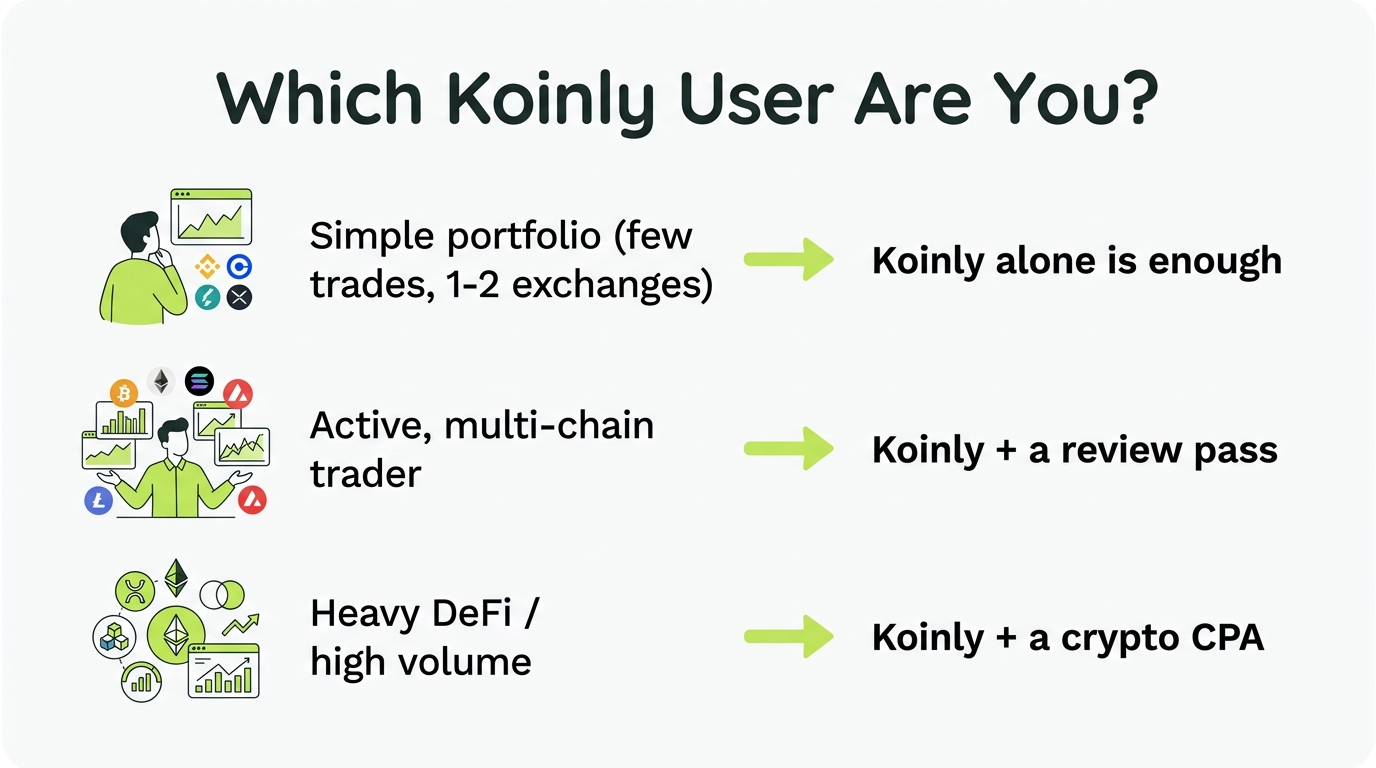
- Simple portfolio (a few buys and sells on one or two exchanges): Koinly alone is plenty.
- Active, multi-chain trader: Koinly is a strong fit, with a review pass before filing.
- Heavy DeFi or very high volume: Koinly as the data layer, a crypto tax specialist for reconciliation and sign-off.
A client trading across five exchanges and three chains came to us sure his Koinly report was wrong: it showed roughly $80,000 in gains. The engine was fine. The problem was a closed exchange he never connected and several mislabeled DeFi transactions. After we connected the missing source, matched transfers, and corrected the labels, his real gain was about $24,000. Koinly was accurate the whole time. It just needed the right inputs.
Koinly vs CoinTracker vs CoinLedger
The three tools people compare most often, from a crypto tax specialist who works in all of them. For a deeper head-to-head, see Koinly vs CoinTracker comparison for 2026, and for the wider field, our full crypto tax software roundup ranks every major tool:
| Factor | Koinly | CoinTracker | CoinLedger |
|---|---|---|---|
| Best for | Active, multi-chain, international | Coinbase users, US filers | Simple US portfolios |
| Exchange/chain coverage | Very broad (800+) | Broad (500+) | Good |
| DeFi depth | Strong import, needs label fixes | Decent, weaker reconciliation | Lighter |
| Cost basis methods | FIFO/LIFO/HIFO | FIFO/HIFO (tier-dependent) | FIFO/HIFO |
| Countries | 100+ | US-centric | US-centric |
| Files your return? | No | No (Full Service does not file either) | No |
No crypto tax tool files your return for you. They generate the forms. A human files them, and a human is what catches the errors above.
When Koinly Is Enough vs When You Need a Crypto Tax Specialist
Koinly alone is fine when your activity is simple and traceable: a handful of buys and sells on one or two exchanges, no DeFi, no missing wallets. You generate the report, review it, and file.
You have outgrown DIY Koinly when you hit any of these: high transaction volume, meaningful DeFi or staking or liquidity-pool activity, multiple chains, years of unreconciled history, a 1099-DA that conflicts with your records, or an IRS notice. At that point Koinly becomes the data layer and a crypto tax specialist does the reconciliation, the per-wallet allocation, and the sign-off.
The Bottom Line
Koinly is an excellent crypto tax tool and a deserving market leader for active traders. It is accurate, broad, and flexible. But it is software, and software cannot interview you about that weird 2021 transaction or decide how to treat an ambiguous DeFi event. For simple situations, run it yourself with a careful review. For complex ones, use Koinly as the foundation and bring in a crypto tax specialist to reconcile and defend the final numbers.
If your Koinly report looks off, or you just want a crypto tax specialist to confirm it before you file, that is exactly what we do. Learn when to bring in a Koinly expert, or hand it off entirely with a done-for-you Koinly tax filing service.
Key Takeaways
- Bottom line: Koinly earns the recommendation, but with a caveat. It is only as accurate as the data you give it, so the verdict depends on how messy your activity is
- Lean on its strengths for active, multi-platform trading: broad exchange and chain coverage, flexible cost basis methods, and reliable gains math
- Go in clear-eyed about the weak spots. DeFi labeling, wrapped and bridged tokens, and zero basis from missing sources are where reports go wrong
- Before you trust 2025 numbers, confirm your per-wallet settings are applied, since the old universal pooling no longer holds
- Decision point: a simple portfolio runs on Koinly alone, while a complex DeFi one needs Koinly plus a crypto tax specialist to review the labels
Frequently Asked Questions
Is Koinly accurate for crypto taxes?
Koinly is accurate when it has complete, correctly labeled data. It does the capital gains math reliably once every wallet and exchange is connected and transfers are matched. Inaccuracy almost always comes from gaps in the inputs, such as a missing wallet causing $0 cost basis, or DeFi transactions that were auto-labeled incorrectly. The software is only as accurate as the data and labeling behind it.
Is Koinly worth it in 2026?
For most active crypto investors, yes. Koinly saves significant time versus manual tracking and handles broad exchange and chain coverage well. It is most worth it for traders with activity across multiple platforms. Very simple portfolios may not need it, and very complex DeFi-heavy portfolios will still need manual review or a crypto tax specialist on top of it.
What are Koinly's biggest weaknesses?
DeFi classification, wrapped and bridged tokens, and any situation with missing source data. Koinly imports DeFi but frequently mislabels liquidity pool, staking, and wrapping events, which a human has to correct. It also assigns $0 cost basis whenever it cannot trace a coin, so incomplete account connections produce inflated gains.
Does Koinly handle the 2025 per-wallet cost basis rule?
Yes, Koinly updated for per-wallet cost basis tracking required under Rev. Proc. 2024-28 starting January 1, 2025. The important step is confirming your account settings actually apply per-wallet basis for 2025 and later, because accounts set up under the old universal method can show unexpected figures.
How much does Koinly cost?
Koinly prices its tax reports by transaction count, so your cost depends on how much you traded during the year. Portfolio tracking is free, and you only pay when you generate a tax report. Compare the tier that matches your annual transaction volume, since high-volume traders land in higher tiers.
Should I use Koinly or bring in a crypto tax specialist?
Many people do both. For a clean portfolio, Koinly plus careful review is often enough. For high volume, meaningful DeFi, multiple chains, years of unreconciled history, or a 1099-DA that conflicts with your records, a crypto tax specialist who uses Koinly daily will produce a more accurate and defensible result. The software is a strong starting point, not always the finish line.