

CoinTracking is the most powerful crypto tax tool most people will ever fight with. It launched in 2013, tracks just about everything, and produces reports deep enough to satisfy a German tax auditor. It is also the platform we see people abandon half-finished more than any other, usually somewhere between their third duplicate import and their first negative balance warning.
This guide covers when CoinTracking alone is enough, when it is time to bring in a crypto tax expert, and what that help actually looks like.
One disambiguation first, because these two get mixed up constantly: CoinTracking (cointracking.info) is the German platform this article covers. CoinTracker (cointracker.io) is a different US product with a similar name. If you are a CoinTracker user, you want our CoinTracker expert help guide instead.
Disclaimer: This guide is for informational purposes only. Always consult a qualified CPA regarding your specific situation.
Why CoinTracking Users End Up Needing Help
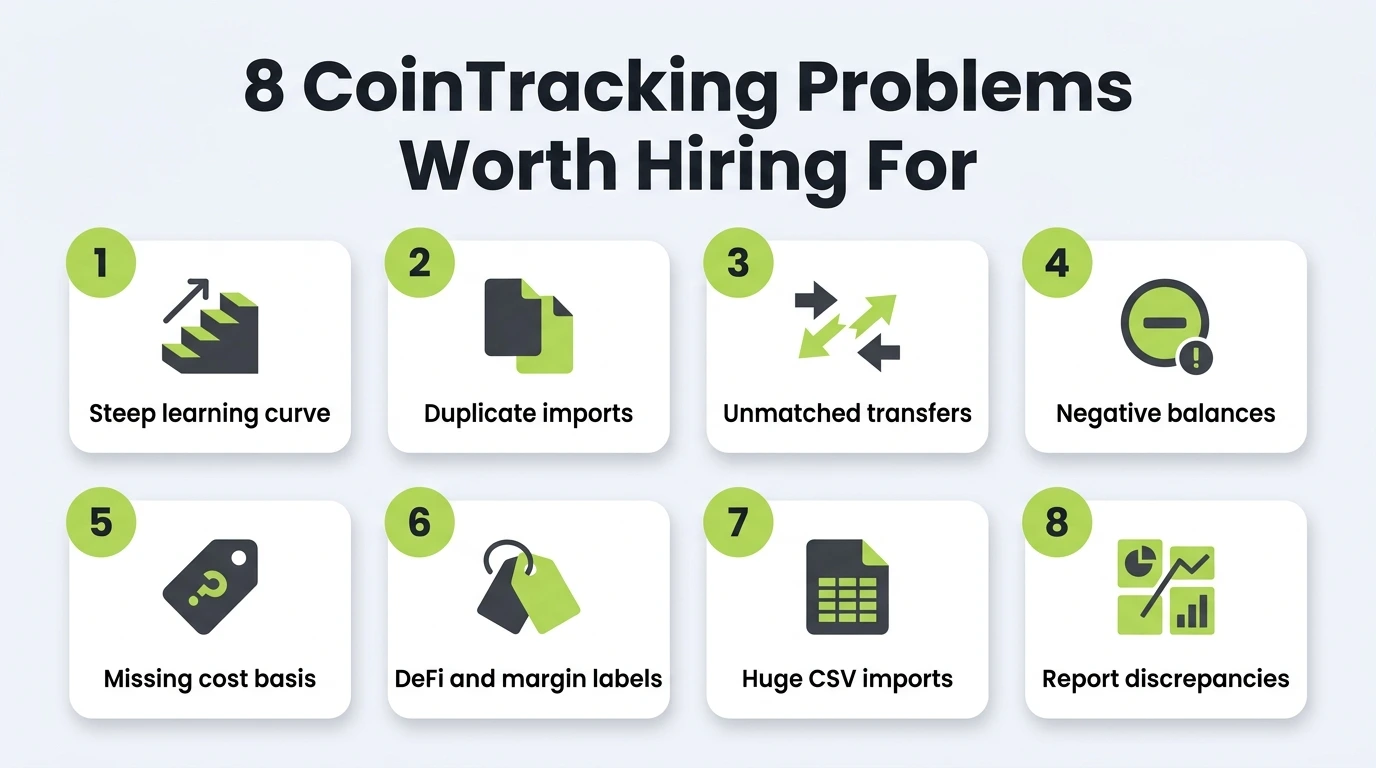
CoinTracking’s depth is the draw and the trap. The same flexibility that lets it handle margin trades and obscure exchanges also gives you a hundred ways to import the same data wrong. These are the problems that fill our inbox:
- The learning curve. The interface has not changed much in a decade. Settings are scattered, the terminology is its own dialect, and the sheer number of transaction types (deposits, withdrawals, trades, margin profits, lending income, and many more) overwhelms first-time users.
- Duplicate imports. Import an exchange by API, then again by CSV, and every trade exists twice. Balances inflate, gains double, and the Duplicate Transactions check under Analysis becomes your new home page.
- Unmatched transfers. When a withdrawal from one exchange is not paired with the matching deposit in your wallet, CoinTracking can treat the movement as a disposal and the arrival as new money with no history. Your own coins moving between your own accounts start generating phantom gains.
- Negative balances. The report says you sold more of a coin than you ever owned. The real cause is almost always a missing source: an unimported wallet, a closed exchange, or a bridge transaction that only recorded the outflow.
- Missing cost basis. Coins that arrive with no purchase history get treated as if they cost $0, which means the entire sale price shows up as gain. On a large sale, that single error can add tens of thousands of dollars to your bill.
- DeFi and margin classification. Liquidity pools, wrapped tokens, bridges, and margin trades import as generic transactions that need correct labels. Each wrong label changes your tax result, and there are usually hundreds of them.
- Huge CSV imports. Years of history from a high-volume exchange means wrestling with file size limits, header formats, and timezone quirks. One malformed column can silently corrupt thousands of rows.
- Report discrepancies. The capital gains report says one number, the balance report implies another, and your exchange statements say a third. Figuring out which one is right is reconciliation work, not software work.
If you only have one or two of these and the portfolio is small, the fixes are usually DIY-able. If you have four or five stacked on top of each other across several years, you are past the point where clicking harder helps.
CoinTracking’s Built-In Help, and Where It Stops
CoinTracking knows its users get stuck, so it sells its own cleanup: the Full-Service program. An expert team reviews your account, fixes the data, and delivers an audit-ready tax report, typically within 7 to 14 days. Packages run from a $69 account review to a $1,099 basic package to the $2,799 advanced package that covers DeFi, NFTs, and bots with no transaction limit. Express hourly work runs about $439 per hour.
For data cleanup alone, it is a legitimate option. But read the fine print: Full-Service prepares the report, and then you or your own tax professional still file the return. Nobody on that team is preparing your Form 8949 and Schedule D as part of a complete US filing, answering an IRS letter with you, or standing behind the return afterward. CoinTracking is a German company, and its US tax support ends at the report.
| CoinTracking Full-Service | Done-for-you crypto tax service | |
|---|---|---|
| Data cleanup | Yes | Yes, all years |
| Audit-ready report | Yes | Yes |
| Prepares and files your US return | No | Yes |
| Audit defense | No | Yes |
| Per-wallet 2025 allocation | Software-led | Specialist judgment, documented |
| Price | $1,099 to $2,799 packages | Quoted by complexity |
The distinction matters most in years like this one, when Form 1099-DA means the IRS is receiving exchange-reported numbers it will compare against yours.
DIY or Hire: A Quick Decision Framework
If your CoinTracking account is small and clean, do it yourself. Connect every source, run the checks under Analysis (Missing Transactions, Duplicate Transactions, Transaction Flow), fix what they flag, verify the totals against your exchange statements, and file. Our best crypto tax software guide can also confirm whether CoinTracking is even the right tool for your situation, and our full CoinTracking review covers its strengths and weak spots in detail.
Here is the matrix we use:
| Your situation | DIY CoinTracking | CoinTracking + review | CoinTracking + specialist |
|---|---|---|---|
| Under ~100 trades, 1-2 exchanges, no DeFi | Yes | ||
| Active trading, some transfers, light DeFi | Yes | ||
| High volume or margin trading | Yes | ||
| Meaningful DeFi, staking, liquidity pools | Yes | ||
| Years of unreconciled history or negative balances | Yes | ||
| 1099-DA mismatch or IRS notice | Yes |
If you are still comparing tools, our Koinly vs CoinTracking comparison breaks down which platform suits which kind of portfolio. And if you are a Koinly user with the same stuck feeling, the Koinly expert help guide is the twin of this article.
What a Crypto Tax Professional Actually Does With Your CoinTracking Data
The mechanical work comes first: import every missing exchange, wallet, and chain (including exchanges that no longer exist), clear the duplicates, pair withdrawals with deposits so transfers stop reading as sales, and chase each negative balance back to its root cause using the Transaction Flow report and on-chain data.
Then comes the part software cannot do, which is judgment:
- Classifying ambiguous DeFi, margin, and bridge activity consistently and defensibly
- Reconstructing cost basis for coins that arrived with no history, instead of accepting $0
- Choosing a cost basis method that is both optimal and supportable
- Reconciling and documenting any 1099-DA mismatch
- Applying the 2025 per-wallet rules correctly
- Producing a report that holds up if the IRS asks questions
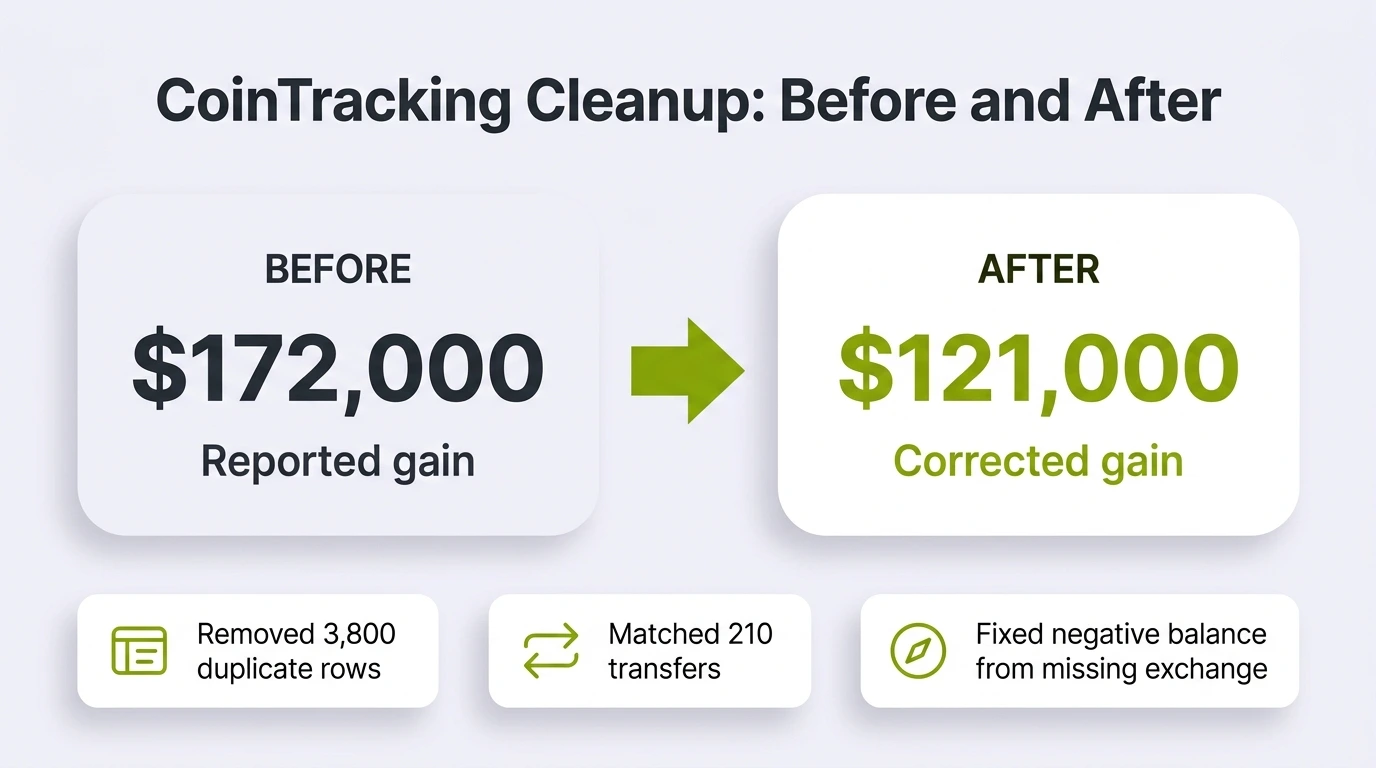
A client came to us with a CoinTracking account he had been maintaining, loosely, since 2016: about 41,000 transactions across 14 exchanges and 6 wallets. CoinTracking showed a $172,000 gain for the year and he knew that was wrong. We found roughly 3,800 duplicate rows from a Binance history imported by both API and CSV, matched about 210 transfers that were being treated as zero-basis disposals, and traced a negative ETH balance to a closed exchange he had never imported. His corrected gain came in near $121,000. That $51,000 difference was worth roughly $10,000 in tax at his rates. He kept CoinTracking. We made the numbers true.
What to Look For in a Crypto Tax Professional
Not every accountant who says “we do crypto” can reconcile a CoinTracking account. Before you hire anyone, ask four questions:
- Have they worked in CoinTracking specifically? The platform has its own import quirks, its own checks, and its own failure modes. Someone who only knows Koinly will burn hours learning on your dime.
- Do they reconcile, or just report? Plenty of preparers will take whatever number the software spits out and put it on a form. You want someone who verifies the number against exchange statements and on-chain data first.
- Do they file and defend? Cleanup without filing leaves you holding the last mile. Ask whether they prepare the actual return and whether they respond with you if the IRS sends a letter.
- Can they explain their judgment calls? How they treat a bridge transaction, why they chose a cost basis method, how they documented a 1099-DA gap. If they cannot explain it to you, it will not hold up when it matters.
How Count On Sheep Works With Your CoinTracking Data
You keep CoinTracking. We do the work. Count On Sheep is a done-for-you crypto tax reconciliation service: you share access to your account or a complete export, and our team imports the missing sources, clears the duplicates, matches the transfers, resolves the negative balances, classifies the DeFi and margin activity, and reconstructs any missing cost basis. Every judgment call gets documented, so the finished report is not just accurate but defensible.
Then we take it through to a return you can actually file, which is the step CoinTracking’s own service leaves on your desk. If your account has years of stacked problems, our crypto tax cleanup service overview explains how multi-year reconciliation works across platforms.
If any of the eight problems at the top of this page sounded like your account, the worst move is waiting for the filing deadline to force a rushed guess. A 20-minute look at your CoinTracking account is usually enough for us to scope what is wrong and what it will take to fix.
Key Takeaways
- Bottom line: CoinTracking is powerful enough for almost any portfolio, but its depth creates duplicates, unmatched transfers, and negative balances that take real reconciliation skill to fix
- Run the built-in checks first. Missing Transactions, Duplicate Transactions, and Transaction Flow will resolve the simple problems for free
- If you have imported everything and the numbers still will not reconcile, the remaining problem is judgment, not clicks. That is when to hire
- CoinTracking Full-Service cleans data and delivers a report, but you still file your own US return with no audit defense
- You keep your software either way. A crypto tax specialist plugs into your existing CoinTracking account, fixes the data, and hands you a finished return you can stand behind
Frequently Asked Questions
Can I hire someone to do my CoinTracking for me?
Yes. A crypto tax specialist can work directly in your CoinTracking account or from a complete export. They import missing sources, remove duplicates, match transfers, fix negative balances, classify DeFi and margin activity, and deliver a finished tax report. You keep CoinTracking as your system of record and hand off the reconciliation work.
How much does CoinTracking help cost?
It depends on volume and complexity. CoinTracking's own Full-Service packages run from about $1,099 to $2,799, with hourly work around $439 per hour. Independent done-for-you services quote by complexity and typically include filing support and audit defense, which CoinTracking's packages do not. Either way, the fee is usually small next to the tax you overpay from wrong cost basis.
Is CoinTracking hard to use?
It has a steeper learning curve than most competitors. CoinTracking is powerful, with deep reports and flexible imports, but the interface is dated and the settings run deep. Simple portfolios are manageable. High-volume, multi-exchange, or DeFi-heavy accounts often produce duplicates, unmatched transfers, and negative balances that take real reconciliation skill to fix.
Does CoinTracking Full-Service file my US tax return?
No. CoinTracking Full-Service cleans up your account and prepares an audit-ready tax report, but you or your own tax professional still file the return with the IRS. If you want someone to reconcile the data, prepare the forms, and stand behind the numbers through filing, you need a done-for-you crypto tax service.
Will a professional work inside my existing CoinTracking account?
Usually yes. Most crypto tax specialists work directly in your CoinTracking account with shared access, or reconcile from a full trade export. You do not need to switch software or rebuild years of history in a new tool. CoinTracking stays your system of record while the professional fixes the data.
What is the difference between CoinTracking and CoinTracker?
CoinTracking (cointracking.info) is a German platform launched in 2013, known for deep reporting and a steep learning curve. CoinTracker (cointracker.io) is a US company with a simpler interface. They are separate products that are easy to confuse. This guide covers CoinTracking; we have a separate guide for CoinTracker users.