

Is swapping SOL for mSOL, JitoSOL, or bSOL taxable? There is no direct IRS answer. The conservative position says yes, it is a crypto-to-crypto trade and a taxable disposal of your SOL. A defensible minority position says no, it is a deposit receipt for staked SOL you still own. That single unsettled question sits at the center of liquid staking taxes, and how you answer it changes your basis, your holding periods, and what you owe on the way out.
This guide walks through the whole liquid staking token (LST) tax picture for 2026 on Solana: what mSOL, JitoSOL, and bSOL actually are, both positions on the entry swap with their honest strengths and weaknesses, how yield accruing inside the token is taxed compared to separate reward drops, redemptions, DEX trades, DeFi use, the JTO airdrop, wash sales, and how to report all of it. It supports our complete Solana tax guide, which covers the rest of the ecosystem.
If you stake SOL natively instead, through a stake account in your own wallet, the rules are more settled and completely different. Start with our guide to Solana staking rewards taxes.
Disclaimer: This guide is for informational purposes only and is not tax or legal advice. Liquid staking taxation is an unsettled area with no direct IRS guidance. Always consult a qualified CPA about your specific situation.
What Liquid Staking Tokens Are
Native Solana staking locks your SOL in a stake account. It earns rewards, but you cannot spend it, trade it, or use it in DeFi without deactivating and waiting out a cooldown. Liquid staking protocols solve that liquidity problem: you hand the protocol your SOL, it stakes across validators, and it hands you back a token representing your staked position. That token stays liquid. You can trade it, lend it, or provide it to pools while the underlying SOL keeps earning.
The big three on Solana:
- mSOL (Marinade). Marinade delegates deposited SOL across a large validator set. mSOL’s redemption rate against SOL rises as staking rewards accrue to the pool.
- JitoSOL (Jito). Same structure, with a twist: Jito’s validator network also captures MEV (maximal extractable value) tips, which are added to the pool, so JitoSOL’s rate reflects staking yield plus MEV yield.
- bSOL (BlazeStake). Another value-accrual pool token following the same appreciating exchange rate design.
The design detail that drives everything in this guide: these are value-accrual tokens. You do not receive reward payments while holding them. Instead, one mSOL slowly becomes redeemable for more and more SOL. Yield lives inside the token as an appreciating exchange rate. Hold 100 JitoSOL for a year and you still hold exactly 100 JitoSOL; it is just worth more SOL than when you started.
The Big Question: Is Swapping SOL for an LST Taxable?
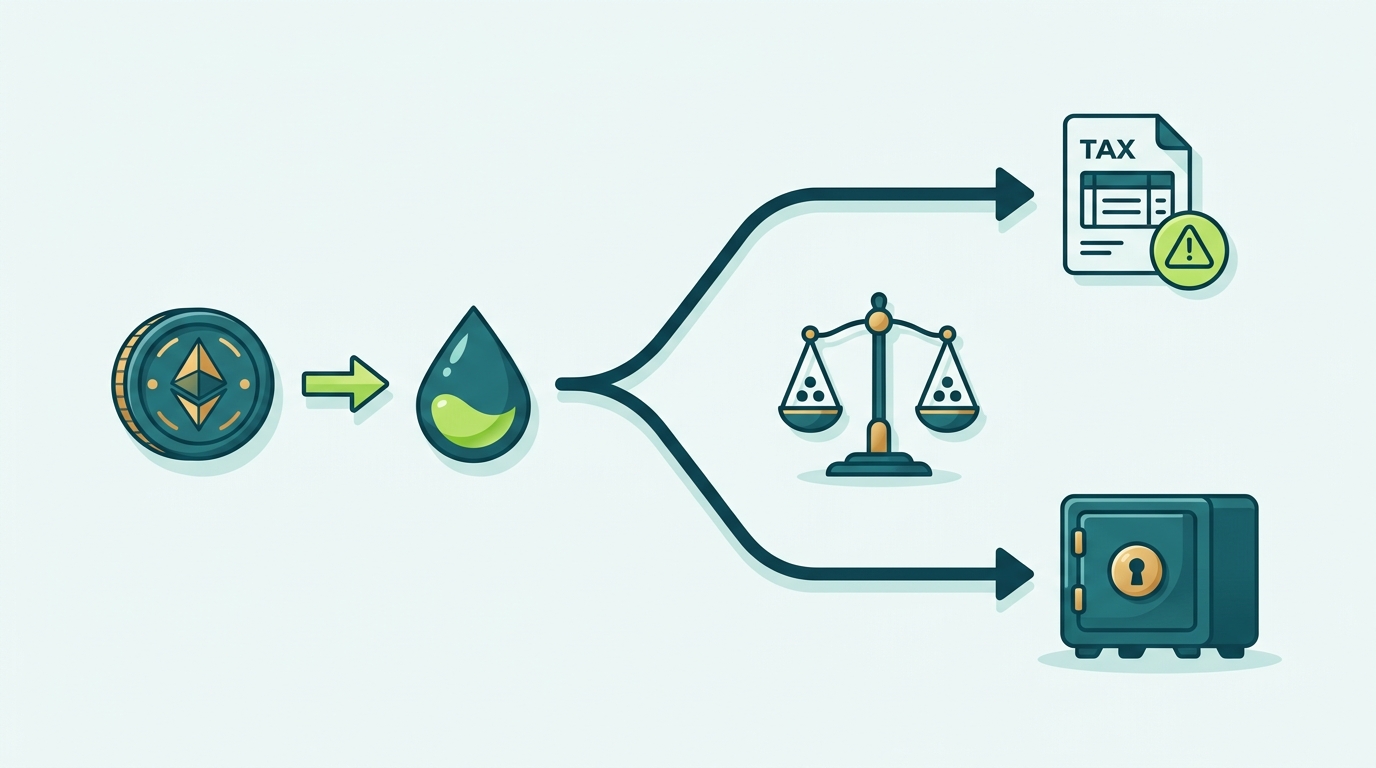
Here is the honest state of the law: the IRS has never addressed liquid staking, wrapping, or deposit-receipt tokens directly. Notice 2014-21 says crypto is property, and exchanging one property for a materially different property is a taxable disposal. Whether an LST is “materially different property” from the SOL that went in is exactly where reasonable positions split.
The Conservative Position: It Is a Taxable Trade
Under this view, swapping SOL for mSOL disposes of your SOL at fair market value, exactly like trading SOL for ETH. The arguments are straightforward:
- You gave up one token and received a different token with its own ticker, its own contract, and its own market price that floats against SOL on DEXs, sometimes at a premium or discount to the redemption rate.
- The LST carries different rights: instant liquidity, DeFi composability, exposure to the protocol’s validator set and smart contract risk, and in Jito’s case, MEV yield that plain SOL does not earn.
- The IRS default for crypto-to-crypto exchanges is disposal, and nothing published carves out staking derivatives.
Consequences: you recognize gain or loss on the SOL at the swap, the LST takes a basis equal to the SOL’s value that day, and a fresh holding period starts. This is what Koinly, CoinTracker, and most major software will calculate by default, and it is the position an examining agent is most likely to accept without argument.
The Aggressive Position: It Is a Non-Taxable Deposit
The counterargument treats the LST as a receipt for property you still beneficially own, like a warehouse receipt or a claim ticket. You deposited SOL, the protocol staked it on your behalf, and the token merely evidences your claim. Nothing was sold; ownership just changed form. On this theory the swap is not a disposal, your original basis and holding period carry over, and tax waits until you truly part with the position.
The argument has real weaknesses to weigh honestly. LSTs trade at market prices that can and do deviate from redemption value, which looks more like a distinct asset than a claim check. Pool-based LSTs give you a share of a changing validator pool rather than a claim on your specific coins. And there is no ruling, case, or regulation blessing the analogy for crypto. Some practitioners are comfortable with the deposit theory, particularly for tightly redeemable tokens; others consider it wishful. If you take it, take it with professional advice, disclose appropriately, and apply it everywhere it logically extends, including the exit.
The Same Swap, Two Positions
You swap 100 SOL, bought years ago for $6,000, into mSOL when SOL trades at $100. Conservative position: you disposed of 100 SOL for $10,000, recognizing a $4,000 long-term gain now; your mSOL takes a $10,000 basis with a new holding period. Deposit position: no gain now; your mSOL inherits the $6,000 basis and the old holding period, and everything is reckoned at redemption. Same swap, very different returns.
How LST Yield Is Taxed While You Hold
Once you hold the LST, the tax picture is actually cleaner than native staking, and it comes down to the difference between value accrual and reward drops.

Value Accrual: No Income While Holding
mSOL, JitoSOL, and bSOL never hand you new tokens. Your balance stays constant while the redemption rate climbs. Under standard tax principles, unrealized appreciation in property you hold is not income, and there is no receipt of new property to trigger Rev. Rul. 2023-14. So the standard treatment is simple: no ongoing income events while you hold a value-accrual LST. The accumulated yield is captured as capital gain when you dispose of the token.
That is a meaningful structural difference from native staking, where every epoch credit is ordinary income at receipt. Value-accrual LSTs effectively defer the tax and, if you hold more than a year, can convert what would have been ordinary-rate staking income into long-term capital gain. That is not a loophole so much as a consequence of the wrapper design, but it is real, and it is one reason high-bracket holders gravitate to LSTs.
Reward-Drop Tokens Are Different
Not every staking derivative uses value accrual. Rebasing tokens, which increase your token balance periodically, and products that pay separate reward distributions put new property in your wallet on a schedule. Those receipts look like income under Rev. Rul. 2023-14, each at fair market value when credited. If you hold anything that grows in quantity rather than redemption rate, treat the increases as income events and track them like native staking rewards. Know which design your token uses before assuming the deferral treatment applies.
With native staking, the yield knocks on your door every epoch and the IRS hears it. With value-accrual LSTs, the yield builds quietly inside the token until the day you let it out.
Redeeming, Trading, and Exiting
Every path out of an LST position is a disposal under the conservative view, and most are disposals under any view.
Redeeming Back to SOL
Unstaking mSOL or JitoSOL through the protocol, whether delayed unstake or instant liquid unstake, returns SOL at the current redemption rate. Conservatively, that disposes of the LST: gain or loss equals the value of SOL received minus your LST basis. Because the rate only rises, a redemption after any meaningful holding period usually shows a gain roughly equal to your accumulated yield plus or minus SOL price movement since entry. The SOL you receive takes a fresh basis at its value on redemption day.
Under the deposit theory, redemption unwinds the deposit, but the accumulated yield still has to be accounted for at this point; the position defers recognition, it does not erase it. This is another place where consistency between your entry and exit treatment matters.
Selling or Swapping LSTs on a DEX
Selling mSOL for USDC on Jupiter or Orca is a taxable disposal under every reading; there is no deposit to unwind, you sold the token to a third party. Proceeds minus basis, short-term or long-term by your holding period, onto Form 8949.
Swapping Between LSTs
Rotating mSOL into JitoSOL to chase MEV yield exchanges one protocol’s token for another protocol’s token. Even deposit-theory advocates struggle here, because you are not redeeming a claim, you are exchanging claims on two different validator pools run by two different protocols. Treat LST-to-LST swaps as taxable disposals.
LSTs in DeFi: Collateral, Pools, and Lending
Liquidity is the whole point of LSTs, so most holders eventually put them to work. Each use has its own tax texture.

Collateral on Lending Protocols
Depositing mSOL or JitoSOL as collateral to borrow against, on protocols like Kamino or MarginFi, is generally not a disposal. Pledging property for a loan does not sell it, and borrowed funds are not income. Two caveats: if the protocol swaps or wraps your token into a different receipt asset on deposit, the entry question resurfaces, and if you are liquidated, the protocol selling your collateral is a taxable disposal at that moment, often at the worst possible price. Liquidations belong on your Form 8949 like any other sale.
Liquidity Pools
Providing mSOL to an mSOL/SOL pool typically means handing over tokens and receiving an LP position or LP token in return. The common conservative treatment is a disposal of the deposited tokens, with the LP token taking basis at the value contributed, and a second disposal when you withdraw. Fees and incentive rewards earned along the way are income as received. DeFi pool taxation is its own maze, and our DeFi and liquidity pool tax guide covers the mechanics in depth.
Lending LSTs
Supplying LSTs to earn lending yield adds interest-style income, taxable as ordinary income as it is credited. The deposit itself raises the same receipt-token question as everything else in this space: if you receive a distinct interest-bearing token in exchange, conservative treatment books a disposal.
Airdrops to LST Holders: The JTO Lesson

In December 2023, Jito airdropped JTO governance tokens to jitoSOL holders and users. At claim, many recipients received five and six figure windfalls. The tax treatment is not gray: airdropped tokens are ordinary income at fair market value when you gain dominion and control, consistent with Rev. Rul. 2019-24 and the dominion standard in Rev. Rul. 2023-14. JTO claimed at $2 per token was $2 per token of income on the claim date, and that value became your basis for the later ride up or down.
Two follow-on points holders miss:
- Selling the airdrop later is a second event. Gain or loss from your claim-date basis, short-term if sold within a year of claim. People who claimed JTO high and sold low have deductible capital losses, but only if the original income was reported.
- NIIT exposure. High earners above $200,000 single or $250,000 married filing jointly face the 3.8% net investment income tax on investment income. LST capital gains count toward NIIT, and large airdrop years can push income over the thresholds so that the gains stacked on top get hit. Anyone with a big JTO claim or large LST gains should have NIIT checked before filing, not after.
Airdrops keep coming in this ecosystem, and holding LSTs is precisely what qualifies you for many of them. Every claim is an income event with a date, a value, and a basis. Log them when they happen.
Wash Sales and Loss Harvesting With LSTs
Under current law, the wash sale rule in Section 1091 applies to stocks and securities, and the IRS classifies crypto as property. So the rule does not reach mSOL, JitoSOL, bSOL, or SOL today: you can sell at a loss and rebuy quickly without the loss being disallowed. That makes LSTs popular harvesting instruments, and some traders even rotate between SOL and an LST to stay exposed while realizing losses.
Keep three cautions in view. Congress has repeatedly proposed extending wash sale treatment to digital assets, so verify the law for the year you are filing. Instant round-trips can attract economic substance scrutiny, where a transaction with no purpose except the tax loss gets challenged; a small time gap and a real market position change strengthen your ground. And every harvesting sale is itself a disposal that needs clean basis records to survive review. Our wash sale guide and loss harvesting guide cover the strategy and its limits.
Record-Keeping and Reporting for LST Holders
The reporting mechanics are standard once your positions are documented; the work is in the documentation.
Records to keep per Rev. Proc. 2024-28’s per-wallet rules:
- Every wallet address that ever held SOL or LSTs, with lots tracked per wallet, as covered in our per-wallet cost basis guide.
- Entry swaps: date, SOL given, SOL fair market value, LST received, and the position you took on taxability.
- Redemption rates and market prices at every entry and exit, since LSTs can trade away from redemption value.
- Airdrop claims with date and fair market value.
- DeFi deposits, withdrawals, liquidations, and reward claims involving LSTs.
Where it all goes:
- LST disposals (redemptions, DEX sales, LST-to-LST swaps, liquidations) go on Form 8949 and Schedule D with proceeds, basis, and holding period.
- Airdrops, incentive rewards, and lending yield go on Schedule 1 as other income, or Schedule C if you are somehow operating a business around it.
- The entry swap goes on Form 8949 under the conservative position, or is documented and disclosed appropriately under the deposit position.
- Answer the Form 1040 digital asset question truthfully; LST activity is a clear yes.
If you move LSTs or redeemed SOL to a centralized exchange and sell there, the exchange’s Form 1099-DA will report gross proceeds without your basis. The reconciliation burden is yours, and it is only manageable if the wallet-side history above actually exists. Wallet imports through Phantom addresses into crypto tax software handle most of the raw data collection; your job is reviewing how the software classified the swaps, because the entry-swap default may not match your chosen position.
Direct Staking vs Liquid Staking: The Tax Scorecard
Pulling the threads together, here is how the two paths compare for a US taxpayer:

- Entry. Native staking: delegating is not taxable. LSTs: taxable disposal under the conservative view, gray under the deposit theory.
- Yield. Native: ordinary income every epoch, taxed at receipt, at your marginal rate, as detailed in our Solana staking tax guide. Value-accrual LSTs: no income while holding; yield realized at disposal, potentially at long-term capital gains rates.
- Exit. Native: unstaking is not taxable; only later sales are. LSTs: redemption or sale is a disposal that releases the accumulated gain.
- Record volume. Native: hundreds of small income entries per year. LSTs: a handful of disposal events, but each carrying an unsettled legal question.
- Extras. LSTs add DeFi composability, airdrop eligibility, and NIIT-relevant gains; native staking adds Schedule C questions only for validator operators.
Neither path is a free lunch. Native staking trades certainty for a steady drip of ordinary income. LSTs trade deferral and rate advantages for gray areas and DeFi complexity. What matters for your return is that the path you actually took is reported consistently, with records that back every number.
Bottom Line
Liquid staking token taxes come down to one unsettled question and a lot of settled ones. The entry swap is genuinely gray: taxable trade under the conservative reading, non-taxable deposit under an aggressive one, with no direct IRS guidance either way. Almost everything else is workable with normal principles: no income while a value-accrual token appreciates, disposals at redemption and on DEX trades, ordinary income for airdrops like JTO, no wash sale rule for now, and NIIT waiting for high earners. The taxpayers who get hurt are not the ones who chose the “wrong” position; they are the ones with no position, no records, and software defaults they never reviewed.
If your history includes mSOL, JitoSOL, or bSOL entries and exits, DeFi layers, or a JTO claim you are not sure was reported right, that is squarely the kind of mess we untangle. Count On Sheep reconciles the full on-chain history, documents your positions, and delivers CPA-ready numbers to you and your tax preparer. Book a 15-minute call with a crypto tax specialist, or reach out to our team for a full liquid staking review.
Related Reading
- Solana Tax Guide: The Complete Picture
- Solana Staking Rewards Taxes
- NFT & DeFi Taxes: Liquidity Pools, Staking, Lending
- Crypto Wash Sale Rule in 2026
- Per-Wallet Cost Basis Under Rev. Proc. 2024-28
- Form 1099-DA Explained
- Phantom Wallet Tax Guide
Frequently Asked Questions
Is swapping SOL for mSOL or JitoSOL a taxable event?
There is no direct IRS guidance, so this is a genuine gray area. The conservative position treats the swap as a crypto-to-crypto exchange and therefore a taxable disposal of your SOL, because you receive a different token with its own market price. A more aggressive position argues it is a non-taxable deposit where you retain ownership of the staked SOL. Most tax software defaults to the conservative treatment, and whichever position you take should be applied consistently and documented.
Are liquid staking rewards taxable as income?
For value-accrual tokens like mSOL, JitoSOL, and bSOL, staking yield shows up as an increase in the token's redemption rate against SOL rather than as separate reward payments. Under the standard treatment, that internal appreciation is not income as it accrues. It is captured as capital gain when you eventually swap, redeem, or otherwise dispose of the token.
Is redeeming mSOL or JitoSOL back to SOL taxable?
Under the conservative position, yes. Redeeming or unstaking an LST back to SOL disposes of the LST, and you recognize gain or loss equal to the value of SOL received minus your basis in the LST. Because the exchange rate rises over time, redemptions typically produce a gain that reflects your accumulated staking yield.
How is direct Solana staking taxed differently from liquid staking?
Native staking produces ordinary income at every epoch, roughly every two to three days, taxed at receipt. Value-accrual LSTs produce no ongoing income under the standard treatment; the yield accumulates inside the token and is realized as capital gain at disposal. That difference affects timing, tax rate, and record-keeping volume, and it is one of the main reasons the two paths deserve separate analysis.
Was the JTO airdrop taxable for jitoSOL holders?
Yes. Airdropped tokens are ordinary income at fair market value when you gain dominion and control over them, under the same principles as Rev. Rul. 2019-24 and Rev. Rul. 2023-14. JTO claimed in December 2023 was income at its value on the claim date, and that value became your basis in the JTO.
Do wash sale rules apply to liquid staking tokens?
Under current law, no. The wash sale rule in Section 1091 applies to stocks and securities, and the IRS treats crypto as property, so selling an LST at a loss and rebuying it quickly does not disallow the loss today. Congress has repeatedly proposed extending wash sale rules to digital assets, so this could change, and aggressive same-day harvesting still carries economic substance risk.
Is using mSOL or JitoSOL as DeFi collateral taxable?
Depositing an LST as loan collateral is generally not a disposal, similar to pledging any property for a loan. Liquidation is different: if the protocol seizes and sells your collateral, that is a taxable disposal at that moment. Providing LSTs to liquidity pools is murkier and often treated as a disposal when you receive LP tokens in exchange.
Are trades between different LSTs taxable, like mSOL to JitoSOL?
Yes, almost certainly. Even people who argue the SOL to LST swap is non-taxable have a hard time extending that to trades between two different protocols' tokens. Swapping mSOL for JitoSOL on a DEX exchanges one distinct asset for another and is best treated as a taxable disposal.
What cost basis does my LST have?
Under the conservative treatment, your LST's basis is the fair market value of the SOL you gave up at the moment of the swap, and your holding period starts then. Under the deposit theory, basis and holding period carry over from your original SOL. This is one of the practical reasons your choice of position matters: it changes both your basis and whether later gains are short-term or long-term.
Does the 3.8% net investment income tax apply to LST activity?
It can. Capital gains from selling or redeeming LSTs are investment income, and for high earners above the NIIT thresholds, the 3.8 percent net investment income tax stacks on top of capital gains rates. Airdrop income like JTO may also factor into the calculation depending on classification. High-income holders should flag LST gains for NIIT review.
How do I report liquid staking tokens on my tax return?
Under the conservative approach: report the SOL to LST swap and any later LST disposal on Form 8949 and Schedule D as capital gains or losses, and report airdrops like JTO as other income on Schedule 1. Import your wallet addresses into crypto tax software, review how it classified each swap, and make sure your position is applied consistently across all years.
Which is better for taxes, native staking or liquid staking?
Neither is automatically better. Native staking creates frequent ordinary income taxed at your marginal rate but with no disposal question on entry. Value-accrual LSTs defer tax until disposal and can convert yield into long-term capital gains, but the entry and exit swaps raise unsettled questions and DeFi use adds taxable events. The right answer depends on your holding period, income level, and appetite for gray areas.