
Is mined Bitcoin taxable? Yes, twice, at two separate moments. Every coin you mine is ordinary income at its fair market value the day it hits your wallet, and every coin you later sell is a capital gain or loss measured against that income value. Whether you run two ASICs in a garage or two hundred in a warehouse, those two events are the skeleton of every mining tax return. Everything else, from Schedule C to depreciation to quarterly estimates, hangs off that frame.
Mining sits in an unusual spot in the tax code. It is one of the few crypto activities that can be a full trade or business, with self-employment tax, equipment write-offs, and electricity deductions, and it is also one of the easiest to get catastrophically wrong. Miners who never book income at receipt end up selling coins with zero basis. Hobby miners who deduct expenses they are not entitled to invite audits. Business miners who skip quarterly estimates hand the IRS penalty interest for no reason.
This guide covers Bitcoin mining taxes end to end for 2026: the hobby versus business line and why it controls everything, income timing for pool payouts, Schedule C and self-employment tax with real numbers, equipment depreciation under the restored 100% bonus rules, electricity and home-office deductions, quarterly estimates, state angles, selling mined coins, and how Form 1099-DA changes the risk picture. It is part of our complete Bitcoin tax guide, alongside our guides to Bitcoin ETF taxes, selling Bitcoin, Ordinals and BRC-20 tokens, and wrapped Bitcoin in DeFi.
Disclaimer: This guide is for informational purposes only and is not tax or legal advice. Cryptocurrency rules change quickly. Always consult a qualified CPA about your specific situation.
The Two Tax Events in Every Mined Bitcoin
Start with the frame, because every mistake in mining taxes is a failure to separate two distinct moments.
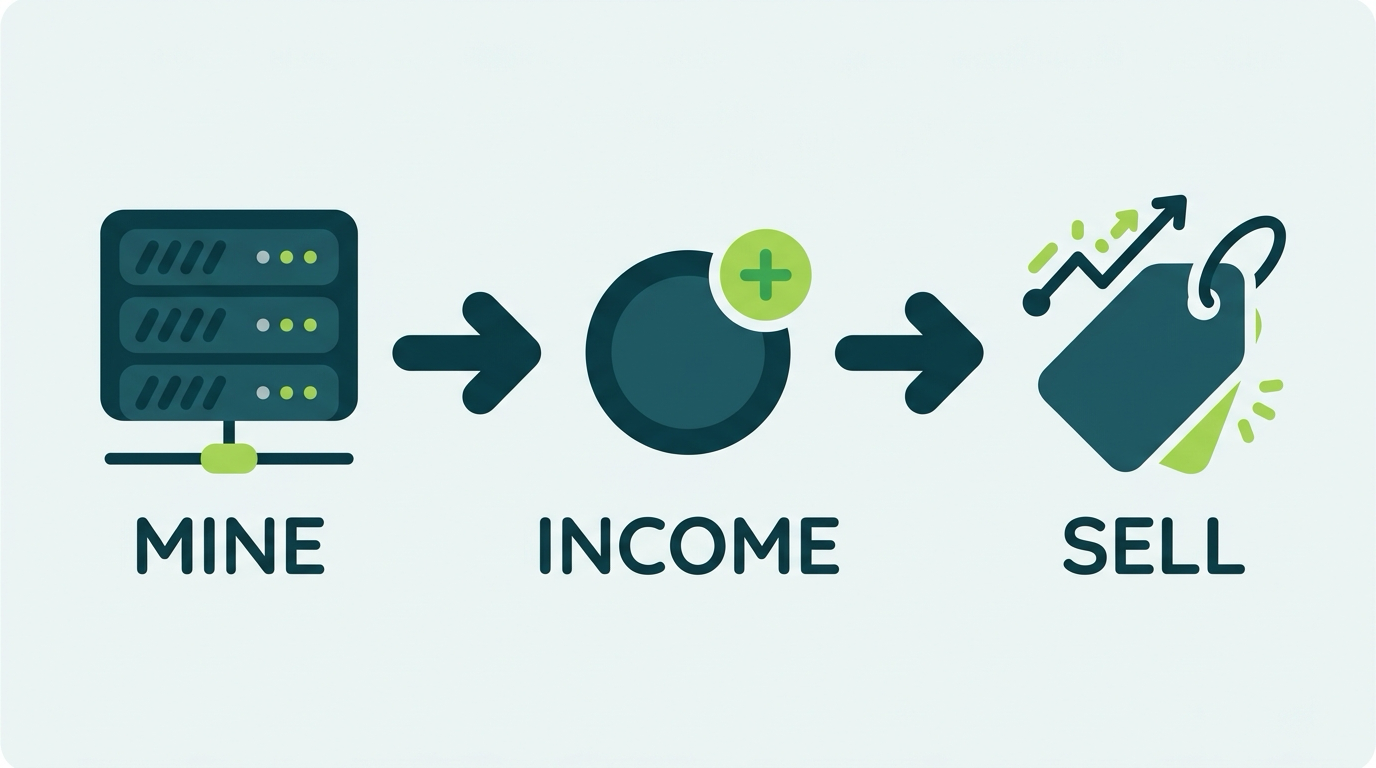
Event one: receipt. Under Notice 2014-21, the IRS’s foundational crypto guidance, a taxpayer who mines cryptocurrency has gross income equal to the fair market value of the coins on the date of receipt. If your rig earns 0.005 BTC on a day Bitcoin trades at $100,000, you have $500 of ordinary income that day. Whether you sell immediately or hold for a decade, the income already happened.
Event two: disposal. The income value from event one becomes your cost basis, and your holding period starts at receipt. When you sell, swap, or spend the coins, you realize a capital gain or loss against that basis under the normal capital gains rules. Held over a year from receipt, the gain is long-term. Sold quickly, any small move since receipt is a short-term gain or loss, usually tiny.
The two events are independent. Miners who sell rewards the same day they receive them still have full ordinary income, just with almost no capital gain on top. Miners who hold through a crash still owe income tax on the receipt-day value, with only a capital loss to show for the decline. That asymmetry drives most of the planning in this guide.
One more foundational point: the character of event one is ordinary income at your marginal rate. There is no long-term rate for mining rewards, no matter how long you have been mining. The preferential rates only ever apply to event two.
Hobby Miner or Business Miner: The Classification That Drives Everything
Before a single deduction gets calculated, your mining activity has to be classified as either a hobby or a trade or business. The label changes the forms, the rates, and, most importantly, whether your expenses count at all.
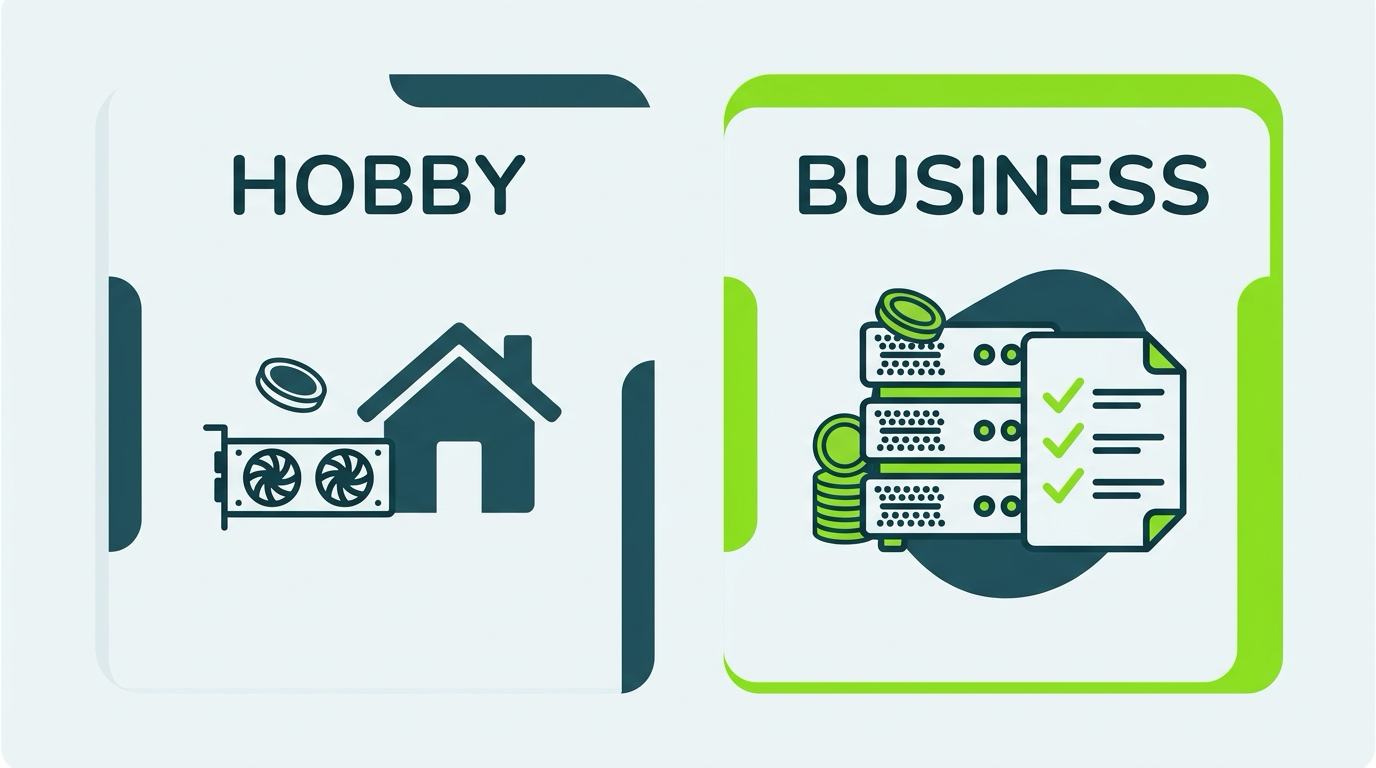
Hobby miners report the fair market value of coins received as other income on Schedule 1 of Form 1040. That is the entire filing. No electricity deduction, no equipment write-off, no home office. The TCJA suspended the miscellaneous itemized deductions that once let hobbyists offset hobby income, and that suspension is now permanent law. A hobby miner with $6,000 of coin income and $4,000 of power bills pays tax on the full $6,000. The upside is simplicity and no self-employment tax.
Business miners file Schedule C, deduct ordinary and necessary expenses, depreciate or expense equipment, and pay self-employment tax on net profit. Losses in bad years can generally offset other income, subject to hobby-loss and at-risk limits. The compliance burden is real, and so is the benefit: for any miner with material expenses, business treatment is dramatically better math.
So where is the line? There is no bright-line test. The IRS weighs factors drawn from the hobby-loss regulations: whether you operate in a businesslike manner with complete books and records, the time and effort you put in, your expertise, your history of profit or loss, and whether the activity has a genuine profit motive. Applied to mining, the practical markers look like this:
- Businesslike operation. Separate bank account and wallet, tracked payouts, logged expenses, a spreadsheet or software that could survive an audit.
- Regular, sustained activity. Rigs monitored and maintained, downtime addressed, firmware updated, pool performance compared. Not a machine someone plugged in once and forgot.
- Economic rationality. Power costs measured against expected rewards, hardware chosen on payback math, decisions that make sense if the goal is profit.
- Scale and intent. Nothing in the law requires scale, and a single efficient ASIC run deliberately for profit can be a business. But a rig that mostly heats the garage while losing money looks like a hobby no matter what the owner calls it.
Same Rig, Two Classifications
Dana mines $9,000 of BTC during the year with $5,000 of electricity and a $3,000 rig. As a hobby, Dana reports $9,000 of income and deducts nothing: at a 24% bracket that is $2,160 of tax. As a documented business, Dana deducts the power and expenses the rig, leaving $1,000 of net profit. Income tax plus self-employment tax on that profit is roughly $380, and the QBI deduction trims it further. Identical mining, identical coins, wildly different bill.
Income at Receipt: Valuing Pool Payouts
Almost nobody solo-mines Bitcoin anymore. Real-world mining income arrives as pool payouts, and the mechanics matter for timing.
The income event is when you gain dominion and control over the coins: the moment a payout lands in a wallet or account you control. Three practical consequences follow.
Payout thresholds delay income. Most pools accrue your earnings internally and pay out when you cross a threshold, often 0.001 or 0.01 BTC. While the balance sits on the pool’s ledger below the threshold, you generally cannot move it, so the conservative and common treatment is income at payout, not at accrual. A pool balance that crosses the threshold on December 30 and pays out January 2 is next year’s income.
Every payout is its own income entry. A miner on daily FPPS payouts has 365 income events a year, each valued at the market price at its timestamp. This is not hand-calculable at any real scale. Crypto tax software that ingests wallet addresses and applies per-payout pricing is effectively mandatory, and the miner’s job is verifying that payouts are classified as mining income rather than deposits or transfers.
Consistency beats precision theater. Use one defensible price source (a major exchange feed or your software’s pricing engine) and apply it to every payout all year. Cherry-picking a daily low for big payout days and a daily average elsewhere is the kind of pattern that unravels under exam.
Mined coins also count toward the digital asset question on Form 1040, and mining income belongs on the Schedule 1 line for digital assets received as rewards (hobby) or on Schedule C gross receipts (business). Our crypto income guide covers how mining sits alongside staking and airdrop income if you have several income streams.
Schedule C and Self-Employment Tax: The Business Miner’s Return
Business miners report gross mining income and expenses on Schedule C, and the net profit flows to two places: Form 1040 as ordinary income, and Schedule SE for self-employment tax.
Self-employment tax is 15.3% on 92.35% of net Schedule C profit: 12.4% for Social Security (up to the wage base, $184,500 for 2026) and 2.9% for Medicare with no cap, plus an extra 0.9% Medicare surtax above $200,000 single or $250,000 married filing jointly. Half of the self-employment tax is deductible against income. Most miners also qualify for the 20% qualified business income (QBI) deduction, now permanent, which shelters a fifth of net profit from income tax (but not from self-employment tax).
Here is what the whole stack looks like with real numbers.
A Profitable Garage Operation
Marcus mines $75,000 of BTC (fair market value at receipt) during 2026. His deductions: $22,000 of electricity, $10,000 of rigs fully expensed in year one, $2,000 of hosting fees and repairs, and $1,000 of software and internet. Net Schedule C profit: $40,000. Self-employment tax runs about $5,650, half of it deductible. After the QBI deduction, roughly $29,400 of the profit faces income tax; in the 22% bracket that is about $6,500. Total federal hit: near $12,000 before credits, closer to $10,000 after the interactions settle. His basis in the mined coins is the full $75,000, so selling near receipt prices adds almost nothing.
Two structural notes for growing operations. A single-member LLC changes liability exposure, not federal taxes; the return is still Schedule C. An S corporation election can reduce self-employment tax by splitting profit into reasonable salary (payroll-taxed) and distributions (not), but it adds payroll filings, a separate 1120-S return, and scrutiny of what “reasonable salary” means for a miner. The break-even is usually around $75,000 to $100,000 of consistent net profit. Below that, the added cost and complexity outruns the savings.
Equipment: Section 179, Bonus Depreciation, and the 2026 Rules
Mining hardware is expensive, it depreciates fast in the real world, and the tax code currently lets business miners match that reality by writing it off immediately. Two overlapping tools do the work.
100% bonus depreciation is back, permanently. The One Big Beautiful Bill Act, signed July 4, 2025, restored full expensing for qualified property acquired and placed in service after January 19, 2025, and made it permanent rather than phasing down. ASICs, GPUs, power distribution units, transformers, immersion cooling systems, and racks are all qualified property with recovery periods well under 20 years. New or used equipment qualifies, as long as it is new to you.
Section 179 expensing runs in parallel: for tax years beginning in 2026 you can elect to expense up to $2,560,000 of equipment, with the deduction phasing out once total purchases exceed $4,090,000. Section 179 is limited to your business income (it cannot create a loss), while bonus depreciation has no such limit.
For most miners the practical playbook is simple: expense everything in year one, using bonus depreciation by default and Section 179 where state rules or income limits make it the better fit. The wrinkles worth knowing:
- Placed in service means running. A rig in a box on December 31 is not deductible for that year. Powered on and hashing is. Year-end hardware purchases need to be racked and mining before January 1 to count.
- Loss years favor bonus. Bonus depreciation can create or deepen a net loss that offsets other income (subject to excess business loss limits). Section 179 cannot exceed business income; the excess carries forward.
- States do not all follow. Several states decouple from federal bonus depreciation, and California famously allows neither bonus depreciation nor more than $25,000 of Section 179. A California miner expensing $200,000 of rigs federally still depreciates them over years on the state return. Check your state before assuming the federal answer travels.
- Selling equipment triggers recapture. Fully expensed rigs have zero basis, so selling used ASICs later produces ordinary income up to the original deduction. Budget for it when you flip hardware after a halving.
Depreciation strategy is one of the highest-leverage decisions a mid-size operation makes, and it interacts with entity choice, state conformity, and loss limits. Fifteen minutes with a crypto tax specialist before a big hardware buy routinely pays for itself.
Electricity, Hosting, and the Home Miner’s Deductions
Power is the largest ongoing cost of mining, and it is fully deductible for business miners: the challenge is proof, not eligibility.
Dedicated facilities are easy. A hosting contract or a commercial space with its own meter produces clean invoices. Deduct them.
Home mining requires allocation. Only the electricity the rigs actually consume is deductible, and the IRS will not take “most of my bill” as an answer. The strong move is measurement: a dedicated circuit with a sub-meter, or smart plugs and PDUs that log kilowatt-hours per rig. Rig nameplate wattage multiplied by logged uptime hours, times your utility’s rate per kWh, is a defensible fallback. An S19-class ASIC pulling around 3 kW around the clock consumes roughly 2,200 kWh a month; at $0.12 per kWh that is about $265 a month, or over $3,100 a year, of documentable deduction per machine.
The home office and workspace deduction can apply to space used exclusively and regularly for the mining business: a dedicated rig room or the office where you manage the operation. The simplified method allows $5 per square foot up to 300 square feet. Exclusivity is the trap; the guest room that also hosts rigs does not qualify.
Everything else ordinary and necessary: internet allocable to mining, pool fees (often netted from payouts, but deductible if booked as gross income), firmware and monitoring software, repairs and replacement fans, cooling, shipping, and travel to a hosting site. Pool fees deserve a check in your software: if payouts import net of fees, do not deduct the fees again.
Quarterly Estimated Taxes: The Penalty Nobody Budgets For
Employees have withholding. Miners have nothing. The IRS expects tax to arrive as income does, which for meaningful mining income means quarterly estimated payments on April 15, June 15, September 15, and January 15.
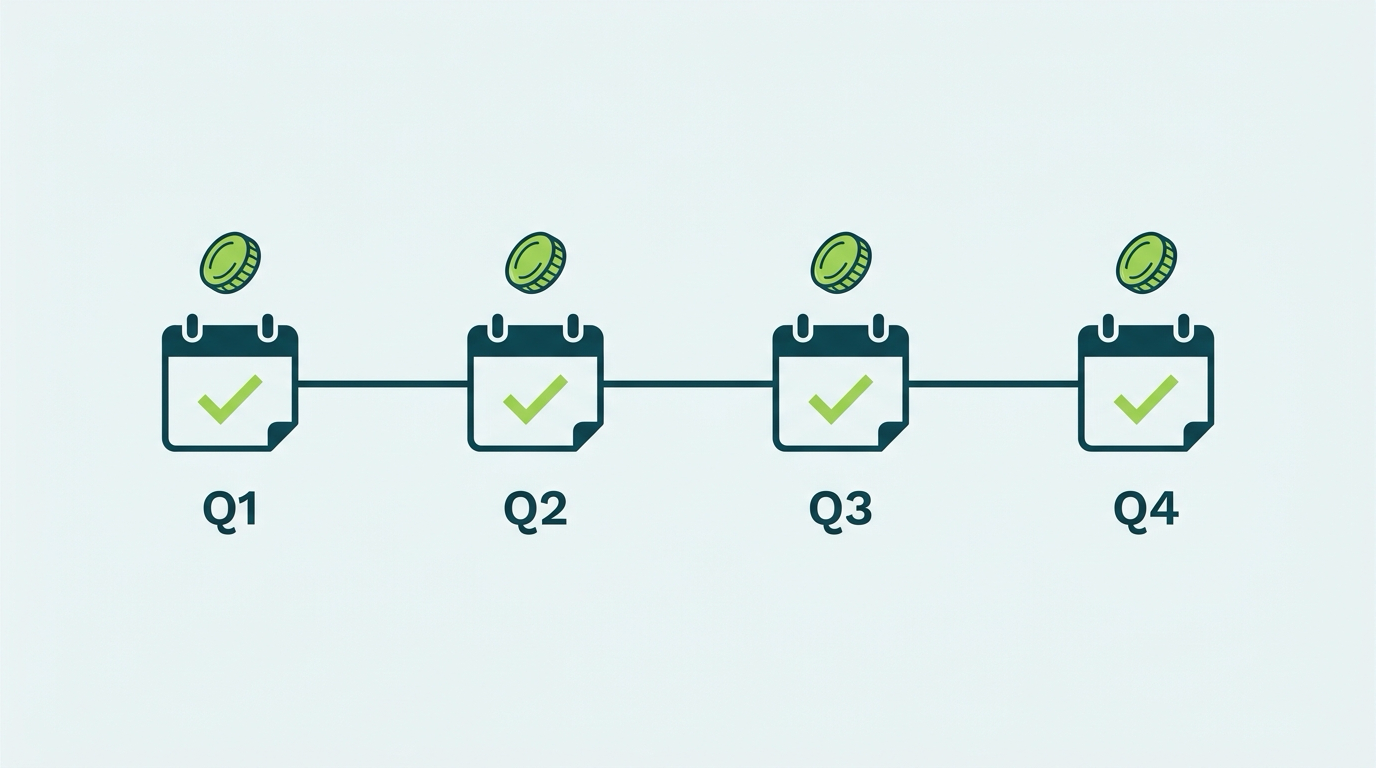
The safe harbors keep you penalty-free: pay in at least 90% of the current year’s tax or 100% of last year’s total tax (110% if last year’s AGI topped $150,000), in even quarterly installments. Fall short and the underpayment penalty accrues quarterly at the federal short-term rate plus three points, which has been running near 7 to 8% annually. It applies even if you pay every dollar by the filing deadline.
Mining makes this harder than ordinary freelancing for one reason: income volatility. Hashprice swings, difficulty adjustments, and BTC’s own price mean a quarter’s income can double or halve. Two workable approaches:
- Prior-year safe harbor. Pay 100% (or 110%) of last year’s tax in four flat installments and stop thinking about it. Ideal when this year looks bigger than last year, since the safe harbor locks in regardless of how much you actually earn.
- Annualized installments. Compute each quarter’s payment from actual year-to-date income on Form 2210’s annualized method. More work, but it fits mining’s lumpiness and avoids overpaying in weak quarters.
A rough planning number for a profitable business miner: set aside 30 to 40% of the fair market value of each payout for combined federal income, self-employment, and state tax. Selling that fraction of rewards as they arrive both funds the estimates and keeps the tax liability from riding on BTC’s price. If you want the percentage dialed in for your bracket and state instead of a rule of thumb, a crypto tax specialist can run the projection in one sitting.
The Miner Who Paid in April
Priya nets $130,000 from mining in 2026 and owes about $50,000 of combined federal tax. She makes no estimated payments and pays everything with her April return. The IRS charges underpayment penalties computed quarter by quarter at roughly 7 to 8% annualized, costing her around $1,500. Nothing about her income was misreported. She simply paid on the wrong schedule, and held the tax reserve in BTC that could just as easily have dropped 30% before April.
Selling Mined Coins: Basis Is the Income You Booked
Event two, eventually, comes for every mined coin. The rule is clean: your basis equals the fair market value you reported as income at receipt, and your holding period starts that day. Sell higher and the difference is capital gain, long-term if you held past one year. Sell lower and you have a capital loss that offsets gains plus up to $3,000 of ordinary income a year.
The full disposal mechanics (lot selection, long-term versus short-term stacking, exchange reporting) are covered in our guide to selling Bitcoin, but three mining-specific points belong here.
Zero-basis sales are the classic mining disaster. If receipt income was never booked, tax software assigns zero basis and the entire sale is gain. A miner who earned $60,000 of BTC, never reported it, and sold for $70,000 does not owe tax on $70,000 of gain; they owe income tax on $60,000 and capital gains tax on $10,000. Reporting it wrong overpays capital gains tax while underreporting income, the worst of both worlds.
Wallet-by-wallet tracking is mandatory now. Under Rev. Proc. 2024-28, effective January 1, 2025, basis lives in the wallet that holds the coins. Mining payouts landing in one wallet and consolidating into cold storage must carry their specific lots and receipt dates through the transfer. Universal pooled basis across wallets is over.
Every payout is its own lot. Daily payouts for three years means a thousand-plus lots with distinct bases and holding periods. When you sell, lot selection (HIFO, specific identification) can materially change the gain, especially across a volatile few years. This is where cost basis method choices earn their keep.
A mined coin is never free. Its price was set the day it arrived, in ordinary income, at your marginal rate. The only question left when you sell is whether the market moved since the IRS set your entry.
Mining in the 1099-DA Era
Form 1099-DA changed the visibility of crypto disposals, and miners sit in a specific position in the new reporting map.
Mining rewards generate no form. The final broker regulations exclude miners and validators from the broker definition; block rewards and pool payouts to your own wallet are invisible to the information-reporting system. Hosting providers and pools generally do not issue income forms either (a large US pool might issue a 1099-MISC in some setups, but most do not).
Selling through an exchange is fully visible. Starting with 2025 transactions, exchanges report gross proceeds on Form 1099-DA. Basis reporting begins for covered assets acquired in the account from 2026 onward, but coins you mined and transferred in are noncovered: the exchange reports what you sold them for and nothing about what they cost. The IRS sees proceeds with no origin.
That combination creates a predictable enforcement pattern: a return with no mining income in prior years and large 1099-DA proceeds this year looks like unreported gain from nowhere. The defense is boring and completely effective: book receipt income every year, carry basis wallet by wallet, and reconcile the 1099-DA proceeds against your own disposal records at filing. Miners with several years of unreported rewards should clean up proactively; the blockchain preserves every payout timestamp and price, so the history is fully reconstructible, ideally with help from a crypto tax specialist before a notice forces the issue.
State Angles: Where You Mine Matters
Federal rules are only part of the bill. State treatment varies on three axes.
Income tax. Mining income and Schedule C profit flow to state returns in the roughly 40 states with income taxes. Miners in Texas, Florida, Wyoming, Washington, and the other no-income-tax states keep the state layer at zero, which is one reason industrial mining clusters where it does. Our state crypto tax guide covers the big four in depth.
Depreciation conformity. As noted above, states like California decouple from bonus depreciation and cap Section 179 at $25,000, so the federal year-one write-off becomes a multi-year state schedule. New York, New Jersey, and a dozen others have their own partial conformity quirks. The federal and state depreciation ledgers must be tracked separately.
Sales tax and incentives. Buying rigs usually incurs sales or use tax, and buying out of state does not eliminate use tax owed at home. On the favorable side, several states (Kentucky, Montana, Arkansas, and others) have enacted exemptions or incentives for commercial mining operations, mostly aimed at facilities buying wholesale power. A handful of jurisdictions have gone the other direction with energy surcharges. If you are siting a real operation, the state package deserves as much diligence as the power contract.
Common Bitcoin Mining Tax Mistakes
The cleanup work we see clusters into a short list.
Never Reporting Receipt Income
The foundational error. No form arrives, so the income never hits the return, and every downstream number (basis, gain, estimates) is wrong. The chain records everything, and 1099-DA proceeds eventually force the question.
Selling With Zero Basis
The mirror image: income was skipped, so software taxes the entire sale price as gain. Same value taxed twice, badly.
Hobby Miners Taking Business Deductions
Electricity and rig costs on a return with no real business behind them. The deductions do not exist for hobbyists, and the pattern is easy to flag.
Business Miners Skipping Self-Employment Tax
Schedule C profit reported without Schedule SE. The IRS computers catch this one almost automatically.
No Quarterly Estimates
Full payment in April still earns a penalty. Volatile income is not an excuse the penalty math accepts; the annualized method exists for exactly that.
Double-Counting Pool Fees
Deducting fees that were already netted out of imported payouts. Small individually, material over years.
Losing the Receipt-to-Sale Thread
Payouts in one wallet, consolidation in another, sales on an exchange, and no lot tracking connecting them. Post Rev. Proc. 2024-28, this is not just messy; it is noncompliant.
Your Bitcoin Mining Tax Checklist
- Classify honestly: hobby or business, based on facts you can document.
- Log every payout with date, amount, and fair market value at receipt.
- Report receipt income: Schedule 1 for hobby, Schedule C for business.
- File Schedule SE and take the QBI deduction if you are a business.
- Expense or depreciate equipment placed in service this year, and check state conformity.
- Measure electricity with meters or logs before deducting it.
- Pay quarterly estimates under a safe harbor; set aside 30 to 40% of payouts.
- Track basis per wallet under Rev. Proc. 2024-28, one lot per payout.
- Reconcile 1099-DAs from any exchange where you sold mined coins.
- Archive everything: pool statements, invoices, meter logs, and price evidence.
Bottom Line
Bitcoin mining taxes reduce to a short set of rules with long consequences. Coins are ordinary income at fair market value the day they arrive. The hobby-or-business call decides whether your costs count. Business miners get Schedule C, immediate equipment expensing under the restored 100% bonus rules, and electricity deductions, and they pay self-employment tax and quarterly estimates for the privilege. Every mined coin carries its receipt-day value as basis into the eventual sale, where the Bitcoin disposal rules take over.
If your mining history includes unreported payouts, zero-basis sales, or a classification you are no longer sure about, the fix is very achievable: payouts are timestamped on-chain and prices are recoverable, so a clean rebuild is a process, not a miracle. Count On Sheep reconstructs mining income histories, repairs basis records, and delivers CPA-ready returns for everyone from single-ASIC home miners to commercial operations. Book 15 minutes with a crypto tax specialist to size your situation, or reach out to our team for a full mining review.
Related Reading
- Bitcoin ETF Taxes: Grantor Trusts, Expense Sales & IRAs
- Selling Bitcoin: Capital Gains, Lots & Reporting
- Bitcoin Ordinals & BRC-20 Taxes
- Wrapped Bitcoin & DeFi Taxes
- Crypto Income Taxes: Staking, Mining & Airdrops
- Form 1099-DA Explained
- Per-Wallet Cost Basis Under Rev. Proc. 2024-28
Frequently Asked Questions
Is mined Bitcoin taxable when I mine it or when I sell it?
Both, as two separate events. Under Notice 2014-21, mined coins are ordinary income at their fair market value the day you receive them. When you later sell, you have a capital gain or loss measured against that income value, which becomes your cost basis. Mining and selling on the same day produces income plus a near-zero gain. Mining and holding produces income now and gain or loss later.
How do I know if my mining is a hobby or a business?
The IRS looks at whether you operate in a businesslike way with a profit motive: separate records and accounts, regular sustained activity, time and expertise invested, and a realistic path to profit. A couple of ASICs in the garage run casually is usually a hobby. Dedicated equipment, monitored uptime, managed power costs, and consistent effort usually add up to a business. The classification drives everything else, so get it right before filing.
What tax rate do business miners pay?
Net mining profit on Schedule C is taxed at your ordinary income rate (10% to 37% federally) plus 15.3% self-employment tax on 92.35% of net earnings, covering Social Security and Medicare. Half the self-employment tax is deductible, and most miners qualify for the 20% qualified business income deduction, which softens the total. State income tax stacks on top where it applies.
Can hobby miners deduct electricity and equipment?
No. Hobby income goes on Schedule 1 as other income with no offsetting deductions. The miscellaneous itemized deductions that once allowed hobby expenses were suspended by the TCJA, and that suspension is now permanent. A hobby miner pays tax on the full value of coins received while eating the power bill personally. This is the single biggest reason serious miners document a business.
How does equipment depreciation work for mining rigs in 2026?
Business miners can generally deduct the full cost of rigs in the year they are placed in service. The One Big Beautiful Bill Act restored permanent 100% bonus depreciation for qualified property acquired and placed in service after January 19, 2025, and Section 179 separately allows expensing up to $2,560,000 for 2026. Either path can zero out the equipment cost immediately; the differences matter for state conformity and income limits.
How do I value pool payouts for income purposes?
Each payout is income at its fair market value when it lands in a wallet or account you control. Use the market price at the payout timestamp from a consistent source. Pools that hold a balance until you hit a payout threshold delay the income until the payout actually reaches you. Daily payouts mean daily income entries, which is why mining tax software or a good CSV pipeline is essential.
Do I owe quarterly estimated taxes on mining income?
Probably, if mining income is meaningful. No one withholds tax on mined coins, so the IRS expects estimated payments four times a year. The safe harbors are paying 90% of the current year's tax or 100% of last year's (110% if your AGI was over $150,000). Miss the estimates and you owe an underpayment penalty that compounds quarterly, even if you pay in full by April.
What is my cost basis when I sell mined Bitcoin?
The fair market value you reported as income when you mined it, with the holding period starting on the receipt date. Sell above that basis for a capital gain, below it for a loss. If you never booked the income, your software will show zero basis and tax the entire sale price as gain, which is double taxation of the same value plus an unreported income problem.
Does mining income show up on Form 1099-DA?
No. Miners and validators are excluded from the broker definition, so the mining rewards themselves generate no form. But when you deposit mined coins on an exchange and sell, the exchange reports the gross proceeds on Form 1099-DA starting with 2025 transactions, without knowing your basis. Your own records supply the basis that keeps that report from looking like pure profit.
Can I deduct part of my home electricity bill for mining?
Business miners can deduct the portion of electricity actually consumed by mining, and documentation is everything. A dedicated meter or a smart plug that logs rig consumption turns an estimate into evidence. Deducting your entire household bill because rigs run in the basement is an audit invitation. Hobby miners cannot deduct electricity at all.
Does an LLC or S corp help with mining taxes?
An LLC by itself changes nothing federally; a single-member LLC still files Schedule C. An S corp election can trim self-employment tax for consistently profitable operations by splitting income into salary and distributions, but it adds payroll, a separate return, and reasonable-compensation requirements. It usually starts making sense somewhere around $75,000 to $100,000 of steady net profit. Model it before electing.
What records should miners keep?
Every payout with date, amount, and fair market value; electricity usage logs or meter readings; equipment invoices and in-service dates; pool statements; hosting contracts; and records tying mined coins to eventual sales for basis. Under Rev. Proc. 2024-28 basis is tracked wallet by wallet, so also record which wallet received each payout and where those coins moved.