

If Robinhood sent you a 1099-DA, start with the proceeds, then verify the cost basis. For 2025 crypto transactions, Robinhood reported gross proceeds to the IRS. Any cost basis shown on your copy was informational and may be incomplete if you transferred crypto into the account.
You might also see a 1099-B in the same Robinhood tax package. That is normal. Robinhood uses Form 1099-B for securities and Form 1099-DA for crypto, even though it used to put crypto sales on Form 1099-B.
For the IRS rules behind the new form, read our Form 1099-DA guide. For the rest of your account activity, use our complete Robinhood tax guide.
What is the Robinhood 1099-DA?
The Robinhood 1099-DA is the tax form for reportable digital asset sales and dispositions handled through your Robinhood Crypto account. It replaced Form 1099-B as Robinhood’s crypto sales form beginning with transactions on January 1, 2025.
You may also see it written as “Robinhood 1099 DA” without the hyphen. It is the same federal form.
Robinhood’s official crypto tax FAQ says customers who sold crypto received Form 1099-DA for the 2025 tax season. Rewards of $600 or more were reported separately on Form 1099-MISC, so do not assume every crypto-related number belongs on the 1099-DA.
The IRS uses Form 1099-DA to match broker-reported digital asset proceeds with tax returns. You still have to calculate the gain or loss. The IRS guidance for 1099-DA recipients tells taxpayers to use the form with their other records and calculate basis before filing.
Robinhood may aggregate multiple sales of the same crypto on the same day when they share the same holding-period category. That can make one line on the form represent several app trades. Robinhood’s 1099-DA walkthrough says the additional information field shows how many transactions were aggregated and whether the basis was customer-provided.
Why did Robinhood switch crypto from 1099-B to 1099-DA?
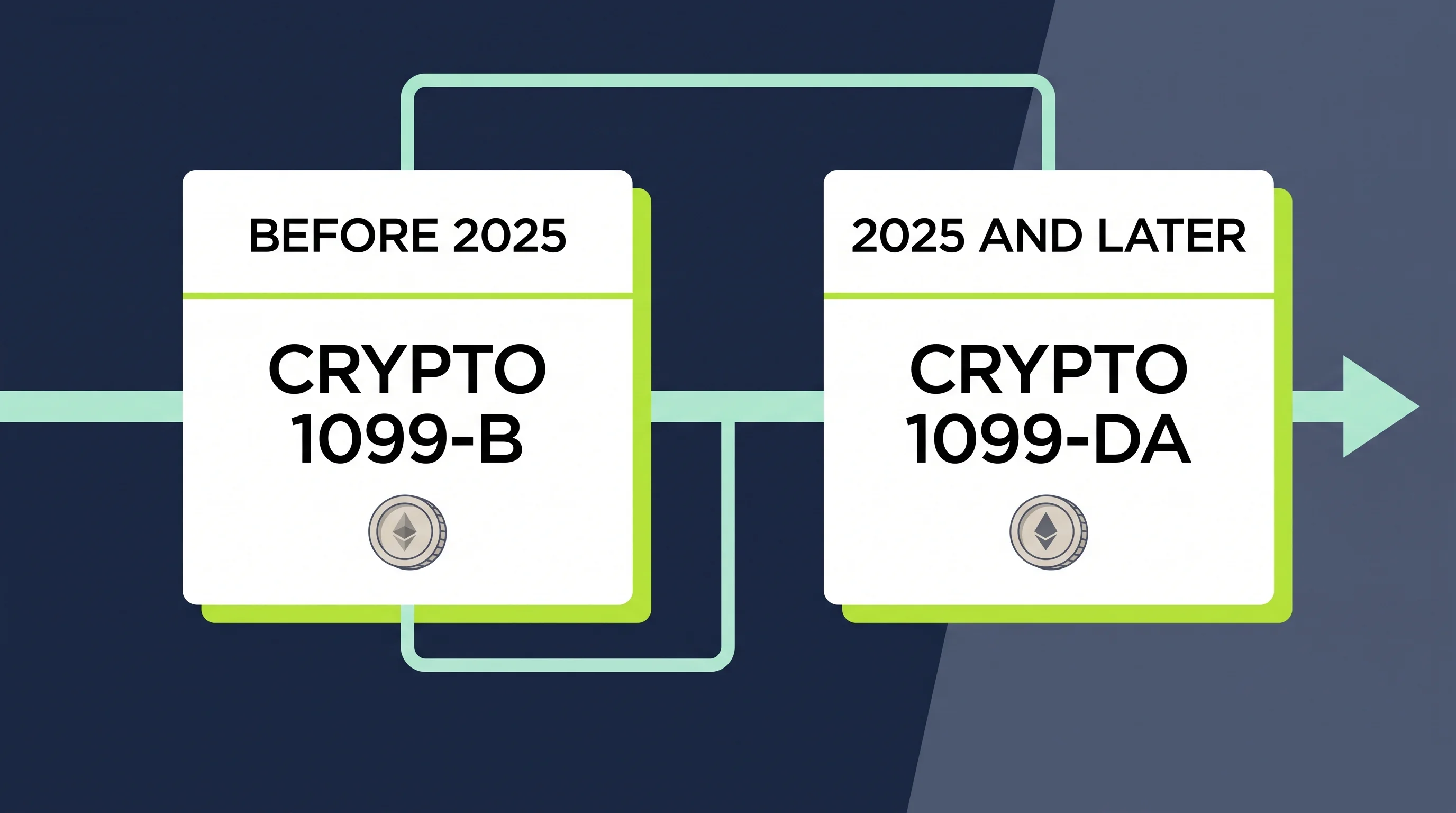
Robinhood switched because Form 1099-DA became the IRS form specifically designed for digital asset broker reporting. Before 2025, Robinhood was unusual among crypto platforms because it reported crypto sales on Form 1099-B. For 2025 transactions, those crypto dispositions moved to Form 1099-DA.
The change is mostly about the form, not a second taxable event. Robinhood says its 2025 1099-DA reported information in a way similar to its earlier crypto 1099-B: gross proceeds went to the IRS, while cost basis was provided to the customer when available.
Here is the clean comparison:
| Robinhood activity | Before 2025 | 2025 transactions |
|---|---|---|
| Crypto sale or reportable disposition | Crypto appeared on Form 1099-B | Crypto appears on Form 1099-DA |
| Stock, ETF, or other reportable securities sale | Form 1099-B | Form 1099-B |
| Crypto rewards meeting Robinhood’s reporting threshold | Form 1099-MISC | Form 1099-MISC |
If you are comparing an old return with your new tax package, do not look for the crypto section in the same place. Our 1099-DA versus 1099-B guide explains the form-level differences in more detail.
Can you receive both a Robinhood 1099-B and 1099-DA?
Yes. A Robinhood customer who sold stocks and crypto can receive both forms, often inside one combined Robinhood Markets PDF.
Robinhood’s taxes and forms page says its 2025 consolidated package can include Form 1099-B and Form 1099-DA, along with other forms that apply to Robinhood Securities, Robinhood Crypto, Robinhood Derivatives, and Robinhood Money. The forms share a package, but they do not report the same assets.
Think of it this way:
| Form | What it covers in a typical Robinhood package | What to check |
|---|---|---|
| Form 1099-B | Reportable securities sales and certain contracts | Proceeds, basis, holding period, wash-sale adjustments |
| Form 1099-DA | Reportable Robinhood Crypto dispositions | Proceeds, crypto units, disposition date, available basis |
| Form 1099-MISC | Certain rewards or other miscellaneous payments | Type and amount of income |
Do not combine the forms into one unexplained total. Reconcile the 1099-B against the securities history and the 1099-DA against the crypto history. Your tax software may import both from the same document ID, but they still feed different reporting categories.
What did Robinhood report to the IRS for 2025?
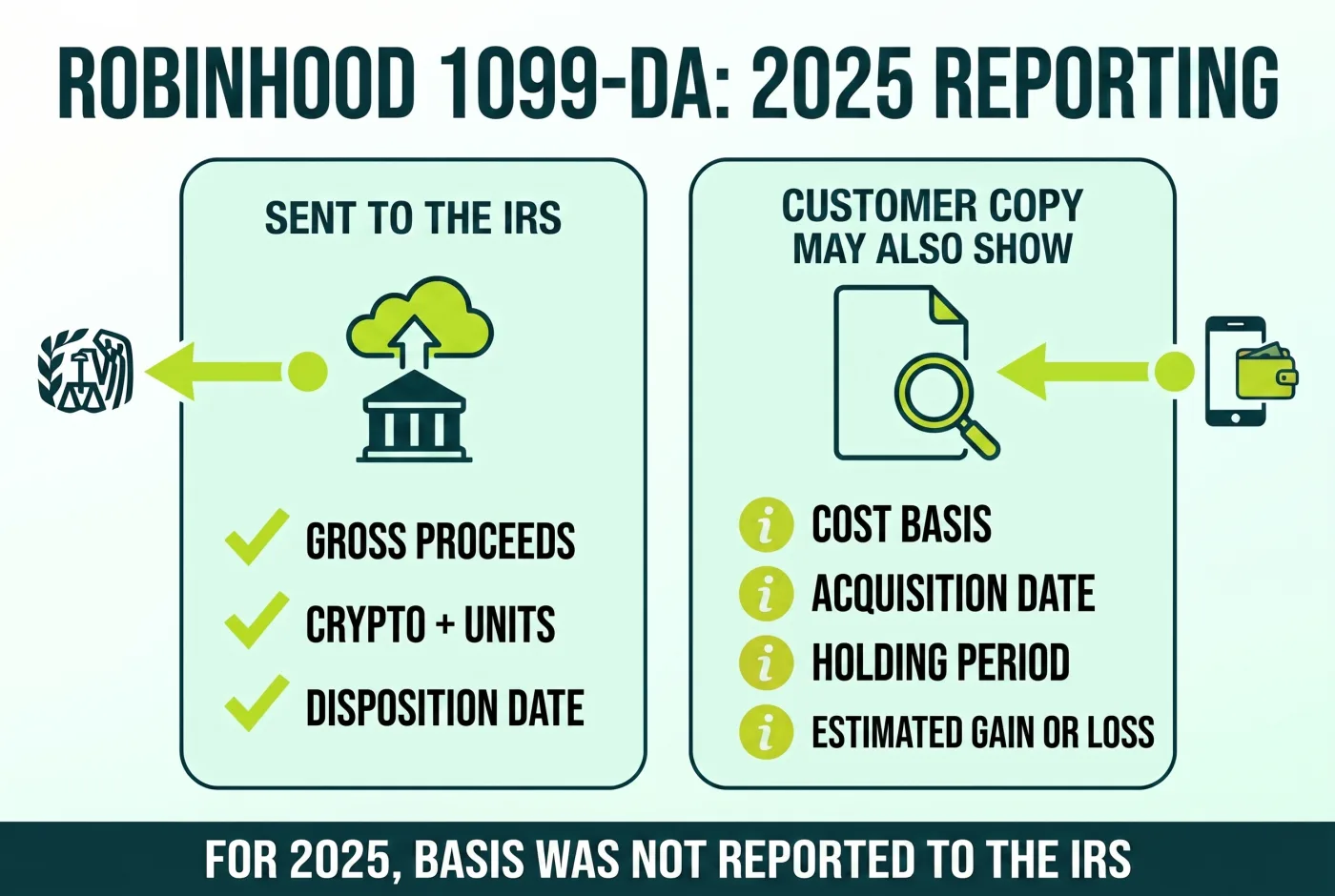
For 2025 crypto transactions, Robinhood reported gross proceeds to the IRS. It did not report cost basis, even when your customer copy showed a basis estimate, acquisition date, or gain and loss amount.
Robinhood states this directly in its guide to reading the 1099-DA. The IRS instructions for the 2025 form also made basis reporting voluntary for sales effected in 2025.
| Item | Shown to you when available | Reported to the IRS for 2025 |
|---|---|---|
| Gross proceeds | Yes | Yes |
| Crypto name and quantity | Yes | Yes |
| Disposition date | Yes | Yes |
| Cost basis | Sometimes | No |
| Acquisition date and holding period | Sometimes | No |
| Estimated gain or loss | Sometimes | No |
This distinction matters when a basis number looks wrong. Robinhood says it will not issue a corrected 2025 1099-DA just because the informational basis changes. You should still contact Robinhood when the filer information, crypto, units, date, or proceeds are wrong.
For a box-by-box explanation of the federal form, see our 1099-DA instructions.
Is the cost basis on your Robinhood 1099-DA correct?
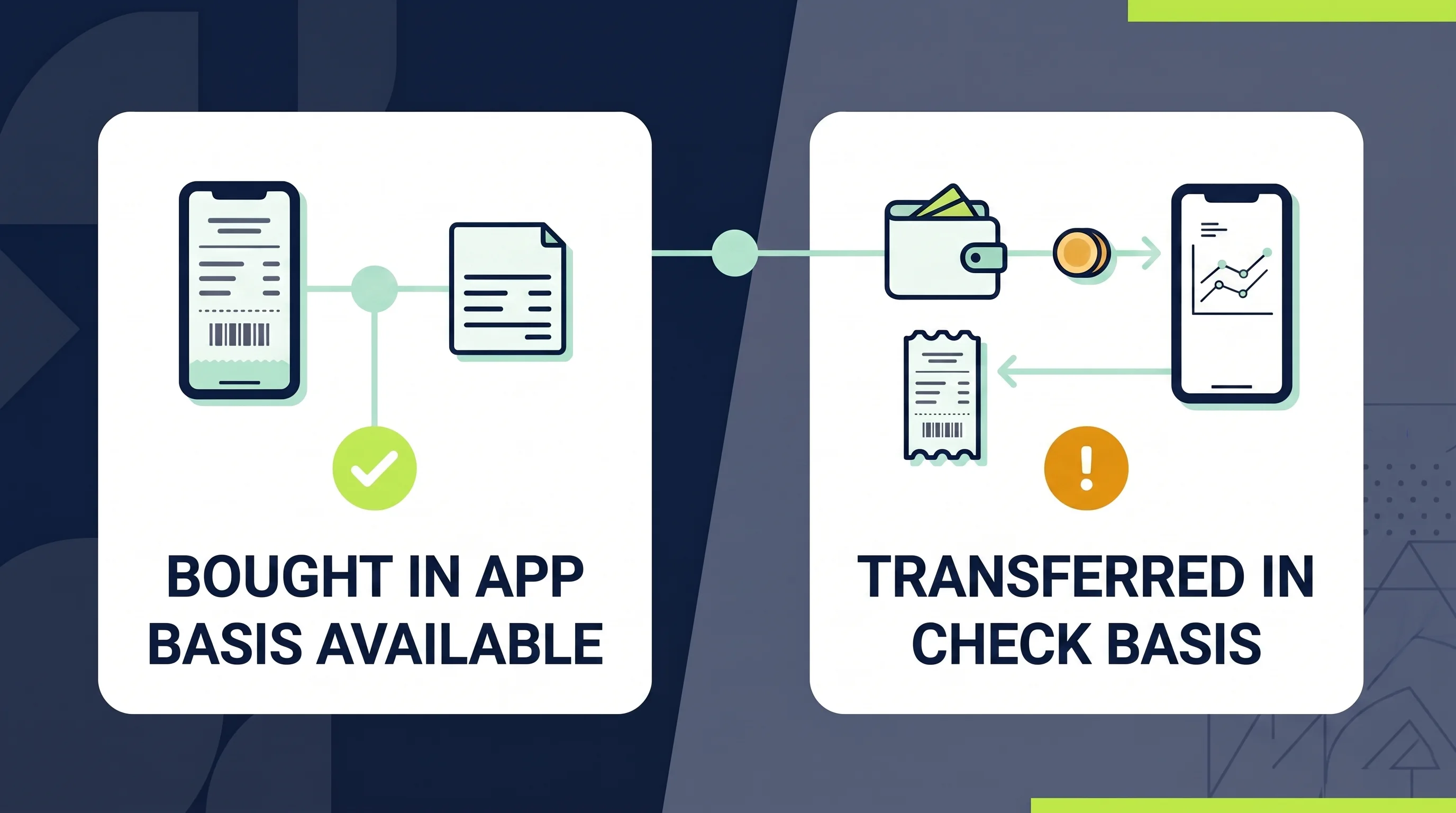
The basis is often complete when you bought the crypto inside Robinhood and kept it there until the sale. Robinhood’s crypto cost basis guidance says it provides basis for crypto purchased through Robinhood. The platform saw the purchase price, acquisition date, quantity, and later disposition, so it can connect both sides of the transaction.
That makes a buy-and-sell-only Robinhood account easier to reconcile than an account funded by deposits from outside exchanges or wallets. The form is not automatically correct, but the platform has more of the source data.
The weak point is transferred-in crypto. Robinhood now supports crypto deposits and withdrawals, but a blockchain transfer does not send the original purchase price or acquisition date. Robinhood says it does not have that information unless you enter it.
Robinhood’s basis rules create three common cases:
-
Crypto bought in Robinhood has basis from the in-app purchase.
-
Crypto received as a Robinhood reward uses a basis based on fair market value at receipt.
-
Crypto bought elsewhere and transferred in has unknown basis until you supply the original tax-lot details.
For transferred-in lots without basis, Robinhood says it may estimate the basis as zero and use the deposit date as the acquisition date. It also says unknown or zero-basis transfer lots can be closed before ordinary FIFO lots. That can make the displayed gain look far too high and can change whether a sale appears short-term or long-term.
If you find missing or unreliable basis, follow our full process for fixing wrong or missing 1099-DA cost basis.
What if you transferred crypto into or out of Robinhood?
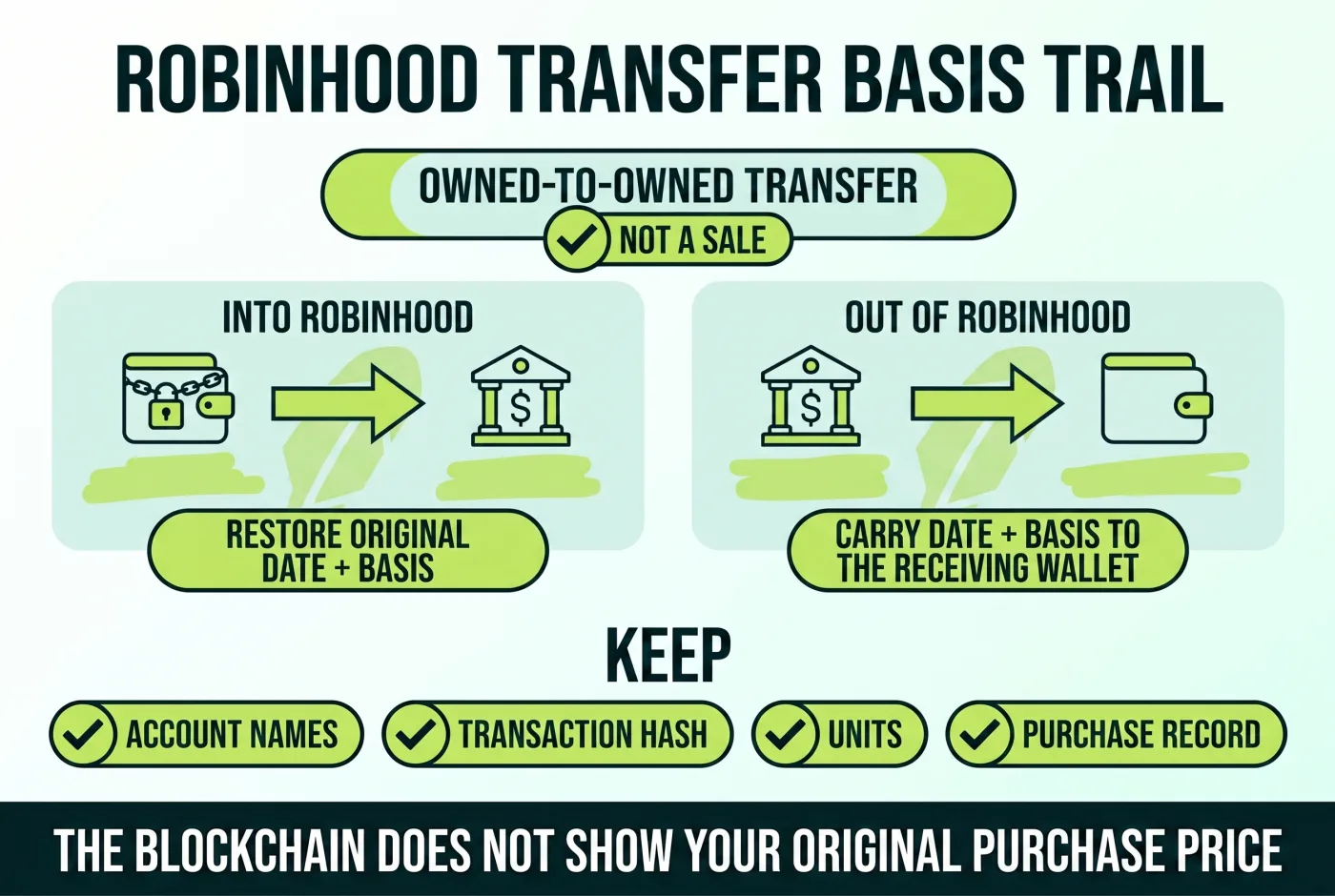
A transfer between wallets or accounts you own is generally not a sale, but it can break the basis trail. Match the outgoing and incoming sides before you calculate any later Robinhood disposition. The IRS digital asset FAQ confirms that moving digital assets between wallets or accounts you own is not itself a disposition.
This issue is newer for many long-time Robinhood users. In 2021, Robinhood announced crypto wallets that would support sending and receiving. Those transfers are now available, which means a current account can contain both in-app purchases and assets acquired elsewhere.
For each transfer, preserve:
-
The sending and receiving wallet or account
-
The transaction hash
-
The crypto and unit quantity
-
The original acquisition date
-
The original purchase amount and eligible fees
-
Any units consumed by network fees
If you transferred crypto into Robinhood and later sold it, do not use zero just because Robinhood lacked the basis. Pull the source exchange CSV or wallet records and restore the original lot history. If you withdrew crypto from Robinhood, keep the Robinhood acquisition record with the receiving wallet history so the basis remains available for a future sale.
For sales after 2025, mandatory basis reporting phases in for covered digital assets. Under the IRS 2026 Form 1099-DA instructions, a covered asset generally must be acquired after 2025 in a custodial account and stay in that account until the broker handles the disposition. Pre-2026 lots and transferred-in lots generally remain noncovered, so you still need your own records.
How do you report a Robinhood 1099-DA?
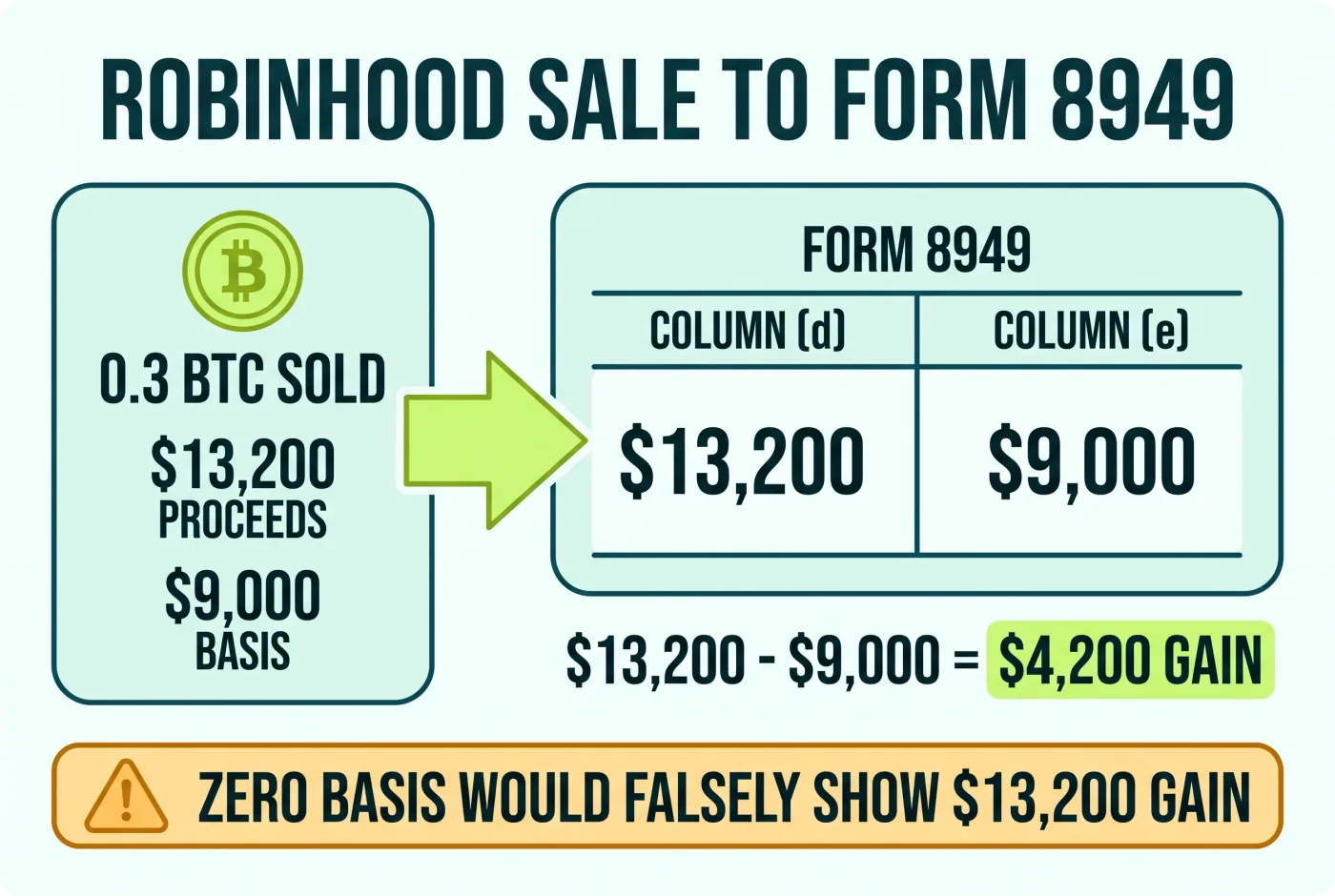
Report the Robinhood proceeds and your correct basis on Form 8949, then carry the totals to Schedule D. For 2025 sales, the basis shown by Robinhood was not reported to the IRS, so the filing must supply the correct number from your records.
Use this workflow:
-
Download the combined 1099 PDF and the Robinhood Crypto transaction CSV.
-
Separate the 1099-DA crypto activity from any 1099-B securities activity.
-
Match every crypto disposition to the detailed Robinhood history.
-
Rebuild basis for transferred-in lots from the source exchange or wallet.
-
Separate short-term and long-term transactions.
-
Prepare Form 8949 and carry the totals to Schedule D.
The IRS Form 8949 instructions say to enter the Form 1099-DA proceeds in column (d). For a noncovered transaction or a transaction whose basis was not reported to the IRS, enter the correct basis in column (e). Robinhood 2025 crypto transactions will generally use the Form 8949 category for digital asset transactions reported on Form 1099-DA with basis not reported, separated between short-term and long-term.
Our Form 8949 guide explains the columns and adjustments. If you want the full return workflow, follow how to report 1099-DA on your tax return.
Example: Robinhood reports proceeds, but not basis to the IRS
You bought 0.5 BTC inside Robinhood for $15,000. Later, you sold 0.3 BTC for $13,200. If the 0.3 BTC came from that lot, its basis is $9,000.
Robinhood reports $13,200 of proceeds to the IRS for the 2025 sale. You enter $13,200 in Form 8949 column (d) and $9,000 in column (e). Before any other adjustment, the gain is $4,200.
If you held the 0.3 BTC for more than one year, the gain is generally long-term. If you held it for one year or less, it is generally short-term.
The mistake to avoid is entering $0 in column (e) simply because the IRS did not receive a basis from Robinhood. In this example, that would turn a $4,200 gain into a false $13,200 gain.
How do you download Robinhood tax documents and crypto history?
Download the tax package from Robinhood’s Tax Center, then save the crypto transaction CSV with the original PDF. You need both because the form may aggregate several trades into one line.
Robinhood gives these steps in its tax document access guide:
-
Select Account.
-
In the app, open Menu.
-
Go to Tax Center.
-
Select the form to review or download it.
Robinhood says web classic may work better for large files. For the 2025 tax year, it also made CSV transaction files available after the consolidated 1099 for Robinhood Securities, Robinhood Crypto, and spending accounts.
Do not rely on the general custom account activity report for crypto. Robinhood’s reports page says those custom reports cover brokerage and retirement activity but exclude crypto. Use the tax-season Robinhood Crypto CSV, your app history, and any outside wallet or exchange records.
Save the unedited files before importing them into tax software. If the import groups trades differently or drops a transfer, the originals let you trace the discrepancy.
If you also sold crypto elsewhere, reconcile each platform before merging the ledgers. Our Coinbase 1099-DA guide and Kraken 1099-DA guide cover the same review for those exchanges.
When should you get help with a Robinhood 1099-DA?
Get help when the form no longer tells the whole story. Multiple wallets, transferred-in assets, old Robinhood 1099-B history, missing acquisition dates, or large proceeds with little visible basis can turn a simple import into a full ledger problem.
Count On Sheep’s 1099-DA help service matches transfers, rebuilds tax lots, checks the Robinhood 1099-DA against the underlying records, and prepares clean gain and loss data for filing.
Frequently Asked Questions
What is the 1099-DA Robinhood sent me?
Robinhood Form 1099-DA reports sales and other reportable dispositions from your Robinhood Crypto account. For 2025 transactions, Robinhood reported gross proceeds to the IRS and showed cost basis to you when it had that information.
Why did Robinhood send a 1099-DA instead of a 1099-B for crypto?
Form 1099-DA became the dedicated IRS form for digital asset dispositions beginning with 2025 transactions. Robinhood previously reported crypto sales on Form 1099-B, but it now uses Form 1099-DA for crypto while Form 1099-B continues to cover reportable securities transactions.
Can I get both a 1099-B and 1099-DA from Robinhood?
Yes. If you sold securities and crypto in the same tax year, your Robinhood combined tax PDF may contain both Form 1099-B for securities and Form 1099-DA for crypto. Reconcile and report each form in the correct tax section.
Is the cost basis on my Robinhood 1099-DA correct?
It is often complete when you bought and sold the crypto inside Robinhood. It may be missing or unreliable for crypto transferred into Robinhood because the blockchain transfer does not carry your original purchase price or acquisition date.
How do I report my Robinhood 1099-DA?
Use the form and your complete records to prepare Form 8949, then carry the totals to Schedule D. For 2025 sales, enter the proceeds Robinhood reported and your correct basis because Robinhood says the basis shown to customers was not reported to the IRS.
What if I transferred crypto into or out of Robinhood?
A transfer between accounts you own is generally not a sale, but it can break the cost basis trail. Match each Robinhood deposit or withdrawal to the other wallet, preserve the original acquisition date and basis, and check any later sale before filing.