

Are Solana airdrops taxable? Yes. Airdropped tokens are ordinary income at their fair market value the moment you gain dominion and control over them, under Rev. Rul. 2019-24. For claim-gated drops like JTO and JUP, that means the day you claim, at that day’s price, whether you sell immediately or hold. The tokens were free; the income is real.
Solana has produced more meaningful airdrops than any other chain in recent memory: JTO from Jito, JUP from Jupiter, PYTH, TNSR from Tensor, KMNO from Kamino, W from Wormhole, ME from Magic Eden, and a steady stream of smaller drops. Some landed as five-figure windfalls in a single claim transaction. Every one of them carried a tax bill that most claimers never calculated.
This guide covers Solana airdrop taxes end to end for 2026: when income actually hits for pushed versus claim-gated drops, how to value tokens at receipt, what happens when the price collapses after you claim, NIIT exposure for high earners, spam and dust drops, how Form 1099-DA changes the risk picture, and a step-by-step reporting walkthrough. It is one piece of our full Solana tax guide, alongside our guides to Solana staking rewards, liquid staking tokens, Solana DeFi, and Solana NFTs. For the cross-chain rules behind those activities, start with our DeFi tax guide.
Disclaimer: This guide is for informational purposes only and is not tax or legal advice. Cryptocurrency rules change quickly. Always consult a qualified CPA about your specific situation.
Why Solana Airdrops Are a Tax Story
Airdrops are how Solana protocols distribute governance tokens to early users, and the numbers involved moved real money into ordinary wallets.
Jito’s JTO drop in December 2023 allocated tokens to JitoSOL holders and MEV users, and a median claimer received thousands of dollars of value on day one. Jupiter’s first JUP drop in January 2024 reached roughly a million wallets, one of the widest distributions in crypto history, and the “Jupuary” follow-ups extended it. Pyth, Tensor, Kamino, Wormhole, Drift, and Magic Eden all followed with their own drops. If you were active on Solana between 2023 and 2025, you almost certainly claimed something.
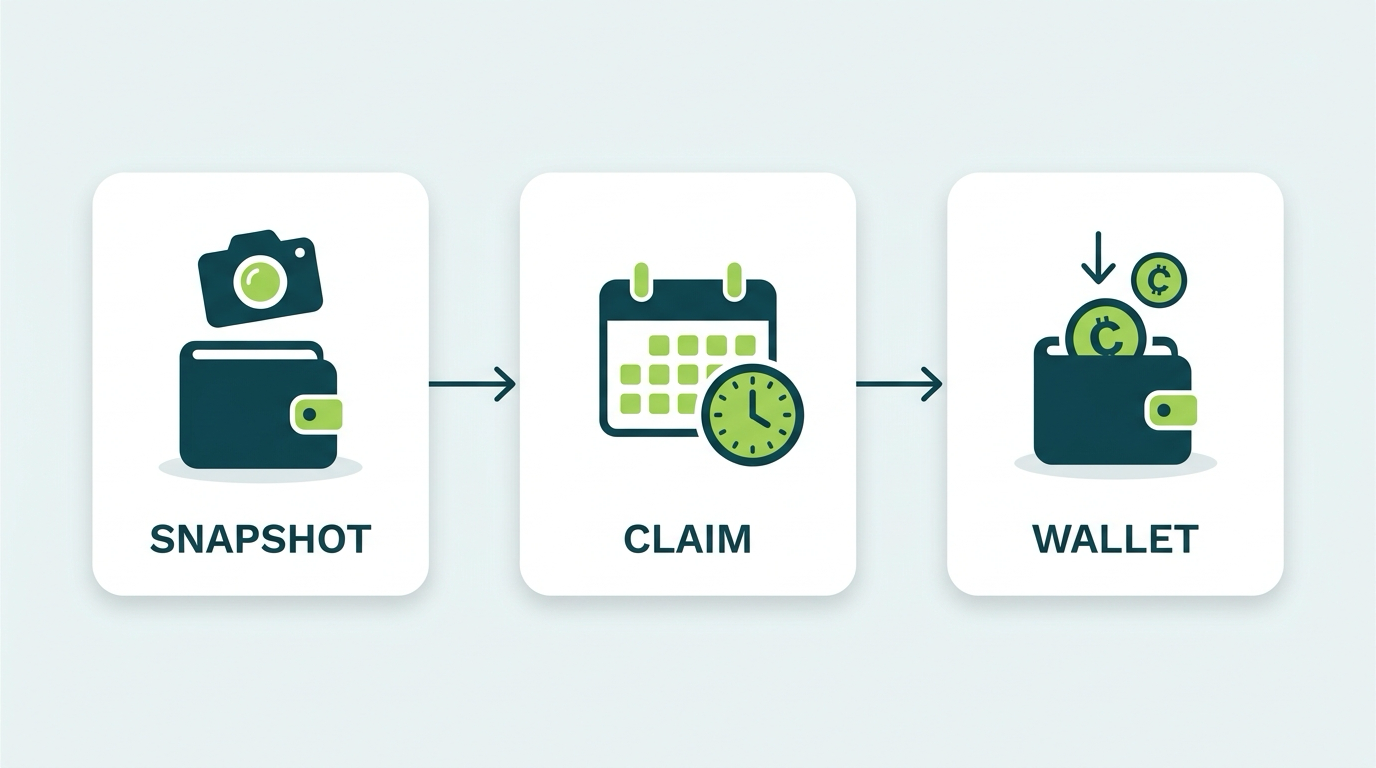
Each of those claims shares the same anatomy. A protocol takes a snapshot of past activity, publishes an allocation, and opens a claim window. You connect your wallet, sign a claim transaction, and the tokens arrive. Sometimes the window expires and unclaimed tokens are swept back. That anatomy, snapshot then claim then receipt, is what drives the tax timing, so keep it in mind through the next section.
The Rule: Income at Dominion and Control
The governing guidance is Rev. Rul. 2019-24, the IRS ruling on airdrops following hard forks. Its core principle applies to airdrops generally: you have ordinary income when you receive new tokens and gain dominion and control over them, meaning the ability to sell, exchange, or otherwise dispose of them. The income equals the tokens’ fair market value at that moment.
Two things follow immediately:
- Free does not mean tax-free. You gave up nothing, so the entire value is income, not gain. There is no basis to subtract because you paid nothing.
- Control, not announcement, is the trigger. An allocation you cannot yet touch is not income. Tokens sitting in your wallet that you can sell right now are.
The same dominion and control standard drives staking reward timing under Rev. Rul. 2023-14, so if you have worked through Solana staking taxes, the logic here will feel familiar. The difference is mechanical: staking rewards arrive on a schedule, while airdrops arrive once, usually behind a claim button.
Pushed Drops vs Claim-Gated Drops
Solana airdrops arrive in two ways, and the timing rule treats them differently.
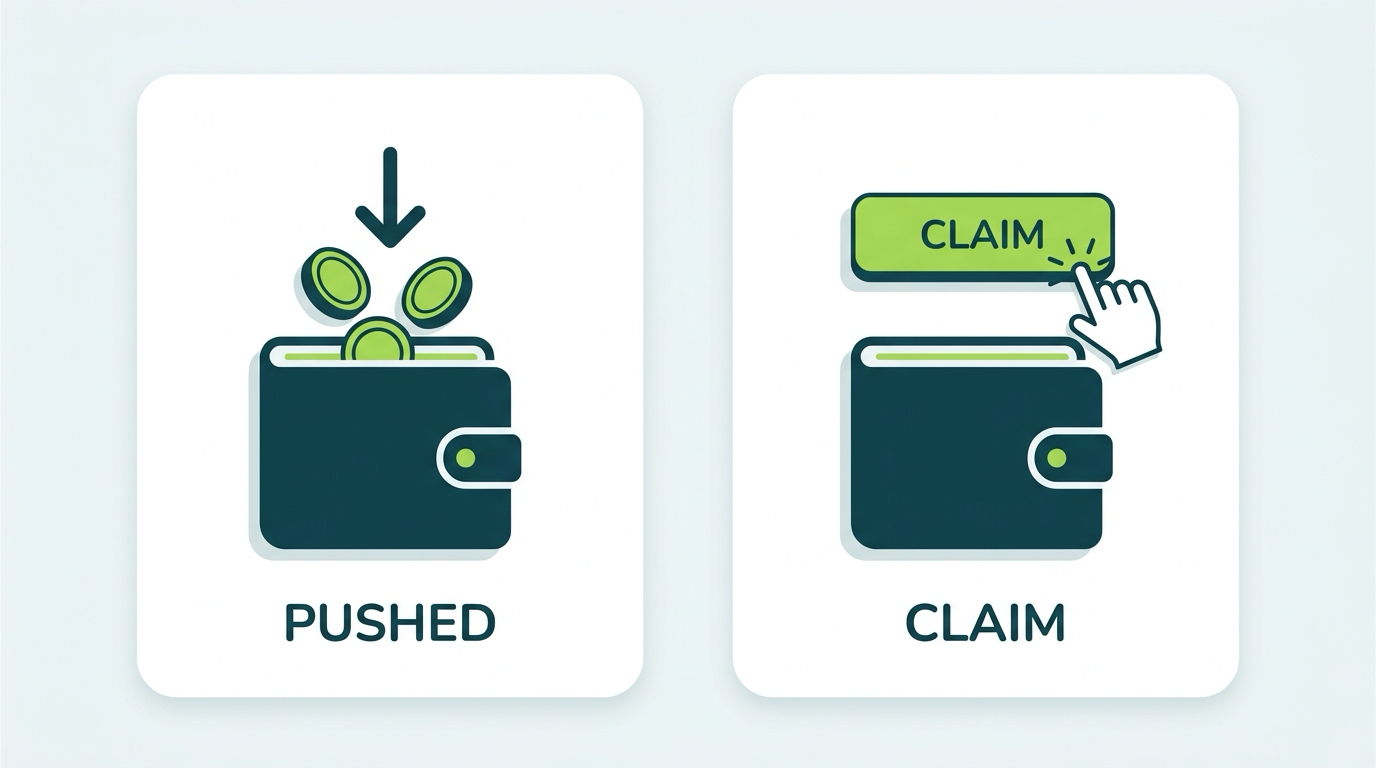
Pushed drops land in your wallet with no action from you. Solana’s account model makes this cheap, which is why your wallet accumulates random tokens you never asked for. For a pushed token with real value, dominion and control arguably exists at delivery: it is in an account you control and you could sell it. For pushed tokens that are worthless spam, see the spam section below, because the analysis is different.
Claim-gated drops are the norm for serious protocols. JTO, JUP, PYTH, TNSR, KMNO, W, and ME all required a claim transaction. Before you claim, you cannot sell, transfer, or use the allocation, so you lack dominion and control and have no income. The claim transaction is the income event. Your income is the token’s fair market value at the moment the claim lands, not at the snapshot, not at the announcement, and not at the market open.
That timing rule has a sharp practical edge: when you claim is partly a choice, and the choice has tax consequences.
Two Claimers, Same Allocation, Different Income
Two users each have 1,000 JUP allocated. The first claims on launch day when JUP trades at $2.00 and reports $2,000 of income. The second waits three weeks, claims at $3.50, and reports $3,500 of income. Same allocation, same tokens, 75 percent more taxable income for waiting, plus a higher basis. In a falling market the effect reverses. The claim date is the income date.
What If You Never Claim?
If you never claim, you never gain dominion and control, and you generally have no income. An allocation that expires unclaimed is a missed windfall, not a taxable event. This matters for people who discover old allocations after windows close: there is nothing to report.
It also creates a legitimate planning question. Claiming an airdrop you intend to hold long-term late in a bear market means less income now and a lower basis; claiming during a spike means more income at possibly the worst time. There is nothing abusive about timing a claim; the rule itself keys income to the claim. Just document when and why, and remember that a lower basis means more capital gain later.
Valuing the Drop: Fair Market Value at Receipt
Your income equals fair market value at receipt, so the valuation question is where airdrop taxes get practical.
For major Solana drops, this is straightforward. JTO, JUP, PYTH, W, and ME had deep liquidity on Solana DEXs and major exchanges within minutes of launch. Use the market price at your claim time, from a consistent, defensible source: a major exchange’s price feed, a reputable aggregator, or your tax software’s pricing engine. Consistency matters more than the specific source; do not cherry-pick the lowest print of the day for one drop and a daily average for another.
Harder cases exist, and Solana produces plenty of them:
- Thin launch liquidity. A small protocol’s token might trade on one DEX pool with little depth. The quoted price is still the best evidence of value, but if selling your whole allocation would crater the pool, a reasonable, documented discount to the headline price can be defensible. Get advice before applying one; this is not a place to improvise.
- Day-one volatility. Airdrop launch prices routinely swing 50 percent in hours. Your income is the value at your claim moment, so record the timestamp and use a price close to it, not a daily open or close that flatters you.
- Genuinely illiquid or locked tokens. If a token cannot be traded anywhere at receipt, its fair market value may be low or genuinely uncertain, and if transfer restrictions prevent you from disposing of it, dominion and control itself may be in question until they lift. Document the facts and apply a consistent method. These edge cases are exactly what professionals are for.
After the Claim: Basis, Holding Period, and the Crash Problem
The fair market value you report as income does a second job: it becomes your cost basis in the tokens, and your holding period starts at the claim. From that point forward, airdropped tokens are ordinary property, taxed like any other crypto under the capital gains rules.
Sell above your basis and you have a capital gain, short-term or long-term depending on whether you held past one year from the claim. Sell below it and you have a capital loss. Nothing is taxed twice: the claim value is income once, then only the change from that value is gain or loss.
The trap lives in the sequencing, and it deserves its own warning because it burned thousands of Solana users.
The Claim-High, Sell-Low Trap
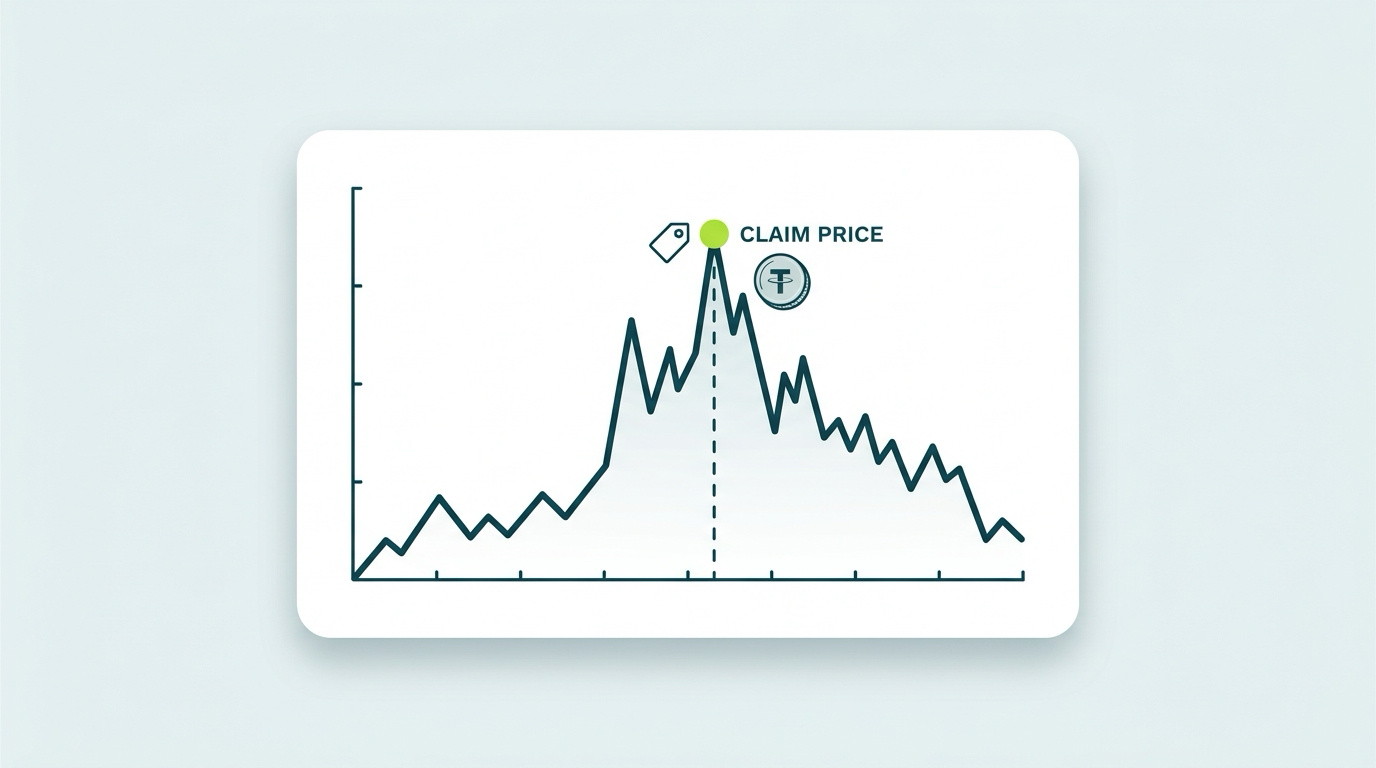
Airdrop tokens frequently spike at launch and grind down for months. If you claimed at the spike and held, you owe income tax on the spike value even though the tokens are worth a fraction of it by filing season.
The JTO Claimer Who Held
You claim 1,000 JTO at $4.00 and report $4,000 of ordinary income. You hold. By the time you sell, JTO trades at $1.50, so you collect $1,500 in proceeds and realize a $2,500 capital loss. That loss offsets capital gains, plus at most $3,000 of ordinary income per year. If you have no gains, you are paying full income tax on $4,000 while the offsetting loss dribbles out over years. The cash you received never covered the tax.
The standard defense is simple: sell enough at claim time to cover the tax. Selling immediately also produces almost no capital gain, because your basis equals the claim price. Many sophisticated claimers sell 30 to 40 percent on day one for exactly this reason. Whether you hold the rest is an investment decision; funding the tax is risk management.
If you are sitting on airdrop tokens with large unrealized losses, tax-loss harvesting can at least bank the loss. Under current law the wash sale rule does not apply to crypto, so you can sell and rebuy without a waiting period, though Congress has repeatedly proposed closing that gap and any change deserves attention.
NIIT: The 3.8 Percent Layer High Earners Miss
The net investment income tax adds 3.8 percent on investment income for filers with modified adjusted gross income above $200,000 (single) or $250,000 (married filing jointly). Airdrops interact with it twice.
First, the clear part: capital gains from selling airdropped tokens are investment income. If you are over the threshold, NIIT stacks on top of your capital gains rate when you dispose of the tokens.
Second, the murkier part: the airdrop income itself. Other income from an airdrop does not fit neatly into NIIT’s categories, and treatment can depend on how the activity is classified. For most one-off claimers the practical exposure is on the disposal side. But note the compounding effect: a large drop can single-handedly push your income over the NIIT threshold, dragging your other investment income into the 3.8 percent net in the same year. A $60,000 JUP claim does not just create income tax; it can reprice every capital gain you realized that year.
High earners with five-figure or larger claims should run the NIIT math before year-end, while there is still time to manage the disposal side. This is standard territory for a crypto tax specialist.
Spam Drops, Dust, and Scam Tokens
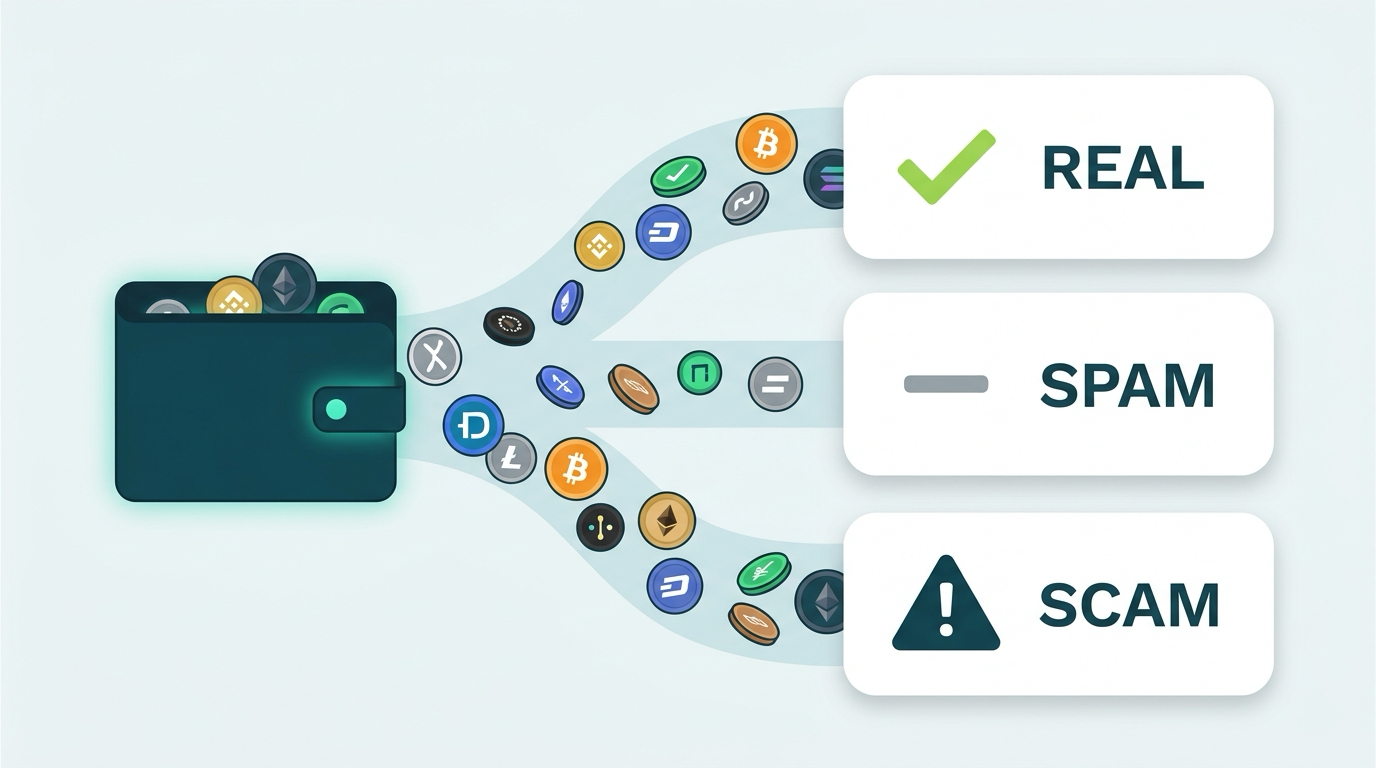
Every active Solana wallet accumulates junk: unsolicited tokens with lottery-scam names, dust amounts of unknown coins, and NFTs pointing to malicious sites. Solana’s low fees make mass spam distribution nearly free, so the volume is enormous. Three points cover it.
Worthless spam is generally not meaningful income. Income requires value, and a scam token with no real market has a fair market value of zero or close to it. You did not seek it, and in many cases you cannot even sell it through legitimate routes. The reasonable position, and the one tax software effectively takes when it marks spam as ignored, is that nothing happened.
Never interact with spam tokens. Many exist to bait you into visiting a site that requests wallet approvals and drains you. Do not visit the URL, do not try to sell them, do not burn them through untrusted tools. Hide them in your wallet UI and move on. If you did lose funds to a drainer, see our guide on lost and stolen crypto deductions; the tax relief is narrower than people expect.
Real value is different. If a pushed token turns out to have genuine, sellable value, the conservative position is income at that value once you control it. The line is value and control, not whether you asked for the drop.
Airdrops in the 1099-DA Era
Starting with 2025 transactions, exchanges and custodial brokers file Form 1099-DA reporting gross proceeds from digital asset sales. Airdrops sit in a specific blind spot of that system, and the blind spot creates risk in a predictable direction.
The claim itself generates no form. No protocol reports your JUP claim to the IRS, and self-custody wallets are not brokers. The income event is invisible to the reporting system, which tempts people to treat it as invisible entirely.
The disposal is a different story. Deposit airdropped tokens on Coinbase or Kraken and sell, and the exchange files a 1099-DA reporting your proceeds. The exchange has no idea what your basis is, because the tokens arrived by transfer. The IRS now sees proceeds with no origin story. If your prior returns show no airdrop income, the automated match sees a taxpayer selling assets they apparently never acquired, which is exactly the pattern that generates notices.
The fix is the same discipline that solves most crypto reporting problems: book the income at claim, carry the basis forward, and match the wallet-to-exchange transfer in your records so the deposit is not a zero-basis mystery.
Points, Quests, and Airdrop Farming
Modern Solana airdrops are usually preceded by points programs: protocols track your activity, award points, and later convert points to tokens. Kamino, marginfi, Drift, and most 2024-era drops worked this way. The tax treatment has two stages.
Points are generally not income. While points are untradeable ledger entries with no market, they fail the fair market value test and you cannot dispose of them. Nothing to report.
Conversion to tokens is the income event. When points crystallize into claimable tokens and you claim, standard airdrop treatment applies: ordinary income at fair market value on receipt.
One caveat for heavy farmers. Someone running dozens of wallets through systematic point-farming strategies, treating drops as a revenue operation, starts to resemble a trade or business. Business classification changes the reporting (Schedule C instead of other income) and adds self-employment tax, but also opens expense deductions. Casual users claiming a drop or two are nowhere near this line. Industrial farmers should get advice before filing, not after a notice arrives.
How to Report Solana Airdrops: Step by Step
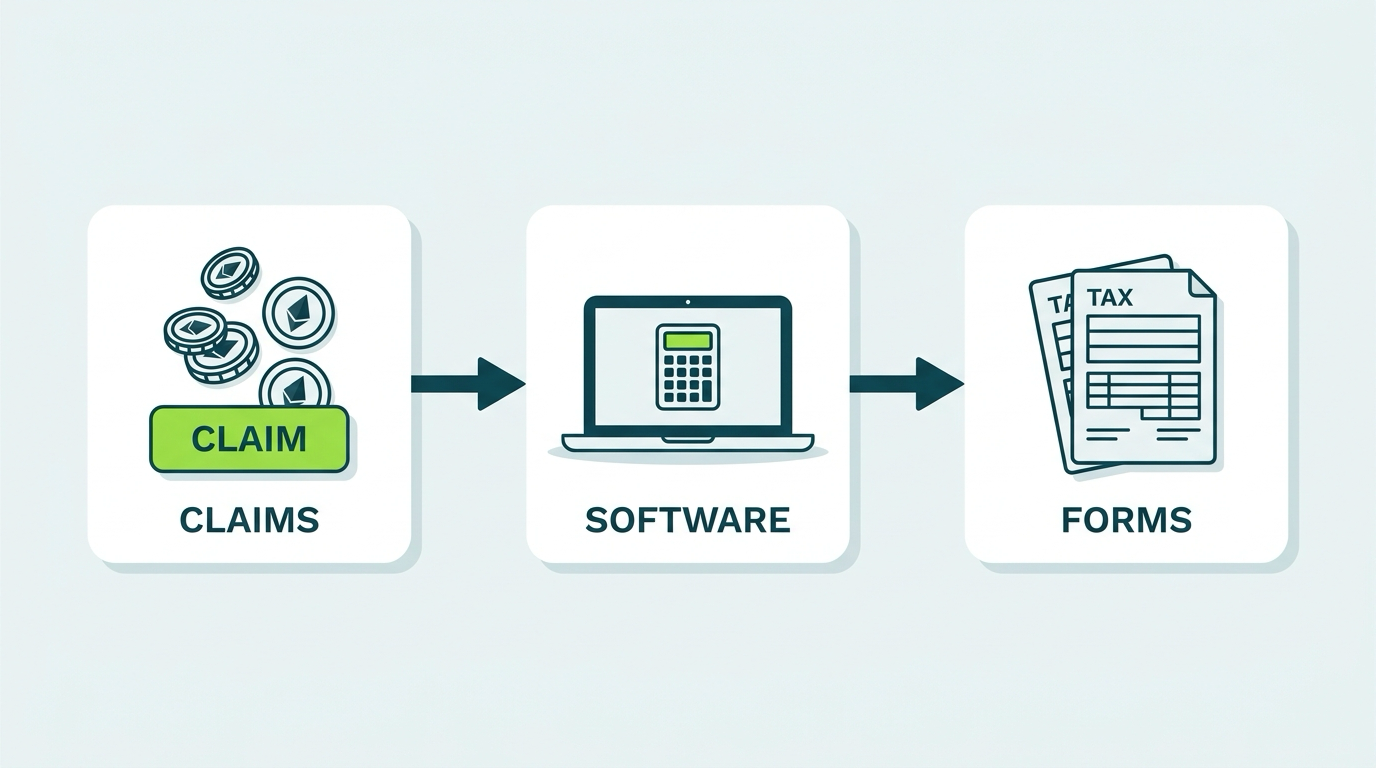
Here is the full pipeline from claim transaction to finished forms.
- Inventory every claim. List each airdrop you claimed during the year with its claim date and transaction signature. Your wallet history and a Solana explorer have the complete record.
- Import your addresses into crypto tax software. Koinly, CoinTracker, and CoinLedger read Solana wallets and generally tag airdrop receipts. Import every wallet you claimed with, not just your main one.
- Verify classification and prices. Confirm each claim is booked as airdrop or other income at a sensible claim-date price, not as a zero-cost deposit or a transfer. Spam tokens should be marked ignored, not counted as income.
- Total the income. The sum of all claim values goes on Schedule 1 of Form 1040 as other income. The current form includes a line for digital assets received as rewards or payments; airdrop income belongs there.
- Report disposals. Any airdropped tokens you sold or swapped go on Form 8949 and Schedule D, with the claim value as basis and the claim date starting the holding period.
- Answer the digital asset question truthfully. Receiving an airdrop means you check yes on Form 1040.
- Apply per-wallet basis tracking. Under Rev. Proc. 2024-28, effective January 1, 2025, basis lives in the wallet that received it. Tokens claimed in one wallet and moved to another must carry specific lots; universal pooling is no longer available.
- Reconcile any forms. If an exchange issued a 1099-DA for tokens you sold there, check its proceeds against your records and supply the basis the form lacks.
For the broader income picture, our crypto income tax guide covers staking, mining, and airdrops together, and our taxable events guide maps what is and is not a taxable moment.
Common Solana Airdrop Tax Mistakes
These are the errors we see most in airdrop cleanups, in rough order of cost.
Never Reporting the Income
The classic. The tokens were free and no form arrived, so the claim never made it to a return. The income is still real, and the chain records everything.
Selling With Zero Basis
The mirror-image error. If the claim was never booked as income, tax software assigns zero basis, and the eventual sale shows 100 percent gain. People end up paying capital gains tax on value they should have already shielded with basis, effectively double-paying.
Reporting at the Wrong Date
Using the announcement date, snapshot date, or a convenient low price instead of the actual claim moment. The claim transaction timestamp is public; use it.
Counting Spam as Income
Some software imports every pushed token at whatever scam price its fake pool displays, inflating income with garbage. Review and mark spam as ignored.
Forgetting Follow-Up Rounds
Jupiter alone ran multiple annual distribution rounds. Each claim is its own income event in its own tax year. One remembered claim and two forgotten ones is not a complete return.
Holding Through a Crash Without a Tax Reserve
Not a reporting error, a cash-flow error, and the most expensive one on this list. If you claim a spike, the tax bill is locked; the token price is not. Sell enough to cover the tax or accept that you are financing the IRS position with a volatile asset.
An airdrop is the only trade where the IRS sets your entry. You choose the exit. Claiming without a tax plan means letting a token chart decide whether you can pay a bill that is already fixed.
Your Solana Airdrop Tax Checklist
- List every claim for the year: token, date, transaction signature, amount.
- Price each claim at its claim-moment fair market value from a consistent source.
- Import all wallets into crypto tax software, including alt wallets used for claiming.
- Verify each claim is booked as income, not a zero-cost deposit.
- Mark spam and scam tokens as ignored, and never interact with them on-chain.
- Report total airdrop income on Schedule 1 as other income.
- Report disposals on Form 8949 and Schedule D with claim-value basis.
- Run the NIIT math if a big drop pushed your income near the thresholds.
- Track basis per wallet under Rev. Proc. 2024-28.
- Archive the audit file: signatures, price evidence, and final forms.
Bottom Line
The tax rule for Solana airdrops is short: ordinary income at fair market value when you gain dominion and control, which for claim-gated drops means the claim transaction. Everything difficult about airdrop taxes flows from the mechanics around that rule: choosing when to claim, valuing volatile launches, surviving the claim-high sell-low trap, keeping spam out of your income, and carrying basis correctly into the 1099-DA reporting net.
If your wallet history includes JTO, JUP, PYTH, or a few seasons of claim transactions you never reported, the cleanup is very doable, because every claim is timestamped on-chain and every price is recoverable. Count On Sheep reconstructs airdrop histories, fixes the income and basis records, and delivers CPA-ready numbers. A 15-minute call with a crypto tax specialist is the fastest way to size the problem, or reach out to our team for a full Solana review.
Related Reading
- Solana Tax Guide: The Complete Picture
- Solana Staking Rewards Taxes
- Liquid Staking Token Taxes: mSOL, JitoSOL, and bSOL
- Solana DeFi Taxes: Raydium, Kamino & Jito
- Solana NFT Taxes: Magic Eden, Tensor & cNFTs
- Crypto Income Taxes: Staking, Mining & Airdrops
- Form 1099-DA Explained
Frequently Asked Questions
Are Solana airdrops like JTO and JUP taxable?
Yes. Under Rev. Rul. 2019-24, airdropped tokens are ordinary income at their fair market value when you gain dominion and control over them. For claim-gated Solana drops like JTO and JUP, that generally means the moment the tokens land in your wallet after you claim, valued at that day's market price.
When exactly do I owe tax on a claim-gated airdrop?
When you actually claim and the tokens hit your wallet. Before you claim, you cannot sell or transfer the tokens, so you lack dominion and control. The announcement date and the snapshot date do not matter for timing. The claim transaction is the income event, measured at that moment's fair market value.
What if I never claim an airdrop?
If you never claim and never gain the ability to dispose of the tokens, you generally have no income. An unclaimed allocation that expires is a missed opportunity, not a taxable event. The risk is claiming late in a rising market, because your income is measured at the higher claim-date price, not the launch price.
How do I value an airdrop with no liquid market?
Use a reasonable, documented estimate of fair market value at the moment of receipt. For most Solana drops there is a tradable price within minutes of launch, so use the price at your claim time from a consistent source. For genuinely illiquid tokens, document whatever pricing evidence exists (DEX pools, OTC quotes, launch pricing) and apply it consistently.
What is my cost basis in airdropped tokens?
The fair market value you reported as income at receipt. That amount becomes your basis, and your holding period starts on the claim date. If the token later drops and you sell, you realize a capital loss against that basis, but the original income does not disappear.
I claimed JUP at a high price and it fell before I sold. Do I still owe income tax on the high value?
Yes. Income is fixed at the claim-date value. Selling later at a lower price produces a capital loss, which can offset capital gains plus up to 3,000 dollars of ordinary income per year. The loss does not directly erase the airdrop income. This mismatch is the most painful airdrop tax trap, and selling a portion at claim time is the standard way people manage it.
Does the 3.8% net investment income tax apply to airdrops?
It can. The later capital gain when you sell airdropped tokens is investment income and clearly NIIT-exposed for filers above the thresholds (200,000 dollars single, 250,000 dollars married filing jointly). The airdrop income itself is generally other income, and whether it counts toward NIIT depends on classification, so high earners with large drops should have a professional review it.
Are spam airdrops sent to my Solana wallet taxable?
Worthless spam tokens that appear uninvited are generally not meaningful income, because their fair market value is zero or near zero and you never sought them. Do not interact with them, because many are wallet-drainer bait. If a pushed token actually has real value and you have control over it, the conservative answer is that it is income at that value.
Do airdrops show up on Form 1099-DA?
Not the airdrop itself. Form 1099-DA covers broker-reported sales and exchanges starting with 2025 transactions. An airdrop claimed into your own wallet generates no form. But when you deposit those tokens on an exchange and sell, the exchange reports gross proceeds without knowing your basis, which is exactly why booking the income and basis at claim time matters.
How do I report Solana airdrops on my tax return?
Report the total fair market value of airdrops received during the year as other income on Schedule 1 of Form 1040. When you later sell or swap the tokens, report the disposal on Form 8949 and Schedule D, using the income value as your cost basis. Check yes on the digital asset question either way.
What about airdrops earned through points programs or activity farming?
Points themselves are generally not taxable while they are untradeable score-keeping. The taxable moment comes when points convert into tokens you control, valued at that day's price. Heavy, systematic farming across many wallets can start to look like a trade or business, which changes the reporting and can trigger self-employment tax, so large-scale farmers should get advice.
What happens if I never reported past airdrops like JTO or PYTH?
You have unreported ordinary income for the claim year, and any tokens you sold were likely reported with zero or wrong basis. The fix is to reconstruct claim dates and values from the blockchain, amend the affected returns, and correct basis going forward. Claim transactions are public and permanent, so the history is fully recoverable.