
Are Solana NFT trades taxable? Yes, twice over. Selling an NFT on Magic Eden or Tensor is a capital gain or loss on the NFT, and buying one with SOL is a disposal of the SOL you spent. Most collectors track the first and completely miss the second, which means even a break-even NFT habit quietly generates taxable events on every purchase.
Solana’s NFT scene earned its own tax guide. Magic Eden and Tensor process enormous volume at fees low enough to make flipping a hobby, compressed NFTs put thousands of items into ordinary wallets, spam NFT drops arrive daily, and a long tail of rugged projects left people holding worthless JPEGs and real questions about deducting the damage.
This guide covers Solana NFT taxes end to end for 2026: buying, minting, and selling mechanics, creator royalties, the unsettled collectibles question and its 28 percent rate, compressed NFTs, spam drops, harvesting losses on dead projects, and how to report all of it. It is part of our complete Solana tax guide, alongside our deep dives on Solana staking, liquid staking tokens, Solana airdrops, and Solana DeFi.
Disclaimer: This guide is for informational purposes only and is not tax or legal advice. NFT taxation includes unsettled areas. Always consult a qualified CPA about your specific situation.
The Solana NFT Market, Tax-Relevant Parts Only
A quick sketch of the machinery, because the tax events map onto it directly.
Solana NFTs trade mostly on Magic Eden and Tensor, non-custodial marketplaces where you buy and sell from your own wallet, typically priced and settled in SOL. Projects launch through mints, where you pay a mint price to receive a newly created NFT. Creators can attach royalties, a percentage of each secondary sale routed to the project wallet, though enforcement has been contested territory for years and both marketplaces have toggled between optional and enforced royalty modes.
Then there is Solana’s distinctive contribution: compressed NFTs (cNFTs), which use state compression to cut minting costs to fractions of a cent. That technology enabled massive distributions, some legitimate (DRiP art drops, game assets), some not (the daily spam in every active wallet). And in December 2024, Magic Eden itself distributed the ME token to users, an airdrop with its own tax consequences covered in our Solana airdrop guide.
Every piece of that machinery produces one of three tax events: a disposal, an income receipt, or nothing. Here is the map.
Buying an NFT: The Taxable Event Nobody Notices
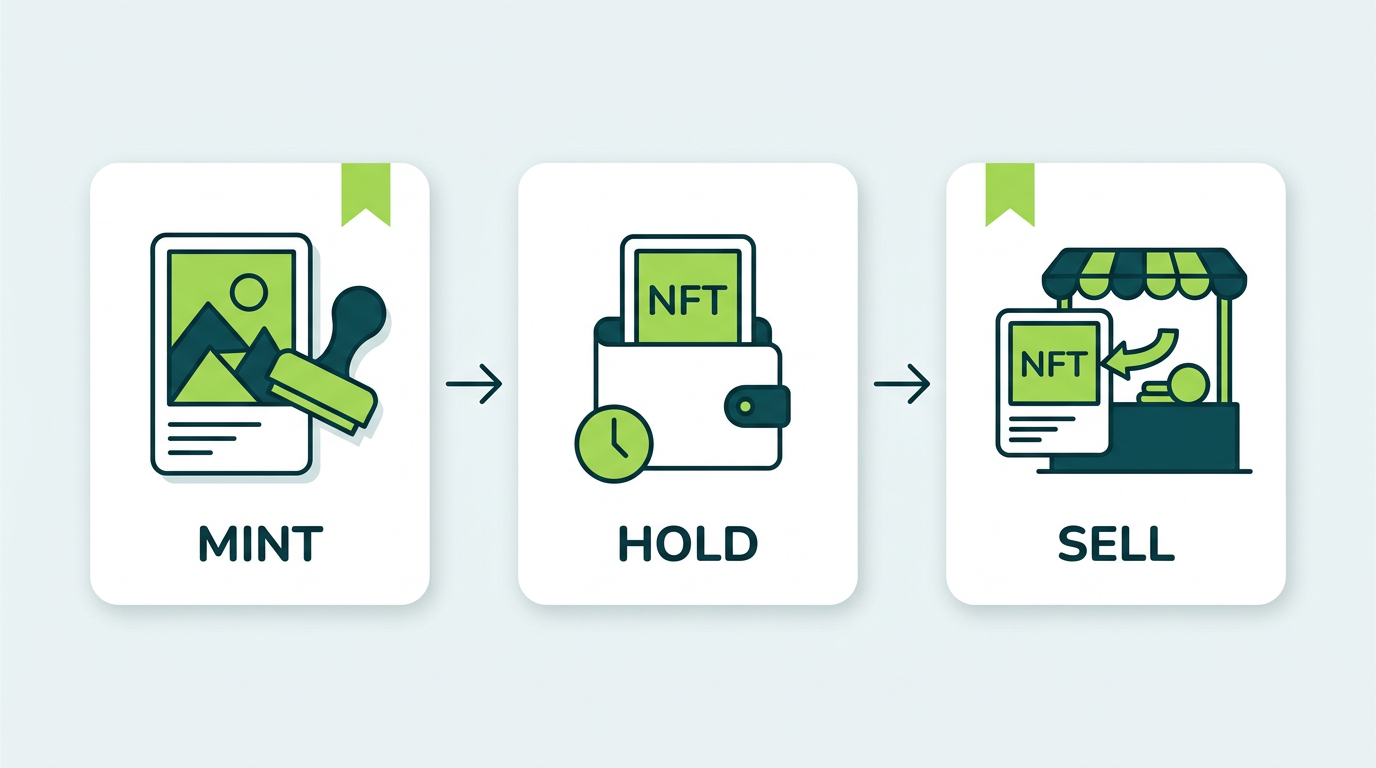
NFTs are property, and so is SOL. When you pay 10 SOL for a Mad Lad, you have disposed of 10 SOL, exactly as if you had sold it for dollars and spent them. Your gain or loss on that SOL is its value at purchase time minus what you paid to acquire it.
Buying a 10 SOL NFT With Old SOL
You bought 10 SOL at $70 ($700 total) and later spend it on an NFT when SOL trades at $150. Spending the SOL is a disposal: $1,500 value minus $700 basis is an $800 capital gain, long-term if you held the SOL over a year. The NFT takes a $1,500 cost basis. You owe tax this year even if you never sell the NFT.
This is the single most-missed event in NFT taxation. Active traders cycling appreciated SOL through dozens of purchases build up real gains without ever “selling” anything in their own mental model. The flip side helps too: buying NFTs with SOL that has fallen since you acquired it realizes losses on each purchase.
Marketplace fees and royalties you pay as a buyer fold into the NFT’s cost basis. So do network fees, trivial as they are on Solana.
Selling an NFT: Capital Gain or Loss
Selling on Magic Eden or Tensor is the straightforward disposal: proceeds minus basis equals capital gain or loss. Proceeds are the dollar value of the SOL you receive, net of marketplace fees and creator royalties taken out of the sale. Basis is what you paid (or minted at), plus buy-side fees. Holding period runs from acquisition to sale: over a year is long-term, under is short-term, taxed as ordinary income rates. The capital gains framework is the same one that governs token trades.
Two mechanical notes that matter on Solana specifically:
- You are paid in SOL, and that SOL starts fresh. Sale proceeds of 12 SOL take a basis equal to their dollar value at sale time. When you later spend or swap that SOL, its gain or loss runs from that date. Every NFT round trip therefore chains into your SOL basis history.
- NFT-for-NFT trades are disposals on both sides. Tensor-style trades and OTC swaps exchange one property for another; each party realizes gain or loss on the NFT given up, at the fair market value received. There is no like-kind deferral for crypto assets.
Minting: Basis Creation for Buyers, Income for Creators
For the minter (buyer): paying a mint price is spending SOL, which is a disposal of that SOL like any purchase. The minted NFT’s basis is the mint price plus fees, valued in dollars at mint time. Flip it the same week and your gain is the sale price minus that basis, short-term. Mint-and-flip strategies are entirely taxable trades; velocity does not launder them.
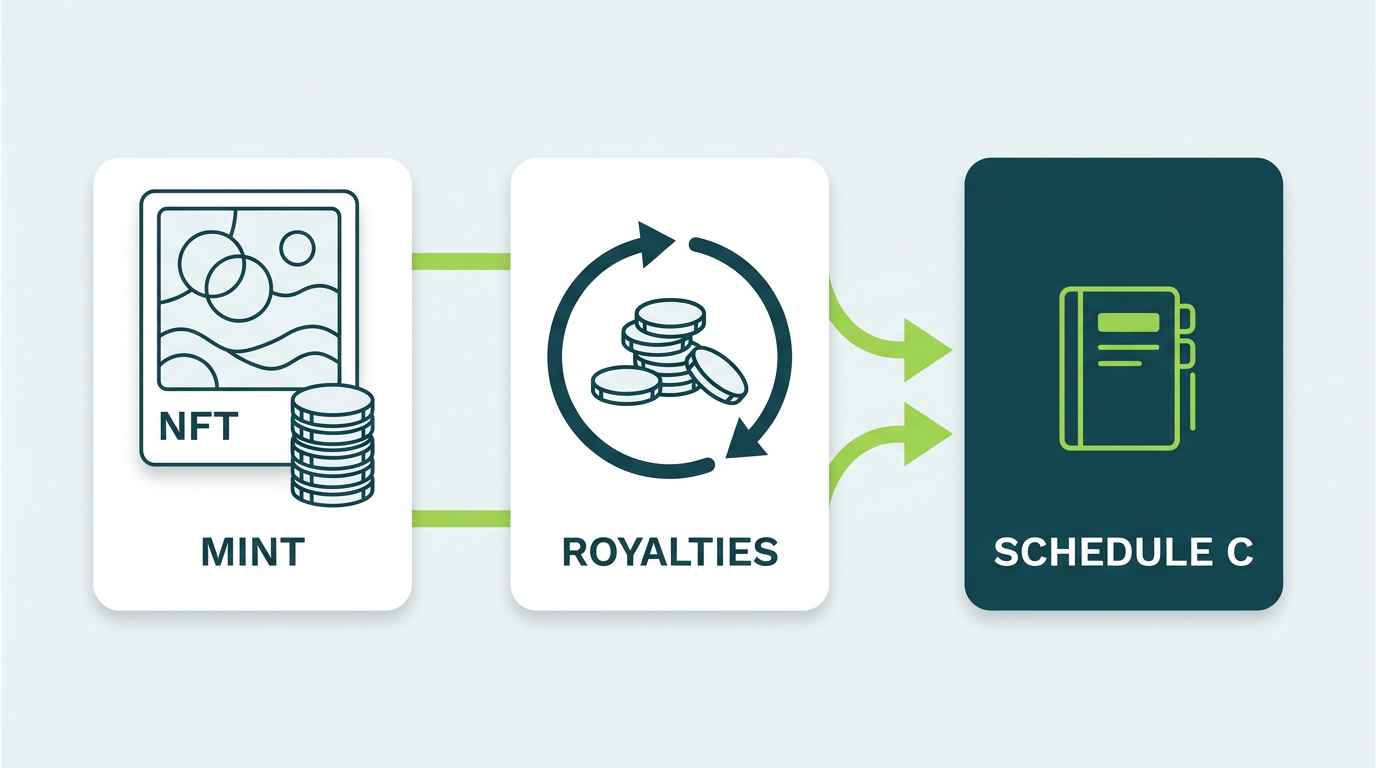
For the creator: revenue from primary mint sales is ordinary income, not capital gain, because you created the asset rather than investing in it. For anyone running a project with continuity and profit motive, that income belongs on Schedule C with self-employment tax on top, and real costs (art, dev work, infrastructure, marketing) become deductible business expenses.
Creator Royalties
Secondary-market royalties are ordinary income at fair market value when received, arriving as a stream of small SOL payments with every resale. For an active creator they are Schedule C income like the mint revenue. A truly passive royalty interest, such as a founder long gone from a project who still receives a royalty share, may belong on Schedule E without self-employment tax; the classification depends on facts, and it is worth getting right because 15.3 percent rides on it.
Royalties received in SOL take basis at receipt-date value, and those little SOL lots follow the normal rules from then on. A successful project generates thousands of them, which is a record-keeping problem, not a conceptual one.
The Collectibles Question: Is Your NFT Taxed at 28 Percent?
Long-term capital gains normally top out at 20 percent. Collectibles are the exception: gains on art, antiques, gems, stamps, and similar items held over a year are taxed at ordinary rates up to a 28 percent cap. In Notice 2023-27, the IRS announced its approach for NFTs: a look-through analysis. An NFT is a collectible if the asset it represents is a collectible.
The clean cases resolve easily. An NFT representing ownership of a physical painting or a gem looks through to a collectible: 28 percent territory. An NFT functioning as a domain name, a game item with utility, or a membership pass looks through to something that is not a collectible: normal rates.
Profile-picture collections, which is to say the bulk of Solana NFT value, sit in the unresolved middle. Is a Mad Lad “a work of art”? The IRS has not said, courts have not ruled, and reasonable professionals land on both sides. Practical guidance while the question is open:
- Short-term flippers can ignore it. Collectibles treatment only changes long-term rates. Gains inside a year are ordinary rates regardless.
- Long-term holders with large gains should plan for the spread. The gap between 20 and 28 percent on a six-figure gain is real money. Get advice before the sale, not after, and document the position taken.
- The digital-art end of the spectrum carries more risk. One-of-one art NFTs (the DRiP and Exchange Art end of Solana) look more like art under any test than a 10,000-piece PFP project does.
Compressed NFTs: Same Taxes, More Rows
Compressed NFTs store their data in Merkle trees instead of individual accounts, which is why minting one costs a fraction of a cent. For tax purposes, compression changes nothing: a cNFT is property, buying and selling it are disposals, and receiving one as a reward or promotion is income at fair market value if it has any.
What compression changes is scale and data quality:
- Volume. Wallets that touch games or DRiP-style art subscriptions accumulate hundreds or thousands of cNFTs. Each transacted item is its own lot with its own basis.
- Import support. Tax software handles SOL and SPL tokens well; cNFT indexing is spottier. Expect missing items, zero-price placeholders, and spam mixed into the feed, and budget review time accordingly.
- Valuation. Most cNFTs have thin or no markets. A cNFT received with no ascertainable value is best documented as zero-value receipt; one sold later for real SOL produces gain from that zero basis.
Spam NFTs: The Daily Junk Drop
Every active Solana wallet receives uninvited NFTs advertising fake claims, fake airdrops, and malicious sites. Compression made this spam nearly free to send at enormous scale. The tax and safety answers are short.
Not income. A worthless spam NFT you never sought, with no real market, has a fair market value of zero or close to it. The reasonable treatment, and what tax software does when you mark items as spam, is that nothing happened. This mirrors the spam token analysis on the fungible side.
Never interact. The entire point of spam NFTs is to get you to visit a URL and sign a malicious approval. Do not visit, do not attempt to sell or “claim,” do not burn through untrusted tools. Hide them in your wallet UI. If you already lost assets to a drainer, our lost and stolen crypto guide covers the narrow deduction paths that exist.
Keep them out of your records. Unfiltered spam pollutes imports with garbage income entries and phantom holdings. Mark it spam, and spot-check that your software did not price a scam NFT off a fake listing.

Rugged and Worthless NFTs: Getting the Loss
Plenty of Solana collections went from hyped mint to abandoned Discord in a season. If you are holding NFTs worth a fraction of what you paid, the loss is real, but the tax system only counts it when you realize it.
Watching the floor hit zero deducts nothing. Unrealized losses do not exist on a tax return. An NFT sitting in your wallet at a 99 percent drawdown is still just property with a high basis.
Selling realizes the loss. Dispose of the NFT for whatever the market pays, list it at the floor, take a lowball bid, or sell into a liquidity pool bid, and you lock in a capital loss equal to your basis minus the trivial proceeds. Capital losses offset capital gains without limit, plus up to $3,000 of ordinary income per year, with the rest carrying forward. Under current law the wash sale rule does not apply to crypto assets, so loss harvesting is mechanically easy, though Congress keeps proposing to change that; our wash sale guide tracks the state of play. Selling to yourself or a related party, however, is not a real disposal and can void the loss, so use the open market.
Weaker routes exist but are hard. Abandonment and worthlessness deductions for individual investors run into the suspension of miscellaneous itemized deductions and casualty-loss limits from the TCJA (currently in effect through 2025 and largely extended), and theft-loss claims require actual theft with profit motive and documentation, not just a failed project. For most collectors, a real sale is the clean, defensible path. Our tax-loss harvesting guide covers timing and strategy.
A rugged NFT is a loss the tax code will happily share with you, but only if you finish the trade. Sell it for something, book the loss, and stop paying storage in hope.
Marketplaces, Forms, and the 1099-DA Gap
Magic Eden and Tensor are non-custodial: they never hold your NFTs or your SOL. After Congress repealed the DeFi broker reporting rule in 2025, platforms like these are not filing Form 1099-DA on your trades, and nothing about your NFT activity is reported to the IRS by anyone.
The reporting net still catches you at the edges. Cash out NFT profits through a centralized exchange, and the SOL sale lands on a 1099-DA as gross proceeds with no basis. Years of unreported flipping followed by a large reported cash-out is precisely the mismatch pattern that automated IRS matching flags. The bridge is your own record: every flip booked, every SOL lot carrying correct basis, every transfer matched, tracked per wallet under Rev. Proc. 2024-28.
How to Report Solana NFT Activity: Step by Step
- Import every wallet into crypto tax software with Solana NFT support. Include mint wallets, vault wallets, and anything that ever held a listed item.
- Filter the spam first. Mark junk NFTs as spam so they never enter the income or holdings picture.
- Audit the NFT trades. Confirm buys are booked as SOL disposals plus NFT acquisitions, sales carry fee-adjusted proceeds, and NFT-for-NFT trades show both sides. NFT price data is the weakest link in every platform; spot-check your biggest trades against marketplace history.
- Book creator income separately. Mint revenue and royalties are ordinary income, not capital gains. Active creators report on Schedule C with expenses; make sure software did not classify royalty receipts as trades.
- Report disposals on Form 8949 and Schedule D, including the SOL disposals from purchases. Flag potential collectibles for the 28 percent analysis with your preparer.
- Harvest what is dead. Before year-end, sell rugged NFTs you are done with, so the losses land in the current year.
- Check yes on the digital asset question, reconcile any exchange forms, and archive marketplace history alongside your wallet records.
Common Solana NFT Tax Mistakes
Missing the SOL Disposal on Every Purchase
The big one. Buying NFTs with appreciated SOL creates gains that never touch a marketplace sale record. Software catches it if the import is clean; people eyeballing their Magic Eden history do not.
Treating Sale Proceeds as Profit
Proceeds minus basis is the gain. Traders who report the full sale amount, or who forget buy-side fees in basis, overpay. Traders who report nothing at all have a bigger problem.
Letting Spam Import as Income
A wallet full of scam NFTs priced off fake listings can add phantom income to a return. Filter before you file.
Forgetting Royalties Are Income Now
Creators sometimes treat royalties as something to deal with if they ever cash out. Each royalty payment was income at receipt, in the year it arrived.
Assuming Long-Term Means 20 Percent
For NFTs that look through to collectibles, long-term gains can run to 28 percent. Large exits deserve the analysis before filing, not an amended return after.
Holding Worthless NFTs Past Year-End
An unsold rug is an unbooked loss. December is the deadline for making this year’s damage deductible.
Your Solana NFT Tax Checklist
- Import every wallet that touched NFTs, including mint and burner wallets.
- Mark spam NFTs as spam and never interact with them on-chain.
- Verify buys booked SOL disposals and NFTs took correct basis with fees.
- Verify sales carry fee- and royalty-adjusted proceeds.
- Classify creator income (mints, royalties) as ordinary income, Schedule C if active.
- Flag long-term gains on art-like NFTs for collectibles review.
- Sell dead NFTs before year-end to realize losses.
- Track basis per wallet under Rev. Proc. 2024-28.
- Report disposals on Form 8949 and Schedule D, income on Schedule 1 or C.
- Archive marketplace and wallet history as your audit file.
Bottom Line
Solana NFT taxes are ordinary property rules applied at Solana speed: every sale is a gain or loss, every purchase is also a SOL disposal, mint costs become basis, royalties are income, and the collectibles question hangs a possible 28 percent rate over long-term art gains. Compression and spam add noise, not new law. The traders who get hurt are not the ones who owed the most; they are the ones whose records could not explain what the chain plainly shows.
If your wallets hold years of Magic Eden flips, mint-week gambles, royalty streams, or a graveyard of rugged projects with unharvested losses, we can turn that history into clean, CPA-ready numbers. Book a 15-minute call with a crypto tax specialist, or reach out to our team for a full Solana NFT review.
Related Reading
- Solana Tax Guide: The Complete Picture
- Solana Staking Rewards Taxes
- Solana Airdrop Taxes: JTO, JUP & More
- Solana DeFi Taxes: Raydium, Kamino & Jito
- Liquid Staking Token Taxes: mSOL, JitoSOL, and bSOL
- Crypto Tax-Loss Harvesting
- How to File Crypto Taxes: Form 8949 & Schedule D
Frequently Asked Questions
Are Solana NFT sales taxable?
Yes. Selling an NFT on Magic Eden or Tensor is a disposal of property, and you owe capital gains tax on the difference between your proceeds and your cost basis. Because you are paid in SOL, the sale price is measured at SOL's dollar value at the time of sale, and the SOL you receive starts its own new basis.
Is buying an NFT with SOL a taxable event?
Yes, on the SOL side. Paying 10 SOL for an NFT disposes of that SOL, so you realize gain or loss on the SOL itself, measured against what you originally paid for it. The NFT then takes a cost basis equal to the dollar value you paid. People miss this constantly because it feels like a purchase, not a sale.
How is minting a Solana NFT taxed?
For the minter, paying the mint price in SOL is a disposal of that SOL, and the minted NFT takes a basis equal to the mint cost plus fees. Minting itself does not create income for the buyer. If you flip the mint, your gain is the sale price minus that basis, short-term if held under a year.
How are NFT creator royalties taxed?
Royalties are ordinary income at fair market value when received. For an active creator, royalty and primary sale income is generally self-employment income reported on Schedule C, subject to self-employment tax, with business expenses deductible against it. A one-off passive royalty stream may land on Schedule E instead; classification depends on facts.
Are NFTs taxed as collectibles at the 28% rate?
Possibly. The IRS said in Notice 2023-27 that it will use a look-through analysis: an NFT is a collectible if the thing it represents is a collectible, like art or gems. Long-term gains on collectibles are taxed up to 28 percent instead of the usual 20 percent maximum. Whether a profile-picture NFT is art has not been settled, so treatment of a Mad Lads sale is genuinely uncertain, and large long-term gains deserve professional review.
How are compressed NFTs (cNFTs) taxed?
The same as regular NFTs. Compression is a storage technology that makes minting cheap; it does not change the tax character. Buying, selling, and receiving cNFTs follow the same disposal and income rules. The practical difference is volume: cNFT activity can involve thousands of items, and some tax software indexes them poorly, so imports need extra review.
Are spam NFTs airdropped to my wallet taxable?
Worthless spam NFTs are generally not meaningful income, because their fair market value is zero or near zero and you never sought them. Do not click their links or try to sell them through the sites they advertise; most are wallet-drainer bait. Hide them and mark them as spam in your tax software so they do not pollute your records.
Can I deduct losses on rugged or worthless NFTs?
Not just by watching them go to zero. A capital loss requires a realization event, normally a sale or other disposal. The practical route is selling the NFT for whatever the market offers, even a trivial amount, which locks in a deductible capital loss. Claiming worthlessness or abandonment without a disposal is a much weaker position for individual investors, and casualty-style theft deductions are narrow, so realize the loss properly.
Do Magic Eden or Tensor send tax forms or report to the IRS?
Generally no. They are non-custodial marketplaces, and after Congress repealed the DeFi broker rule in 2025, platforms like these are not filing Form 1099-DA on your trades. No form does not mean no tax. Your wallet history is the record, and sales still belong on Form 8949.
Was the Magic Eden ME airdrop taxable?
Yes. Claimed airdrop tokens are ordinary income at fair market value when you gain dominion and control, which for ME meant the claim in December 2024. The claim-date value also became your cost basis in the tokens. Our Solana airdrop tax guide covers the mechanics, including what happens when the token price falls after the claim.
How do I report Solana NFT trades on my tax return?
Each sale or taxable disposal goes on Form 8949 and Schedule D with proceeds, basis, and holding period. The SOL you spent buying NFTs also creates disposals of that SOL. Creator royalties and primary sale income go on Schedule C for active creators. Check yes on the Form 1040 digital asset question.
What if I traded hundreds of NFTs and never tracked any of it?
The history is recoverable. Every Solana NFT trade is on-chain, and tax software can rebuild most of it from your wallet addresses. Expect cleanup work: NFT pricing data is spottier than token pricing, spam needs filtering, and marketplace fees and royalties need to land in basis and proceeds correctly. That reconciliation is exactly what a crypto tax specialist can take off your plate.